
Don’t talk about gun control!

Gun rights advocates tout "political correctness" to shut down talk of gun restrictions. We can't let them continue

Topics: Sandy Hook Elementary Shooting, Sandy Hook Elementary, Gun Control, gun rights, political correctness, NRA,

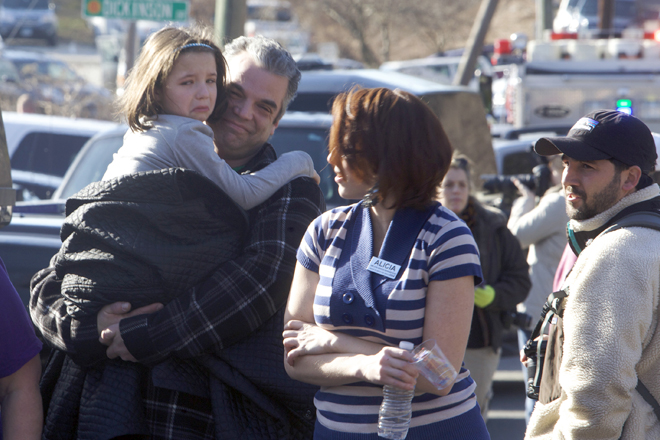
Don't talk about gun control!Parents pick-up children outside Sandy Hook Elementary School after a shooting in Newtown, Connecticut, December 14, 2012. (Credit: Reuters/Michelle Mcloughlin)

How many right-wing media voices were citing the shooting in Portland, Ore., this morning to trumpet the sanctity of gun rights and say we shouldn’t even talk about gun control? How many of them were making this perverse argument at the very moment the Newtown, Conn., shooting was taking place? And how many of those voices are the same ones who, when it comes to other issues, decry “political correctness”?

The answers to these questions should be obvious: almost certainly, a lot of them. And that is a sign that for all the conservative histrionics decrying liberal “political correctness,” the most powerful and most committed “p.c. police” in America are on the right — specifically, those on the right who claim that any critical discussion of the limits of the Second Amendment must be suppressed because they insult the political ideology of conservatives.

This form of “political correctness” is so routinized that we barely recognize it as the censorship system that it truly is. And as mass shootings become a staple of American life, this system is now ubiquitous.

We saw it after the mass shooting in Aurora, Colo., when conservatives rolled out their hallowed Now Is Not the Time talking point to insist that it was inappropriate to even discuss limits to assault-style weapons and ammunition magazines. We saw it last week with the over-the-top reaction to Bob Costas daring to suggest that America have a tempered discussion about gun control in the wake of the Kansas City Chiefs murder-suicide. We see it once again here in Colorado, where Democratic Gov. John Hickenlooper is today facing withering criticism for merely floating the idea that his Legislature debate gun control in the upcoming session. And, no doubt, we will see it in the wake of the Newtown shooting, when the right will inevitably insist nobody has any right to criticize existing gun policies in America (except, of course, to criticize them as somehow too restrictive).

The message here is simple: to even raise tempered questions about gun regulations is to risk not merely being exposed to a barrage of substantively misguided pro-gun rhetoric — but to almost guarantee that you will be told you have no inherent right to make the queries in the first place.

Thanks to that sad reality, there’s been an Orwellian redefinition of the epithet “political correctness” itself. Whereas it used to mean having to temper or censor one’s language to comport to the political sensibilities of anyone, now it means having to temper or censor one’s language to comport specifically to the political sensibilities of the American right.

According to this redefinition, conservatives should be free to, for example, use dehumanizing phrases like “illegal immigrant” or “anchor baby” without fear of any criticism whatsoever, and they somehow have credibility in deriding the critics of such language as the “p.c. police.” Meanwhile, if anyone tries to even start a discussion of gun control in the wake of gun violence, these very same conservative voices deploy their p.c. swat team to say that such a notion must be promptly removed from the public arena — that, in essence, any mere conversation about gun control, much less passage of new gun control legislation, is wholly unacceptable.

What’s unacceptable, of course, is this censorship-via-intimidation scheme. After all, in a democratic society, nobody has a right to have their questions go unchallenged, but everybody has the right to ask questions, no matter whom those questions offend.

Regardless of where you come down on the gun control question, that truism shouldn’t be debatable — that is, unless you are somehow so afraid of a mere conversation about gun regulations that you have joined the right’s p.c. police.

Continue Reading Close
David Sirota

David Sirota is a best-selling author of the new book "Back to Our Future: How the 1980s Explain the World We Live In Now." He co-hosts The Rundown with Sirota & Brown on AM630 KHOW in Colorado. E-mail him at ds@davidsirota.com, follow him on Twitter @davidsirota or visit his website at www.davidsirota.com.

Next Article

Featured Slide Shows

What To Read Awards: Top 10 Books of 2012 slide show

close X
  • Share on Twitter
  • Share on Facebook
  • Thumbnails
  • Fullscreen
  • 1 of 10
  • 10. "The Guardians" by Sarah Manguso: "Though Sarah Manguso’s 'The Guardians' is specifically about losing a dear friend to suicide, she pries open her intelligent heart to describe our strange, sad modern lives. I think about the small resonating moments of Manguso’s narrative every day." -- M. Rebekah Otto, The Rumpus

  • 9. "Beautiful Ruins" by Jess Walter: "'Beautiful Ruins' leads my list because it's set on the coast of Italy in 1962 and Richard Burton makes an entirely convincing cameo appearance. What more could you want?" -- Maureen Corrigan, NPR's "Fresh Air"

  • 8. "Arcadia" by Lauren Groff: "'Arcadia' captures our painful nostalgia for an idyllic past we never really had." -- Ron Charles, Washington Post

  • 7. "Gone Girl" by Gillian Flynn: "When a young wife disappears on the morning of her fifth wedding anniversary, her husband becomes the automatic suspect in this compulsively readable thriller, which is as rich with sardonic humor and social satire as it is unexpected plot twists." -- Marjorie Kehe, Christian Science Monitor

  • 6. "How Should a Person Be" by Sheila Heti: "There was a reason this book was so talked about, and it’s because Heti has tapped into something great." -- Jason Diamond, Vol. 1 Brooklyn

  • 4. TIE "NW" by Zadie Smith and "Far From the Tree" by Andrew Solomon: "Zadie Smith’s 'NW' is going to enter the canon for the sheer audacity of the book’s project." -- Roxane Gay, New York Times "'Far From the Tree' by Andrew Solomon is, to my mind, a life-changing book, one that's capable of overturning long-standing ideas of identity, family and love." -- Laura Miller, Salon

  • 3. "Billy Lynn's Long Halftime Walk" by Ben Fountain: "'Billy Lynn's Long Halftime Walk' says a lot about where we are today," says Marjorie Kehe of the Christian Science Monitor. "Pretty much the whole point of that novel," adds Time's Lev Grossman.

  • 2. "Bring Up the Bodies" by Hilary Mantel: "Even more accomplished than the preceding novel in this sequence, 'Wolf Hall,' Mantel's new installment in the fictionalized life of Thomas Cromwell -- master secretary and chief fixer to Henry VIII -- is a high-wire act, a feat of novelistic derring-do." -- Laura Miller, Salon

  • 1. "Behind the Beautiful Forevers" by Katherine Boo: "Like the most remarkable literary nonfiction, it reads with the bite of a novel and opens up a corner of the world that most of us know absolutely nothing about. It stuck with me all year." -- Eric Banks, president of the National Book Critics Circle

  • Recent Slide Shows

  • Share on Twitter
  • Share on Facebook
  • Thumbnails
  • Fullscreen
  • 1 of 10

More Related Stories

Comments

40 Comments

Comment Preview

Your name will appear as username ( profile | log out )

You may use these HTML tags and attributes: <a href=""> <b> <em> <strong> <i> <blockquote>