
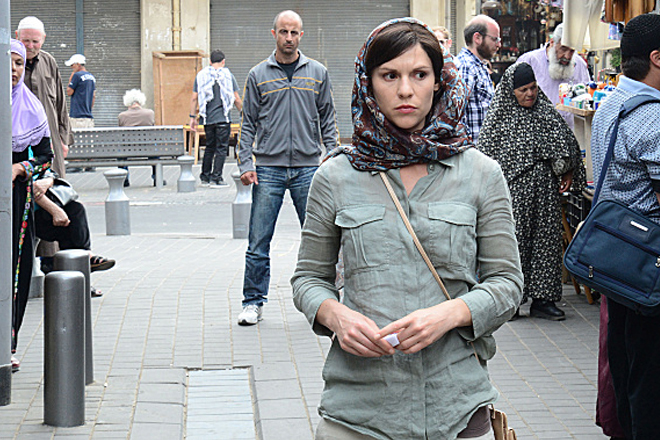

I started watching “Homeland” because I was bored. All of my favorite shows were coming to a (season’s) end, and I needed something new to watch. I’m drawn to smart scripted dramas, but I was immediately suspicious of the show when I learned that its creators were also the ones behind “24,” the Fox drama that somehow became the chief piece of evidence for the effectiveness of torture and was a favorite of Dick Cheney and Rush Limbaugh. But I kept an open mind and was riveted by the first episode, which laid out the intriguing mystery: Is Marine Sgt. Nicholas Brody the POW who’s been turned against his country by al-Qaida and its leader, the nefarious Abu Nazir? Soon CIA agent Carrie Mathison is seen spying on Brody and family in scenes reminiscent of the Stasi’s voyeurism in the Academy Award-winning film “The Lives of Others.” But as we learn more about Brody’s back story, the plot becomes increasingly absurd and insidiously Islamophobic. All the standard stereotypes about Islam and Muslims are reinforced, and it is demonstrated ad nauseam that anyone marked as “Muslim” by race or creed can never be trusted, all via the deceptively unsophisticated bureau-jargon of the government’s top spies. Here are four major, problematic areas (among many others. I couldn’t even get to the oversexed Saudi prince and his international harem):
1. What are Brody’s motivations?
The central conceit of the show is that a white, telegenic American hero in the heart of the nation’s capital can really be a Muslim terrorist. Presumably, Brody’s motivations are a key element of this story. But his character is such an awful pastiche of American fears and pseudo-psychology that only an audience conditioned by the Islamophobic, anti-Arab tropes in our media could find him consistent. Why is Brody so committed (sometimes) to carrying out his terrorist mission for deranged mass-killer Abu Nazir? Abu Nazir certainly played good cop to Brody’s Iraqi/Afghan (well they’re all Muslim) torturers, giving him a Ben Hur-like drink of cool water after a ruthless beating. Brody explains that his affections for Abu Nazir emerged because he alone had provided him with kindness during his ordeal, served, of course, with a solid number of mind games when Abu Nazir has Brody beat his American comrade to death (or so he thinks). Stockholm syndrome? Check.
Or is he out for justice, committed to avenging the death of young Issa? Entrusted to Brody for his English-language training, Issa apparently won a place in the stoic Marine’s heart. When a U.S. drone strike kills Issa and dozens of other children and, still worse, when the U.S. vice-president denies the incident on TV, Brody realizes that he and Abu Nazir share the same mission: revenge. Are we really supposed to believe that a Marine sniper inured to the brutalities of war would be pushed over the edge by the killing of civilians or a politician’s lie? The whole war in Iraq was based on political deceptions and defended with denials. Moreover, anywhere between 150,000 to 1 million Iraqis were killed in the war. But I guess Issa was one Muslim boy too far.
Or, most consistently, is Brody a terrorist because he’s Muslim? When being fitted by his terrorist tailor for his suicide bomb vest, Brody shifts into a morbid trance and reflects on how, when a suicide bomber detonates himself, his head is blown off and up, often remaining unharmed and reflecting his state of spiritual tranquility. “People will see you as you truly are,” the tailor remarks in Arabic. So Brody is truly a Muslim terrorist, despite his character’s conflicts?
“Homeland” leaves little doubt that, regardless of the other red herring motivations of justice and psychological manipulation, it is being Muslim that makes someone dangerous. Brody is able to resist Abu Nazir’s machinations when he wants, and his desire to avenge Issa ultimately is overcome by his love for his own daughter. But nothing can rid him of his Muslimness, and so, like a child molester, he will always be a threat to the audience. When his wife discovers Brody is a Muslim who has been praying in that most sinister of man-caves, the garage, she tears through its contents like she is looking for his kiddie-porn stash. When she finds his Quran, she points angrily at it, shouting, “These are the people who tortured you!” These are the people who, if they found out Brody’s daughter was having sex, “would stone her to death in a soccer stadium!” She thought that Brody had put all the “crazy stuff” behind him, but he can only look sheepish and ashamed. The Quran, the sacred text of billions of people throughout history, is nothing more or less than terrorism and medieval justice embodied. Brody had it all, his wife implies: white, a hero, a family man, but he threw it all away by becoming a Muslim.
2. Muslims are infiltrating America!
Then there’s Roya Hammad, who was introduced to us in the Season 2 premiere. An Oxford-educated television reporter, she is so successful and well-respected (think Christiane Amanpour) that she’s able to arrange interviews with members of Congress and senior CIA officials at the drop of a hat (not for professional purposes, we find out, but to act as a distraction while Brody carries out a sinister task for Abu Nazir). Sexy, self-assured and thoroughly modern, Hammad is also a loyal lieutenant of the Muslim fanatic leader (so much for trusting Oxbridge degrees and tight skirts). She reveals to Brody that she knows Abu Nazir because “our families have been close since 1947. They were refugees from Palestine together.” Since the show doesn’t bother explaining how they became refugees or what that might have meant for their families (their plight, after all, is irrelevant), viewers are left to believe that Muslims/Arabs participate in terrorist networks like Americans send holiday cards. The implicit message is that millions of Palestinian refugees and their descendants (or all Muslims since they are interchangeable on “Homeland”) can pose a similar threat merely because of their backgrounds. And perhaps the even more insidious implication is one that Michele Bachmann would love: that Muslims, no matter how successful, well-placed and integrated, are a hidden danger to their fellow Americans.
“It does not matter whether they are rich, smart, discreetly enjoying a Western lifestyle or attractive: All are to be suspected,” writes Peter Beaumont in the Guardian (“Homeland” has also attracted a large following in the U.K.).
Roya, of course, was not the first character of this type. Last season, viewers met a quiet, bespectacled professor, Raqim Faisel, and his blond American wife, Aileen. The couple cynically uses the quintessential symbol of patriotism, an American flag, as a secret terrorist code. The message, once again, seems to be that Muslim terrorists are lurking under every stone, especially in places of power and influence, from top television news networks and universities to the halls of Congress and even the presidential ticket.
3. Getting it wrong
Speaking of Raqim Faisel, one of my pet peeves about this show is the many mistakes it makes when it comes to Islam and Arab culture. Where to start? The name Raqim does not actually exist in the Arabic language (perhaps they mean Rahim?). Unless the character’s parents were unusually influenced by ’80s hip-hop, I’m not sure where they could have gotten the name.
Similarly, it’s hard to take the show seriously, as an Arabic speaker, when the name of the boy whose death Brody is so semi-committed to avenging is mangled by everyone from Brody to the boy’s father himself (one Abu Nazir). Issa, the Arabic name for Jesus, is pronounced Eee-sa, not Eye-sa. And Roya is a name common with Iranians, not Arabs.
Meanwhile, after Jessica throws Brody’s copy of the Quran in a fit, the episode bizarrely ends with Brody burying the holy book, telling his daughter he had to so because it had been “desecrated.” Thankfully, for Muslim suburban homeowners and urban garden-patch keepers everywhere, a copy of the Quran cannot be so horribly desecrated by touching the floor that it has to be enclosed in clay.
Perhaps this may seem like nitpicking to some, but part of the show’s appeal is that it is supposed to reflect the reality of the world we live in (the opening credits cut between references to 9/11, the Pan Am bombing and footage of Colin Powell testifying before the U.N.). Part of its sell is that we’re supposed to feel like it all really could happen. But for anyone who knows anything about the Middle East or even the world outside the U.S., these mistakes are glaring. Given the show’s popularity and presumably generous budget, one would think there could at least be a line item for an Arab cultural consultant.
Another absurd and perhaps much more important mistake the show makes is in conflating the goals and intentions of various Arab, Middle Eastern and Islamist groups from al-Qaida to Hezbollah, without providing any context about their backgrounds or motivations. In the real world, the animosity and mistrust between the Sunni extremist al-Qaida and Shia Hezbollah is so great that it’s highly unlikely they would ever cooperate. But in the world of “Homeland,” Hezbollah, which has never threatened an attack on U.S. soil, is not only a close ally of Abu Nazir, but is able to deploy heavily armed commando units to attack a CIA team in rural Pennsylvania.
Then there’s the show’s portrayal of the cosmopolitan city of Beirut. The upscale neighborhood of Hamra’s streets are lined with cafes, nightclubs and European clothing stores like H &M. But in “Homeland,” you enter a Taliban den-like place where men in checkered headdresses and women in full hijab shop in ancient souks and machine-gun-wielding thugs roam the streets. While in reality Beirut is the plastic surgery capital of the Middle East and fake (and some real) blondes are a common sight, in “Homeland” Carrie is forced to become a brunette and wear brown contact lenses during her trip there to avoid detection. The portrayal so angered Lebanese officials that they threatened a lawsuit.
Najla Said, a New York-based Arab American actress, auditioned for the role of Roya months ago. She was troubled enough by the Beirut episode that she emailed her friend,”Homeland” star Mandy Patinkin, who plays veteran CIA agent Saul Berenson. “I think I’d actually call it bad research, coupled with orientalist fantasies,” she wrote. “What they have ended up with is just a complete mockery of the ‘culture’ of that city.” She said Patinkin promised to relay her observations to the producers. Said told me that she is concerned that the inaccuracies in “Homeland,” which is based on an Israeli show (“Hatufim” or “Prisoners of War”) and has a number of Israelis on its team including the show’s creator and writer Gideon Raff, will only “foster misunderstanding” and lead Arabs to say, “See everyone hates us.”
4. Racial profiling is OK
It wasn’t always this way. Despite its flaws, Season 1 at least attempted to show how Islam could potentially give Brody peace in the form of his secret, nightly prayers in the garage. “Before I accepted the job, I said I’d feel uneasy if there was any lazy association drawn between violence and Islam,” said Damian Lewis, the actor who portrays Brody. “And wouldn’t it be more subversive if Islam actually became something sustaining for him, was a force for good in his life, poetic, even … nurturing for him.”
But that nuance has all but disappeared in the second season, which has instead been overwhelmed by the twists and turns of the plot, one that’s often asked viewers to suspend their disbelief.
One of the questions the show likes to tackle is whom do you look out for when tracking terrorists? This came to a head early this season when the CIA gang discovered congressman Brody’s allegiance to Abu Nazir and were trying to figure out who Brody’s contact is among the dozens of people he meets with daily. Saul brusquely explains that they will look at all the Middle Easterners and Africans first (“the dark-skinned ones”). “That’s straight-up racial profiling,” a quiet voice pipes up from the corner. “It’s actual profiling,” Saul retorts.
Just when you think you’ve found a silver lining in “Homeland” – that you can’t judge evil by the color of its skin (you do it by its religion!) — you’re reminded that racial profiling still saves time.
While some may say these are hypersensitive complaints in a politically correct obsessed era, the reality is that “Homeland” is not just any show. It has racked up Emmys and attracted an enthusiastic audience, it is being exported around the world, and one of its biggest fans is President Barack Obama.
