

Ever since George Bailey attempted suicide on Christmas Eve in 1946’s “It’s a Wonderful Life,” Hollywood’s been blurring our visions of sugar plums with amorphous specters of death and doom. Gifts may necessitate gift taxes; brown paper packages tied up with string may contain sodden lumps of coal. And in the duel between naughty and nice, an assessment of “naughty” may result in less of a mild finger wag than an apocalyptic bloodbath.
Maintaining good cheer in December 2012 appears particularly challenging. While holiday revelers had been taken by surprise at having to witness the drawn-out death of a beloved yellow Labrador in 2008’s “Marley & Me,” or watch abused horses perishing in the mud, their spindly legs taking a final stumble in the ooze of 2011’s “War Horse,” this year’s audiences have been provided with a veritable cornucopia of cinematic sadism.
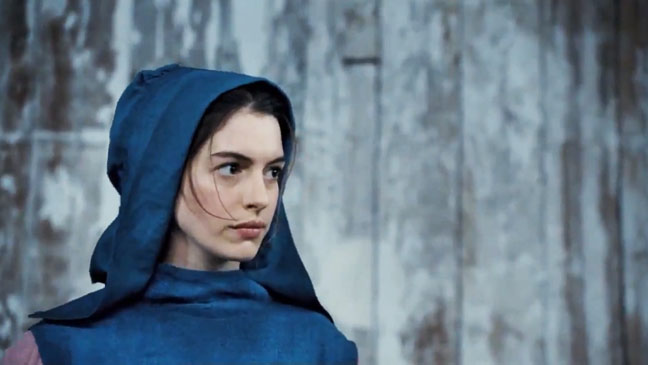
So many choices, so much time: a true story of a tsunami that wipes out 230,000 people (“The Impossible”); brutal poverty in 19th-century France that leads to unwarranted imprisonment, physical abuse and the slaughter of an army of earnest young men (“Les Misérables”); an exploration of a once-vibrant octogenarian couple attempting to stave off a glacially slow descent toward the grave (“Amour”); a revenge fantasy in the pre-Civil War South in which filmmaker Quentin Tarantino outdoes himself in blood and body counts (“Django Unchained”); and lastly, the docudrama of the decade-long hunt for Osama bin Laden (“Zero Dark Thirty”). We are reminded of al-Qaeda’s crimes in the film’s opening minutes when an audio mosaic of desperate voices of 9/11 victims washes over us … followed by ensuing scenes of candidly depicted torture.
It seems that attending year-end movies isn’t for sissies anymore.
But perhaps it never was. Reviewing the last decade of holiday offerings, many über-violent and bleak films have been served up right alongside gentler Christmas fare. Such as in 2011, when the emotionally charged 9/11 drama “Extremely Loud & Incredibly Close” and the sci-fi threat of alien invasion in “The Darkest Hour” mixed it up with the staid biography of “The Iron Lady” and the family-oriented “We Bought a Zoo.” In 2009, an austere examination of nascent fascism, “The White Ribbon,” was overrun by those furry troublemakers “Alvin and the Chipmunks: The Squeakquel,” as well as “Sherlock Holmes,” and “It’s Complicated.”
What isn’t complicated, however, is that a movie’s year-end release is a purposeful gambit in order to keep foremost in the minds of various film industry award-nominating committees. Over the last decade, 70 percent of the Oscars for Best Picture were awarded to films that were released during the last weeks of the year. While a cursory review of movies in earlier decades reveals that exceptional projects had been recognized for merit throughout the year, in modern times it seems that titles released prior to the fourth quarter are relegated to the seemingly dusty cerebral archives of scant recollection. Does the current collective membership of the Academy of Motion Picture Arts and Sciences have a severe case of short-term memory? Recall that Thomas McCarthy’s excellent “Win Win” opened in March of 2011 – and other than the film receiving a nomination for Best Original Screenplay from the WGA (plus a few additional nods from other smaller and/or regional critical organizations), “Win Win” won-won zip.
Among the year-end pictures that vie for prestigious awards and box office bumps, audiences often have to brace themselves and their families for all kinds of holiday mayhem. Take, for example, December 25, 2005 and 2006 when, in an obvious ploy for an extra fistful of dollars, the Weinstein Company released a one-two punch of Christmas horror: 2005’s “Wolf Creek” focused on a murderous bushman, while 2006’s “Black Christmas” looked at multiple sorority-sister slayings. Considering their current offering of the blood-lusty “Django Unchained,” it seems that the Brothers Weinstein have a soft spot in their hearts for gushing rivers of hemoglobin flowing free at Christmas. Maybe it’s all the bright red décor that’s spurring them on.
On a personal note, my mother thought that a movie starring Paul Newman and Steve McQueen sounded like a wonderful choice for a holiday outing in December of 1974, and took the entire family to see the PG-rated “The Towering Inferno.” My younger sister and I had nightmares for a week. That said, I shudder at what any viewer must have experienced on December 25, 1957, after staggering out of that family-rated Disney film, “Old Yeller” (advertised as the “quintessential film about a boy’s love for his dog”). A note posted on the IMDb message board says it all: “This movie runied [sic] my childhood.”
As to the aforementioned box office bump: It seems that high-profile award contenders no longer accrue the kind of excess profits that used to be as much of a guarantee as Santa holding to his annual December 25 deadline. Per Box Office Mojo’s chart (“The Oscar Boost”) that details the effects of a movie’s post-nomination and post-award performance, 2009’s “The Hurt Locker” increased by 11.9 percent ($2 million) after the film’s nominations, and an additional 13.6 percent ($2.3 million) after its six-award sweep.
But the total domestic gross proceeds of $17 million for this multi-Oscar film isn’t all that impressive, particularly given the historical significance of the Best Director award having been accorded to the first female recipient (Kathryn Bigelow). At the other end of the box office spectrum, while the profit bumps still registered from the nominations of the three massively popular chapters of “The Lord of the Rings” franchise (2001, 2002, 2003), since the grosses were already north of $300 million, the critical nods didn’t factor in any great significance.
So why, then, does Hollywood insist on playing Bad Santa? Let’s consider a whole other concept at play. Perhaps witnessing extreme depictions of human suffering on the screen delivers a visceral, unexpected present. To wit, an IMAX’d dose of empathy laced with relief. No matter what horrors unfold in the cinema, we can watch respectfully and carefully from a distance, all the while conscious of the fact that we’re comfortably cushioned in our matinee seats. We may cry, flinch and laugh; we may experience untold waves of emotion. But after the film ends and we head for the exits, we are very much aware that we are the principal actors and survivors of our own destinies.
Unlike those soulfully sad and disturbing December movies, maybe we can create our own happy ending. Because maybe … it’s a wonderful life after all.
