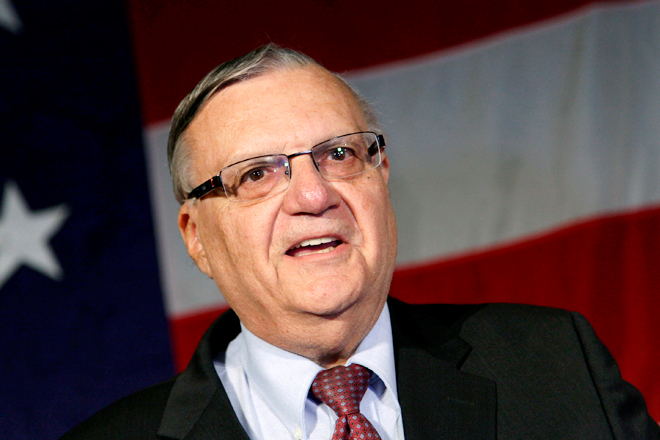

Joe Arpaio accepted award from neo-Confederate group

Exclusive: The infamous sheriff "gratefully accepted" an award from the Sons of Confederate Veterans last year

Topics: Joe Arpaio, Confederacy, confederate flag, Arizona, Editor's Picks,

Joe Arpaio accepted award from neo-Confederate group(Credit: Reuters/Joshua Lott)

While Maricopa County, Arizona, Sheriff Joe Arpaio was denying allegations of racial profiling last year, he was accepting an award from The Sons of Confederate Veterans (SCV), a controversial Confederate heritage group.

Two officials with the Arizona SCV division presented the group’s J. Edgar Hoover Law & Order Award to Arpaio in his office in October of 2011. This has never been previously reported. “Sheriff Arpaio, a genial host (unless you’re in his jail!) gratefully accepted the award and, in return, gave Commander [Richard] Montgomery and Adjutant [Curt] Tipton some souvenirs of the visit, to include autographed posters, a photo and the infamous pink underwear!” according to the Fall issue of the official newsletter of the SCV’s Arizona Division, “The Rebel Yell.”

The newsletter of the Tucson “camp” adds that Arpaio autographed photos of the ceremony. Here’s a picture of Arpaio accepting the award from “Rebel Yell”:

Also receiving the award that year, according to the newsletter: Paul Babeu, the politically ambitious sheriff of Arizona’s Pinal County, who was featured prominently in a John McCain presidential ad in 2008, and came out as gay earlier this year.

The SCV calls itself a “heritage organization” focused on history, and is adamant that it does not promote racism or the reinstatement of the Confederacy. “Today, the Sons of Confederate Veterans is preserving the history and legacy of these heroes so that future generations can understand the motives that animated the Southern Cause,” the group’s website states.

At the bottom of the Arizona division’s website, below the three Confederate flags, there is an image of a KKK hood with a red line striking through it, as in a “no smoking” sign. “The Arizona Division…denounces any and all groups whose objective is to promote hate and discrimination based upon race, religion, ethnicity, gender or national origin,” a disclaimer next to the image adds.

Still, the group has been criticized by organizations like the Southern Poverty Law Center for ties to extremist activists and for promoting a narrative that overlooks the Confederacy’s sins (especially slavery).

The group wasn’t always so controversial. Bill Clinton commended the SCV’s preservation of history, while it protested against Ku Klux Klan rallies in the past, not wanting the confederate symbolism emblazoned across its work associated with the hate group. But in the early 2000s, SCV had its own civil war in which more radical activists seized control of the group and ousted the traditionalist establishment. While the old guard wanted to keep the group focused on preserving headstones and monuments of Confederate soldiers, the more radical wing was committed to advancing the “Lost Cause” narrative of the Civil War and is allegedly motivated by racial resentment, according to the Southern Poverty Law Center.

The former number two leader of the group, Anthony Hodges, who was purged in the coup, emailed colleagues warning that the group was moving “towards a more politically active, secessionist and racist agenda.” There was an “exodus” of respected lifelong SCV members, Hodges added. Most of the “intolerance and ignorance” called out on the national organization’s blog now seems to be about the removal of confederate statues.

Edward H. Sebesta, who researches the neo-Confederate movement and has edited several books on the subject, passed along the newsletters to Salon. “The SCV has an interesting history of white supremacy which continues to this day,” he said, noting that magazines published by the group have advocated against immigration and Muslims, and argued that blacks have lower IQs. Sebesta is now working to establish an Anti-Neo-Confederate Institute.

A spokesperson for Arpaio did not return numerous requests for comment.

Laura Copple, the Chair of the Maricopa County Democratic Party, said the award is troubling. “Arpaio’s relationships with organizations such as the Sons of Confederate Veterans and Minute Men, as well as individuals like neo-Nazi and spree killer J.T. Ready, continue to spotlight Arpaio’s failure to provide equal justice for our diverse community. Maricopa County deserves professional and trustworthy law enforcement from [the Maricopa County Sheriff's Office],” she told Salon.
Continue Reading Close

Alex Seitz-Wald is Salon's political reporter. Email him at aseitz-wald@salon.com, and follow him on Twitter @aseitzwald.

Next Article

Featured Slide Shows

What To Read Awards: Top 10 Books of 2012 slide show

close X
  • Share on Twitter
  • Share on Facebook
  • Thumbnails
  • Fullscreen
  • 1 of 10
  • 10. "The Guardians" by Sarah Manguso: "Though Sarah Manguso’s 'The Guardians' is specifically about losing a dear friend to suicide, she pries open her intelligent heart to describe our strange, sad modern lives. I think about the small resonating moments of Manguso’s narrative every day." -- M. Rebekah Otto, The Rumpus

  • 9. "Beautiful Ruins" by Jess Walter: "'Beautiful Ruins' leads my list because it's set on the coast of Italy in 1962 and Richard Burton makes an entirely convincing cameo appearance. What more could you want?" -- Maureen Corrigan, NPR's "Fresh Air"

  • 8. "Arcadia" by Lauren Groff: "'Arcadia' captures our painful nostalgia for an idyllic past we never really had." -- Ron Charles, Washington Post

  • 7. "Gone Girl" by Gillian Flynn: "When a young wife disappears on the morning of her fifth wedding anniversary, her husband becomes the automatic suspect in this compulsively readable thriller, which is as rich with sardonic humor and social satire as it is unexpected plot twists." -- Marjorie Kehe, Christian Science Monitor

  • 6. "How Should a Person Be" by Sheila Heti: "There was a reason this book was so talked about, and it’s because Heti has tapped into something great." -- Jason Diamond, Vol. 1 Brooklyn

  • 4. TIE "NW" by Zadie Smith and "Far From the Tree" by Andrew Solomon: "Zadie Smith’s 'NW' is going to enter the canon for the sheer audacity of the book’s project." -- Roxane Gay, New York Times "'Far From the Tree' by Andrew Solomon is, to my mind, a life-changing book, one that's capable of overturning long-standing ideas of identity, family and love." -- Laura Miller, Salon

  • 3. "Billy Lynn's Long Halftime Walk" by Ben Fountain: "'Billy Lynn's Long Halftime Walk' says a lot about where we are today," says Marjorie Kehe of the Christian Science Monitor. "Pretty much the whole point of that novel," adds Time's Lev Grossman.

  • 2. "Bring Up the Bodies" by Hilary Mantel: "Even more accomplished than the preceding novel in this sequence, 'Wolf Hall,' Mantel's new installment in the fictionalized life of Thomas Cromwell -- master secretary and chief fixer to Henry VIII -- is a high-wire act, a feat of novelistic derring-do." -- Laura Miller, Salon

  • 1. "Behind the Beautiful Forevers" by Katherine Boo: "Like the most remarkable literary nonfiction, it reads with the bite of a novel and opens up a corner of the world that most of us know absolutely nothing about. It stuck with me all year." -- Eric Banks, president of the National Book Critics Circle

  • Recent Slide Shows

  • Share on Twitter
  • Share on Facebook
  • Thumbnails
  • Fullscreen
  • 1 of 10

More Related Stories

Comments

22 Comments

Comment Preview

Your name will appear as username ( profile | log out )

You may use these HTML tags and attributes: <a href=""> <b> <em> <strong> <i> <blockquote>