

Like many people I know and public figures I’ve seen recently, the killings in Newtown’s elementary school have made me reconsider my position on gun control. As a hunter, a veteran, and a dyed-in-the-wool radical, I write this to show fellow gun owners and, more important, my fellow Americans who are distrustful of an armed government with an unarmed populace that the logic I espoused for most of my life is bankrupt.
Until last week my stance on the Second Amendment was essentially, “Our government can’t be trusted with a monopoly on lethal power. As such, the right to resist tyranny embedded in our constitution justified the tragic deaths that would inevitably result from the proliferation of these incredibly deadly weapons.”
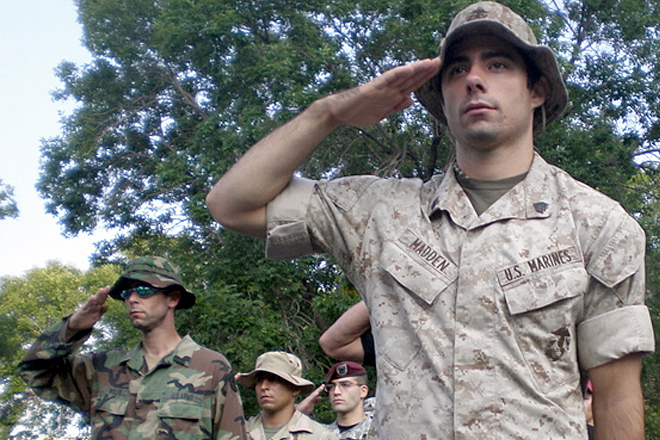
I deployed to the Iraq War in 2004 as a U.S. Marine. I came to see my experience in Iraq as that of a pawn doing the work of liars, profiteers and chickenhawks. I say this to illustrate the point that my outlook on gun control comes from the standpoint of a Constitution-observing public servant and of a person who came to question the integrity of our system of governance to the very core. In short, I was reverent of the Second Amendment’s freedom-guarding intent. I still am.
But my reverence is irrelevant. The Second Amendment stopped giving the insurrectionists among us a chance as soon as military technology advanced beyond the rifle. No modern Shays’ Rebellion is viable, militarily speaking, unless the Second Amendment is read to protect an individual’s right to bear surface-to-air missiles, personally owned Abrams tanks and state-sanctioned depleted uranium artillery. Who in their right mind would want to live in a place that gave access to these things to any person, no matter how law abiding or responsible?
Even if you would prefer that much more dangerous world, it doesn’t exist, thankfully. Because no group of armed citizens is on par with U.S. military power, the “guns guard our freedom” argument is hollow and insane. The “guns guard our freedom” perspective is the bedrock of the anti–gun control movement, and until we speak to it with respect and honesty, we will not sway the disenchanted and angry among us who feel the pain of the mothers in Newtown but fear, rightly or wrongly, the Orwellian implications of disarming. Frankly, arguments to anyone else is preaching to the choir.
As I reconsidered my logic and let go of my previous rationale, the only remaining argument in my mind was the old standby,”Guns don’t kill people, people kill people.” That is undeniable. But given the fact that the UK, France, Germany, Japan and Australia collectively have more people than the U.S. and only 0.05% the gun deaths, it is now obvious to me that the complete story veiled behind the “guns don’t kill people” half-truth is: “Guns don’t kill people, but when people have access to guns, they kill a lot more innocent people than they otherwise could.”
The right to defend ourselves, whether from home intruders or tyrants, is a right I understand and cherish. Through the risk of tragedy, I want to trust my fellow human to exercise their rights responsibly. However, I am also willing to accept that our culture is in need of healing, and we may well heal faster and deeper with less access to our guns, or even no guns at all. The vast majority of us are smart and trustworthy people; if we can lift people into the stars above, why couldn’t we establish systems in which both we and the government are less armed while maintaining contingencies for each to have access to appropriate weapons at appropriate times? Denying this potential is denying the arc of humanity: our intelligence, our compassion and our creativity.
Patriots and rebels alike, lovers of freedom, please take a new point of view with me. If your freedom feels vulnerable, I remind you that an ounce of prevention (read “real community”) is worth a pound of emergency room care, which is revolting. We should not dismiss the NRA’s seed of truth that, in fact, people do kill people. I admit it speaks to the root of the problem. But we would be foolish to allow a treatable symptom like gun violence to run amok before we devote our attention to curing our disease: whether you see it as untreated mental illness, cultural glorification of violence or, as I see it, the worldview that we are separated individuals, alone in our struggles, and that our power to create a more beautiful world is limited by anything but our imagination, our courage and our love.
