
Politics has become the new reality TV

With politicians shamelessly mugging during the "fiscal cliff" crisis, D.C. really is Hollywood for ugly people

Topics: John Boehner, Barack Obama, Fiscal cliff, U.S. Congress, Reality TV, Reality television, Editor's Picks, ,

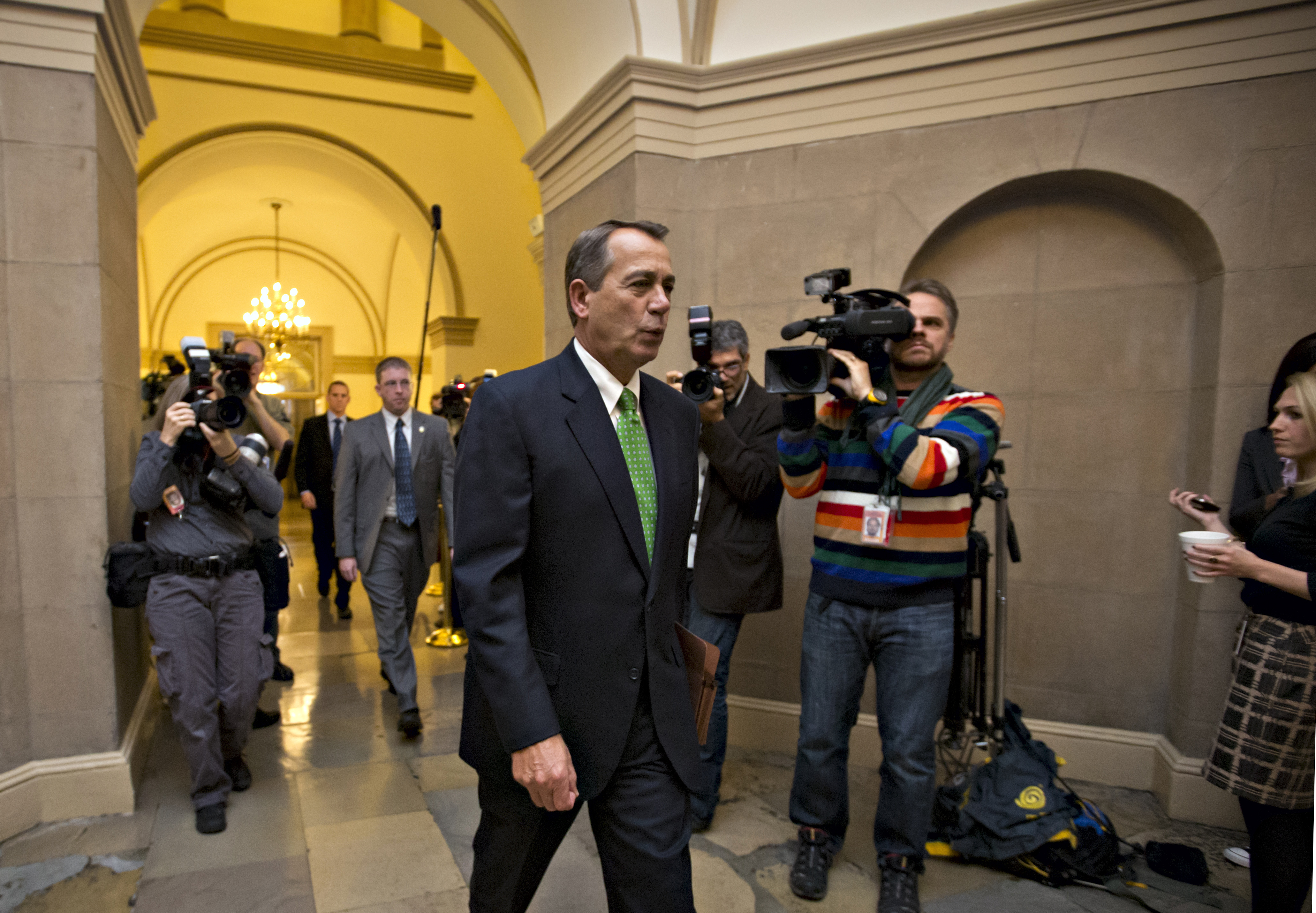
Politics has become the new reality TVHouse Speaker John Boehner (Credit: AP/J. Scott Applewhite)

Politico’s well-reported narrative of the fiscal cliff negotiations begins with an inevitable anecdote:

“Go f— yourself,” Boehner sniped as he pointed his finger at Reid, according to multiple sources present.

Reid, a bit startled, replied: “What are you talking about?”

Boehner repeated: “Go f— yourself.”

The harsh exchange just a few steps from the Oval Office — which Boehner later bragged about to fellow Republicans …

I love those blushing em dashes, as if the four-letter word itself would scandalize Politico’s hard-bitten audience.

Years ago Vice President Dick Cheney expressed himself similarly, addressing Sen. Patrick Leahy, D.-Vt.). While the remark made it into the press, it’s fair to take Cheney at his word. The veep later congratulated himself for his bravado.

Maybe it’s just my rose-tinted memories of the Bush administration, but I see something different at work in Boehner’s outburst. While the speaker may very well have been sincere, it’s hard not to see the comment, which he repeated and boasted about, as an audition for real estate in Politico, maybe even the spot he got: the top of a long story that only the mavens’ mavens will finish. Or maybe Boehner is trying out that three-word sentence as a new platform for the Republican Party. (Cheney’s outburst came in 2004, before Politico existed.)

This is not to single out Politico for debasing the discourse — my colleague Alex Pareene does that far more skillfully than I ever could here and here — but the site is a part of the endless escalation of political coverage. With three cable networks devoted almost exclusively to politics, the players know that any flash of personality will be looped endlessly on cable. They have an incentive to act like reality TV stars.

When you’re auditioning for a reality show, not everyone can try to be the hot one or the cool one but everyone can take a stab at being the crazy one. Boehner, with his orange tan and easy tears, is a perfect fit. So he curses at a colleague to get attention. By Washington standards, it’s as crazy as throwing a fit in public or tampering with your partner’s birth control.

We’ve all heard that Washington is Hollywood for ugly people. But one benefit of that cliché used to be that Washington had fewer cameras. Now power brokers believe that everything they do is interesting because everything they do is covered.

Like reality producers, politicians stretch their dramas and characters far thinner than can be sustained. Every negotiation is a crisis that carries on far past anyone’s patience and, like a soap opera, ends with a new cliffhanger or manufactured crisis “looming.”

It’s hard to see where this stops. There’s a large group of smart, ambitious people professionally interested in covering politicians, no matter how little there is to cover. The irony is that despite the obsessive media, the level of interest in congressional maneuvering is largely illusory. John Boehner’s official Twitter account has 422,000 followers. Lady Gaga has 32.7 million.

Continue Reading Close

Alex Halperin is news editor at Salon. You can follow him on Twitter @alexhalperin.

Next Article

Featured Slide Shows

What To Read Awards: Top 10 Books of 2012 slide show

close X
  • Share on Twitter
  • Share on Facebook
  • Thumbnails
  • Fullscreen
  • 1 of 10
  • 10. "The Guardians" by Sarah Manguso: "Though Sarah Manguso’s 'The Guardians' is specifically about losing a dear friend to suicide, she pries open her intelligent heart to describe our strange, sad modern lives. I think about the small resonating moments of Manguso’s narrative every day." -- M. Rebekah Otto, The Rumpus

  • 9. "Beautiful Ruins" by Jess Walter: "'Beautiful Ruins' leads my list because it's set on the coast of Italy in 1962 and Richard Burton makes an entirely convincing cameo appearance. What more could you want?" -- Maureen Corrigan, NPR's "Fresh Air"

  • 8. "Arcadia" by Lauren Groff: "'Arcadia' captures our painful nostalgia for an idyllic past we never really had." -- Ron Charles, Washington Post

  • 7. "Gone Girl" by Gillian Flynn: "When a young wife disappears on the morning of her fifth wedding anniversary, her husband becomes the automatic suspect in this compulsively readable thriller, which is as rich with sardonic humor and social satire as it is unexpected plot twists." -- Marjorie Kehe, Christian Science Monitor

  • 6. "How Should a Person Be" by Sheila Heti: "There was a reason this book was so talked about, and it’s because Heti has tapped into something great." -- Jason Diamond, Vol. 1 Brooklyn

  • 4. TIE "NW" by Zadie Smith and "Far From the Tree" by Andrew Solomon: "Zadie Smith’s 'NW' is going to enter the canon for the sheer audacity of the book’s project." -- Roxane Gay, New York Times "'Far From the Tree' by Andrew Solomon is, to my mind, a life-changing book, one that's capable of overturning long-standing ideas of identity, family and love." -- Laura Miller, Salon

  • 3. "Billy Lynn's Long Halftime Walk" by Ben Fountain: "'Billy Lynn's Long Halftime Walk' says a lot about where we are today," says Marjorie Kehe of the Christian Science Monitor. "Pretty much the whole point of that novel," adds Time's Lev Grossman.

  • 2. "Bring Up the Bodies" by Hilary Mantel: "Even more accomplished than the preceding novel in this sequence, 'Wolf Hall,' Mantel's new installment in the fictionalized life of Thomas Cromwell -- master secretary and chief fixer to Henry VIII -- is a high-wire act, a feat of novelistic derring-do." -- Laura Miller, Salon

  • 1. "Behind the Beautiful Forevers" by Katherine Boo: "Like the most remarkable literary nonfiction, it reads with the bite of a novel and opens up a corner of the world that most of us know absolutely nothing about. It stuck with me all year." -- Eric Banks, president of the National Book Critics Circle

  • Recent Slide Shows

  • Share on Twitter
  • Share on Facebook
  • Thumbnails
  • Fullscreen
  • 1 of 10

More Related Stories

Comments

2 Comments

Comment Preview

Your name will appear as username ( profile | log out )

You may use these HTML tags and attributes: <a href=""> <b> <em> <strong> <i> <blockquote>