
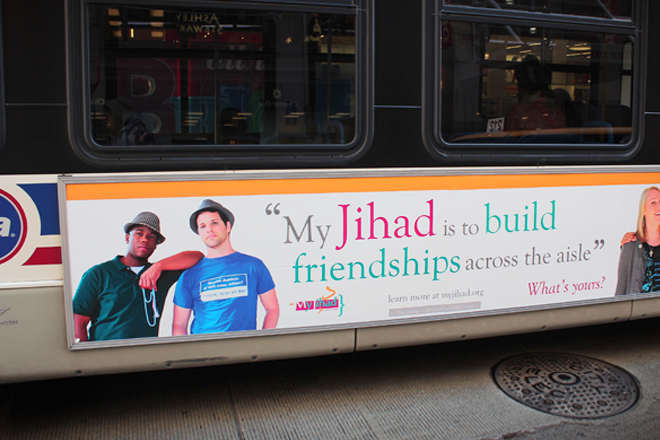

So you want to rebrand a word. It’s hard to think of a more difficult rebranding project than “jihad.”
Since Sept. 11, the term has become synonymous with terrorism and villainy — but now a group of Muslims is trying to reclaim the word from the extremists, and redefine “jihad” to mean something normal and peaceful and good. They realize this won’t be easy.
The campaign hinges on the idea that “jihad” has two commonly accepted usages. One is the violent, physical struggle most of us are familiar with. The other, which many Muslims and Islamic scholars consider the more correct definition, refers to the inner struggle to do good and follow God’s teaching; Muslims strive to attain this every day. This is the “proper meaning” being promoted by My Jihad, a public education campaign recently launched on billboards and on buses in Chicago.
“The campaign is about reclaiming Islam, and not just ‘jihad,’ from both Muslim and non-Muslim extremists,” said Ahmed Rehab, the leader of the effort, in an interview. “Whether it’s the bin Ladens and the al-Qaidas of the Muslim world, or the Pam Gellers and Frank Gaffneys of the non-Muslim world, ironically — even though they come from the two opposite ends of the spectrum — they agree exactly on the same definition of ‘jihad’ and on the same worldview of Islam versus the rest of the world.”
In fact, the ads were directly inspired by Geller, the anti-Muslim blogger and activist, who has plastered her own billboards on subways and buses in New York. They label Muslims as “savages” and incite viewers to “defeat Jihad.”
“Everybody was talking about the ‘savage’ part, but to me, that’s just sort of an insult — she thinks I’m a savage, I think she’s an idiot, we’re even,” he said. “But the problem for me was the use of the word ‘jihad.’ When no one seemed to care about that, I realized that we have a problem.”
In billboards on buses and subways, smiling Muslims and non-Muslims share universal human aspirations, personalized by the individual “jihads” of the non-actor volunteers who share their struggles. In this context, a jihad is no more threatening than a New Year’s resolution. “My jihad is to stay fit despite my busy schedule,” one woman with a headscarf and a barbell says. Others deal with raising children, doing well at work, and making friendships with different kinds of people. To Rehab, jihad means that when you are “confronted with two choices, you make the right choice and not the easy one.”
Ads have already gone up on buses in Chicago and San Francisco, and will soon go up in 10 other major American cities and a handful of international ones, including London, Sydney and Melbourne. There’s a website, Facebook page and Twitter hashtag where people can share their own personal jihads.
On Monday, Egyptian activists working with the group even unfurled a giant banner in front of the main church in Cairo wishing a Merry Christmas (Coptic Christians celebrate the holiday on Jan. 7) in contravention of hard-line Islamic proclamations that Christmas should not be recognized.
That may not sound so scary, but the opposition has been predictably vitriolic. The group’s Twitter and Facebook pages have received hateful messages from hard-line Islamists. Geller, predictably, is exercised.
She has written at least a dozen posts using the campaign’s #myjihad hashtag, which currently represent about two out of every three posts on the front page of her influential anti-Muslim blog. Geller also seems determined to play a game of bait and switch to sabatoge the rival campaign. She registered the domain name MyJihad.us (the real URL ends in .org) and is even trying to run copycat ads that are clearly designed to be confused with Rehab’s. In her ads, the peaceful Muslim is replaced with pictures of Osama bin Laden and the burning twin towers. She trying to get approval from the Chicago Transit Authority for the ads to appear on city buses, but they may be rejected for infringing on My Jihad’s copyright to the template.
One would think that My Jihad is exactly the kind of moderate Muslim voice that Geller — who claims to be so threatened by Muslim “extremists” — would want to promote. But in reality, “the extremists on both sides need each other for validation. And we’re a threat to both,” Rehab said.
Rehab is the executive director of the Chicago chapter of the Council on American Islamic Relations (CAIR), but he’s doing this on his own time and with separate funds to keep it a grass-roots effort. What started as a Facebook group less than a month ago has grown into a sophisticated public relations campaign that has already raised $20,000 and recruited dozens of volunteers, most of whom are “soccer moms” who don’t want their kids to feel intimidated at school because of their religion, Rehab said. “These are the army of My Jihad,” he quipped.
But can the popular conception of “jihad” really be changed with some ads and a hashtag?
“I would look at this conflict as I would any other product: We have an image problem,” said Arash Afshar, an Iranian-American marketing consultant who is not involved with the campaign. “This is exactly what Muslims should be doing … The way to combat an image problem is not to simply sit back and hope it goes away. You develop a branding strategy and motivate your already existing fan-base.”
The challenge will be to sustain the campaign, he said, pointing to the similarly buzzy and controversial Israel Loves Iran campaign.
The challenge is no doubt immense, however, explained Jean-Pierre Dubé, a professor of marketing at Booth School of Business at the University of Chicago. “The problem we have here is that this is a case where we literally want to do an about-face on the interpretation of the word. And there’s so much passion behind how people have used this term that it’s hard to imagine this is something you can change overnight.”
Still, there are plenty of examples of brands dramatically turning their image around, Dubé said. Marlboro, contrary to its contemporary image of masculine ruggedness personified by the Marlboro Man, was initially marketed as a cigarette for women. Its signature red color comes from a red band on the tip designed to hide lipstick stains — “A cherry tip for your ruby lips,” as the slogan went. Likewise, Mountain Dew successfully remade itself as a drink for the X-Games in the 1990s. There’s even some precedent, of sorts, in the religious world. Catholicism essentially tried to rebrand itself in the 1960s with Vatican II, though the success is more dubious.
But those turnarounds took a lot of time and “tons and tons of money,” Dubé noted, and there was hardly the passion around the gender connotation of Marlboro as there is around the concept of jihad. What jihad needs is a “brand hijacking,” Dubé said, like what happened to Doc Martens in the late 1980s and early 1990s, when teenage grunge rockers took over what had been a gardening boot. When Doc Martens executives realized the potential, they immediately changed gears to capitalize on the trend.
The problem here for My Jihad, however, is that there is no central authority in Islam, unlike in Catholicism or with Doc Martens, and thus no “owner” of the brand associated with jihad. So you have Rehab and his cohort trying to execute a “hijacking of a hijacking,” as Dubé put it, to take back the word from the extremists who initially commandeered it. But in the end, no one can rightfully claim to be the final arbiter of the word “jihad.”
If you talk to other Muslim activists, they’ll probably agree that the general usage of “jihad” is an unfortunate perversion, but they are wary to engage in what seems like a losing battle over semantics, especially when there are so many other pressing problems with Islamophobia. Rehab said he’s sympathetic to this argument, but that semantics are important and that his community is starting to realize it. “That was my message to the community. Not only is it so misidentified, but we as Muslims — a lot of us — have resigned ourselves to that and moved on or even stopped trying to change it.”
This isn’t the first effort to change the popular usage of “jihad.” In 2005, Islamic historian Douglas Streusand submitted a paper to the Pentagon arguing that the military should stop using the word to refer to Islamist militants. “If we are calling them ‘people who strive in the path of God,’ in other words — if we are calling them meritorious Muslims — then we are implying that we are fighting Islam, even if we’re not,” he wrote. To make a comparison more Americans would understand, Streusand said calling militants “jihadis” is “like calling Germans during the Second World War ‘National Socialist Aryan Heroes.’”
UCLA law professor Khaled Abou El Fadl, a prominent critic of puritanical interpretations of Islam, has long campaigned against the modern usage of the word. “When I write an article speaking to extremists and convincing them that they are wrong theologically and morally and legally, I consider myself in a state of jihad. I expect to be rewarded by God,” he told NPR in 2006.
Rehab and his compatriots realize it will be difficult to change the meaning of “jihad,” but he’s hoping the campaign will at least “start a conversation” about a concept that is critical to the practice of Islam, yet completely misunderstood. The same could be said about Islam more generally in the West. The religion, omnipresent in pop culture and foreign policy debates, is still mysterious to so many Americans and its popular image too often dictated by the extremists, and not its everyday adherents. If nothing else, the fact that Geller feels threatened shows they’re doing something right.
Hopefully, this campaign can start to demystify Islam by taking the edge out of the scariest word in the religion and making jihad as quotidian as going to the gym. That’s Rehab’s jihad, what’s yours?
