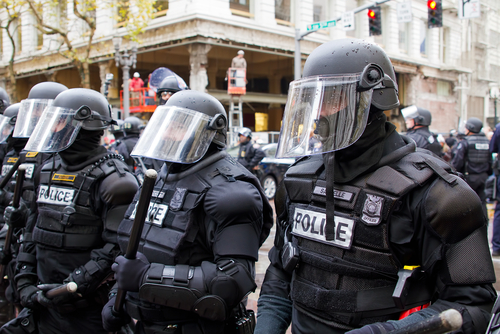

All policing, no protest around the inauguration

A new National Lawyers Guild report examines how policing at National Special Security Events silences dissent

Topics: Inauguration, Riot Police, NSSE, Protest, NLG, DNC, RNC, first ammendment,

In recent years I’ve regularly noted the unabashed militarization of protest policing. Building on a system of summit security established at the 2003 Free Trade Area of the Americas (FTAA) meeting in Miami, the “Miami Model” of militarized, weaponized policing has crystallized into standard procedure for gatherings designated National Special Security Events (NSSE).

Ahead of the presidential inauguration in Washington Monday, an NSSE that will draw 3,000 law enforcement officers and some 13,000 military troops to the area, the National Lawyers Guild has released  a report based on last year’s Republican National Convention in Tampa, Fla., and Democratic National Convention in Charlotte, N.C., highlighting First and Fourth Amendment violations imported with this sort of event policing. The report notes:

The security measures taken at the RNC and DNC are in keeping with the last fifteen years of government planning for national and international political and economic meetings, which have been defined by massive expenditures on weapons and outside personnel, restrictive event permits and ordinances that limit protest activities, and the vilification of constitutionally protected speech and assembly through media manipulation and aggressive police tactics.

In both Tampa and Charlotte, an equally extensive security apparatus was put in place to control dissent. Both cities received $50 million in federal funds to beef up security, and both brought in more than 3,000 officers from outside police departments. In Charlotte, the city manager declared the DNC an “extraordinary event,” which permitted the marking off of a large part of the city in which police officers have extended authority to search and possibly arrest individuals for carrying items like hammers or glass bottles, or masking their faces. Meanwhile, Tampa introduced an “event zone” for the RNC (originally called a “clean zone” before public backlash forced a nomenclature rethink), where similar objects are banned and police authorities are extended.


The establishment of (ever-Orwellian) “free speech zones” for DNC and RNC rallies served as rankling proof that, as a base line, speech is far from free during NSSEs; you have to go to special, cordoned-off areas for that. As the NLG points out, “In advance of the upcoming presidential inauguration, the National Park Service has revoked the permit for a major demonstration at Freedom Plaza, limiting the protesters to a 10-yard wide strip of sidewalk.”

The report authors express concern that the heavy-handed police apparatus has had a “chilling effect on free speech and assembly contributing to poor attendance at convention protests despite widespread dissatisfaction with both political parties.” I’d suggest that an Occupy-inspired lack of interest in engaging with mainstream political fulcrums may have also partly accounted for relatively low protest numbers, but certainly heavy-handed ordinances and militarized police forces serve to intimidate and deter protesters.

Interestingly, the report draws on the media tactics employed by city officials ahead of NSSEs to legitimize large expenditures and protest ordinances, which regularly stay in place long after the NSSE has packed up — the DNC left Charlotte with an anti-protest ordinance on the city’s books, which allows a city manager to invoke sweeping powers that tighten permitting, suspend probable cause for searches, and ban the possession of a host of household items. Of the tired “anarchists are coming!” scare tactic, the NLG notes:

When justifying enormous security expenditures, large numbers of police, and strict event zone ordinances, authorities often refer to the need to defend NSSEs against the threat of so-called “violent anarchists.” Prior to almost every large political event, police and local politicians rationalize these measures by warning of anarchist plans to disrupt the event through violence. This strategy, based on practices of intelligence gathering and police training that rely on amorphous categories such as “anarchist,” produces a “threat amplification” spiral that consistently leads to sweeping police repression. However, these intelligence “warnings” are not simply the unfortunate byproducts of a flawed practice, but rather the desired outcome of a multi-pronged strategy of maintaining control over the populace.

NLG executive director Heidi Boghosian said in a statement that “all too often at National Special Security Events, we see law enforcement vilify protesters and trample the First Amendment in an effort to justify massive security spending and lasting crackdowns,” adding that her organization’s report serves as a “primer on the evolution of police tactics at NSSEs, which is essential to understanding the show of force that will usher in this president’s second term.”

NSSEs are spaces that reveal all too visibly — with riot gear, weapons and tanks — that dissenters are prefigured by the authorities as combat enemies. Little wonder then that the range of recommendations offered by the NLG could be folded into one: This should stop.


Natasha Lennard

Natasha Lennard is an assistant news editor at Salon, covering non-electoral politics, general news and rabble-rousing. Follow her on Twitter @natashalennard, email nlennard@salon.com.

Featured Slide Shows

7 motorist-friendly camping sites

close X
  • Share on Twitter
  • Share on Facebook
  • Thumbnails
  • Fullscreen
  • 1 of 9

Sponsored Post

  • White River National Forest via Lower Crystal Lake, Colorado
    For those OK with the mainstream, White River Forest welcomes more than 10 million visitors a year, making it the most-visited recreation forest in the nation. But don’t hate it for being beautiful; it’s got substance, too. The forest boasts 8 wilderness areas, 2,500 miles of trail, 1,900 miles of winding service system roads, and 12 ski resorts (should your snow shredders fit the trunk space). If ice isn’t your thing: take the tire-friendly Flat Tops Trail Scenic Byway — 82 miles connecting the towns of Meeker and Yampa, half of which is unpaved for you road rebels.
    fs.usda.gov/whiteriveryou


    Image credit: Getty

  • Chattahoochee-Oconee National Forest via Noontootla Creek, Georgia
    Boasting 10 wildernesses, 430 miles of trail and 1,367 miles of trout-filled stream, this Georgia forest is hailed as a camper’s paradise. Try driving the Ridge and Valley Scenic Byway, which saw Civil War battles fought. If the tall peaks make your engine tremble, opt for the relatively flat Oconee National Forest, which offers smaller hills and an easy trail to the ghost town of Scull Shoals. Scaredy-cats can opt for John’s Mountain Overlook, which leads to twin waterfalls for the sensitive sightseer in you.
    fs.usda.gov/conf


    Image credit: flickr/chattoconeenf

  • Nordhouse Dunes Wilderness Area via Green Road, Michigan
    The only national forest in Lower Michigan, the Huron-Mainstee spans nearly 1 million acres of public land. Outside the requisite lush habitat for fish and wildlife on display, the Nordhouse Dunes Wilderness Area is among the biggest hooks for visitors: offering beach camping with shores pounded by big, cerulean surf. Splash in some rum and you just might think you were in the Caribbean.
    fs.usda.gov/hmnf


    Image credit: umich.edu

  • Canaan Mountain via Backcountry Canaan Loop Road, West Virginia
    A favorite hailed by outdoorsman and author Johnny Molloy as some of the best high-country car camping sites anywhere in the country, you don’t have to go far to get away. Travel 20 miles west of Dolly Sods (among the busiest in the East) to find the Canaan Backcountry (for more quiet and peace). Those willing to leave the car for a bit and foot it would be remiss to neglect day-hiking the White Rim Rocks, Table Rock Overlook, or the rim at Blackwater River Gorge.
    fs.usda.gov/mnf


    Image credit: Getty

  • Mt. Rogers NRA via Hurricane Creek Road, North Carolina
    Most know it as the highest country they’ll see from North Carolina to New Hampshire. What they may not know? Car campers can get the same grand experience for less hassle. Drop the 50-pound backpacks and take the highway to the high country by stopping anywhere on the twisting (hence the name) Hurricane Road for access to a 15-mile loop that boasts the best of the grassy balds. It’s the road less travelled, and the high one, at that.
    fs.usda.gov/gwj


    Image credit: wikipedia.org

  • Long Key State Park via the Overseas Highway, Florida
    Hiking can get old; sometimes you’d rather paddle. For a weekend getaway of the coastal variety and quieter version of the Florida Keys that’s no less luxe, stick your head in the sand (and ocean, if snorkeling’s your thing) at any of Long Key’s 60 sites. Canoes and kayaks are aplenty, as are the hot showers and electric power source amenities. Think of it as the getaway from the typical getaway.
    floridastateparks.org/longkey/default.cfm


    Image credit: floridastateparks.org

  • Grand Canyon National Park via Crazy Jug Point, Arizona
    You didn’t think we’d neglect one of the world’s most famous national parks, did you? Nor would we dare lead you astray with one of the busiest parts of the park. With the Colorado River still within view of this cliff-edge site, Crazy Jug is a carside camper’s refuge from the troops of tourists. Find easy access to the Bill Hall Trail less than a mile from camp, and descend to get a peek at the volcanic Mt. Trumbull. (Fear not: It’s about as active as your typical lazy Sunday in front of the tube, if not more peaceful.)
    fs.usda.gov/kaibab


    Image credit: flickr/Irish Typepad

  • As the go-to (weekend) getaway car for fiscally conscious field trips with friends, the 2013 MINI Convertible is your campground racer of choice, allowing you and up to three of your co-pilots to take in all the beauty of nature high and low. And with a fuel efficiency that won’t leave you in the latter, you won’t have to worry about being left stranded (or awkwardly asking to go halfsies on gas expenses).


    Image credit: miniusa.com

  • Recent Slide Shows

  • Share on Twitter
  • Share on Facebook
  • Thumbnails
  • Fullscreen
  • 1 of 9

Comments

6 Comments

Comment Preview

Your name will appear as username ( settings | log out )

You may use these HTML tags and attributes: <a href=""> <b> <em> <strong> <i> <blockquote>