
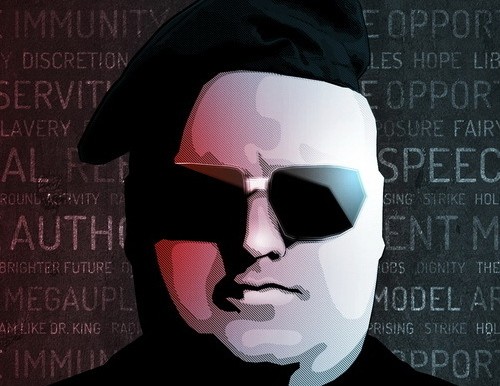

Kim Dotcom is taking Mega to the next step. The New Zealand hacker, who faces extradition to the U.S. over charges that his former file-sharing cite facilitated mass online privacy, launched new file-sharing site Sunday. Simply named “Mega,” the new offers encrypted cloud storage.
With a gala and launch party at his New Zealand home, the hacker celebrated Mega’s launch exactly one year after the New Zealand authorities raided the mansion and shuttered Megaupload. According to reports, the party even featured a spoof raid re-enactment.
Dotcom said half a million users registered for Mega in its first 14 hours, the AP reported. Mega, which Dotcom has dubbed “the privacy company,” functions similarly to cloud storage platforms like Dropbox but with encryption and decryption of files as standard. This not only offers privacy for users, but protection for the company itself. Only users hold the keys for decoding files; Mega can’t see the content of the shared files and thus, according to DotCom, can’t be held liable (as he was for copyright infringing materials shared over MegaUpload).
As Forbes’ Anthony Wing Kosner points out, by giving users both encryption and decryption keys, Mega sets itself out as more than just a well-protected haven for piracy. It is a bastion for cloud privacy too:
This is “unlike the industry norm where the cloud storage provider holds the decryption key.” This distinction is what enables file storage services to decrypt and hand over data to government authorities under subpoena. With MEGA, this can’t happen, because it does not retain the decryption keys. So it doesn’t know what you are storing on its servers and it can’t find out.
Google openly admits to complying with governments — most regularly the U.S. — who request user data. The newly-renewed Foreign Intelligence and Surveillance Act (FISA) amendments permits the U.S. government’s warrantless surveillance of of information stored in U.S.-owned public data clouds, like those of Facebook or Google. In this context, Mega’s encrypted space in the cloud holds much appeal for those with privacy concerns beyond piracy.
According to the Guardian, DotCom framed himself as an online pioneer when speaking at the launch party. “We want to show the world that we are innovators. We want to show the world that cloud storage has a right to exist. And, of course, when you launch something like this, you can expect some controversy. The content industry is going to react really emotionally about this. The US government will probably try and destroy the new business … you’ve got to stand up against that, and fight that, and I’m doing that … I will not allow them to chill me,” said DotCom.
Dotcom, currently free on bail, faces an extradition hearing in March. In the U.S. he faces as long as 20 years in prison for each of the racketeering and money-laundering charges in the indictment against him. The Internet tycoon told the Guardian that he believes U.S. prosecutors were politically motivated to go after MegaUpload in response to the failure of Stop Online Piracy Act (SOPA) legislation — the fight against which was spearheaded by Aaron Swartz.
