
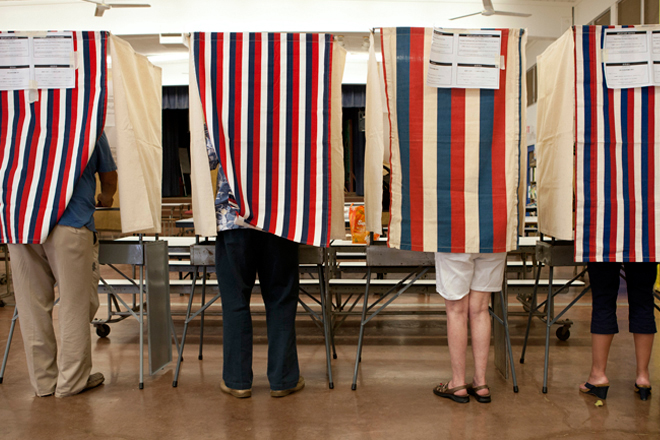

 Early last year, when Attorney General Eric Holder took a strong stand against voter-identification laws, he emphasized how much they violate core American ideals. “What we are talking here is a constitutional right,” he said. “This is not a privilege. The right to vote is something that is fundamental to who we are as Americans. We have people who have given their lives—people have sacrificed a great deal in order for people to have the right to vote. It’s what distinguishes the United States from most other countries.”
The problem is: Eric Holder is wrong. Unlike citizens in every other advanced democracy—and many other developing ones—Americans don’t have a right to vote. Popular perception notwithstanding, the Constitution provides no explicit guarantee of voting rights. Instead, it outlines a few broad parameters. Article 1, Section 2, stipulates that the House of Representatives “shall be composed of Members chosen every second Year by the People of the several States,” while Article 1, Section 4, reserves the conduct of elections to the states. The Constitution does, however, detail the ways in which groups of people cannot be denied the vote. The 15th Amendment says you can’t prevent African American men from voting. The 19th Amendment says you can’t keep women from voting. Nor can you keep citizens of Washington, D.C., (23rd Amendment) or 18-year-olds (26th Amendment) from exercising the franchise. If you can vote for the most “numerous” branch of your state legislature, then you can also vote for U.S. Senate (17th Amendment).
These amendments were passed in different circumstances, but they share one quality—they’re statements of negative liberty, establishing whom the government can’t restrict when it comes to voting. Beyond these guidelines, states have wide leeway in how they construct voting systems. Some, like California, have opted to make voting as easy as possible, with early-voting periods, widely available absentee ballots, and online registration. Others, like Virginia, have made voting difficult, with strict ID laws and no early voting. Throughout American history, some lawmakers and officials have seen the federal government’s hands-off approach as an opportunity to tighten their grip on power and suppress opposition. At the end of Reconstruction, states passed laws to restrict African American voting. Governments led by the Democratic Party throughout the country—not just the South—had passed poll taxes, literacy requirements, and grandfather clauses, all designed to keep blacks away from the polls. When those weren’t enough, vigilantes resorted to violence, with the tacit (or outright) approval of local authorities.
It wasn’t until the Voting Rights Act of 1965 that the federal government made a proactive move to secure the voting rights of all citizens, and of African Americans in particular. But that didn’t put an end to the states’ suppressive shenanigans. During the 2000 election, to cite one unforgettable example, Florida officials made an active effort to remove voters from the rolls (in the interest of “protecting the vote”) and keep former felons from voting. In 2004, Ohio’s secretary of state, Republican Kenneth Blackwell, pushed strict measures that would disqualify provisional ballots submitted to the wrong precinct, even if they came from registered voters (and even if poll workers, not voters, were at fault). In 2011 and 2012, Republicans in state legislatures across the country passed “voter integrity” laws that instituted draconian ID requirements for voters and made it difficult for millions of Americans—disproportionately black and Latino—to vote. “Voter fraud” was the stated reason for these measures, but independent experts have found no evidence of the kind of fraud—voter impersonation—that would be stopped by requiring photo IDs.
In our large, polarized democracy, voting has been an issue fraught with partisanship and ideology. But the ability of states to restrict participation stems from the peculiar fact that Americans don’t enjoy the right to vote. We came close once. Following the end of the Civil War, an early draft of the 15th Amendment featured a blanket right to vote (excluding women); this was rejected in favor of limited suffrage for freedmen. The reason? Southern Republicans didn’t want to enfranchise former Confederates, Western politicians feared that Chinese would participate, and Northern states worried that they would have to abandon their own restrictions on voting.
There have been periodic attempts to revive the right-to-vote idea. In 2005, for example, Representative Jesse Jackson Jr. introduced a right-to-vote amendment that won meager support from other House members. But the recent attempts to block voters and make voting cumbersome—dramatized by the long lines of the 2012 presidential election—could act as a catalyst for a new movement to codify, in the Constitution, a right to vote.
Proponents say that an affirmative constitutional right would, at the very least, force state lawmakers and election administrators to think twice about measures and election procedures that harm voters. “A constitutional amendment for the right to vote is needed to make it explicit,” says Judith Browne Dianis, co-director of the Advancement Project, a civil-rights organization. “Making it explicit will send a signal to state legislatures and courts that any barriers to our democracy must be carefully devised so that they don’t disenfranchise people.” The Supreme Court, she notes, has been happy to defer to states’ laws on voting, even if the result is to keep some people from exercising the franchise. In 2008, the Court upheld Indiana’s voter-identification law, declaring that it wasn’t unconstitutional to require photo identification at the polls because the state had a “valid interest” in deterring fraud. That ruling was made despite Indiana’s inability to produce a single example of in-person voter fraud.
A right-to-vote amendment would raise the standard of constitutional review for voter-identification laws and other measures that deplete the pool of voters. Currently states have to show only a “compelling interest” for their laws to pass muster. An affirmative right to vote would compel courts to apply “strict scrutiny,” the standard used to review laws that operate on the basis of race and other characteristics. The burden would then be on a state like Indiana to prove voter fraud and to show that IDs or other requirements are needed to prevent further problems.
“One way to read the Constitution is as a narrative, and that narrative is one of ever-increasing inclusion and participation for people,” says Jamie Raskin, a Maryland state senator and professor of law at American University in Washington, D.C. Raskin believes that a right-to-vote amendment could be used to settle a question that has always been at the center of our political disputes: Who participates in our democracy?
The founders were preoccupied with what they called “republican virtue.” As they saw it, a democratic society couldn’t function without a virtuous citizenry participating in public life, with virtue defined by one’s economic independence. If you owned your land, the founders believed, you had the ability to reason free of self-interest, and thus you possessed virtue. If you were a lowly worker, or dependent on others for your livelihood, you were too compromised to make political choices, and thus you lacked virtue. Of course, it’s no accident that the only people who had republican virtue—white male landowners—were also the people who defined it. They were, in their estimation, the only people to possess the independence, control, and faculties to govern the country and protect it from mob rule.
Even though we’ve expanded the Constitution to protect voting rights for women, minorities, and young adults, the idea that some people have virtue and others don’t is still embedded in our political thought. During last year’s U.S. Senate election in Massachusetts, Senator Scott Brown, a Republican, decried that public-assistance offices (under the 1993 National Voter Registration Act) were registering those who sign up for social services to vote, calling it “part of a special effort to boost one political party over another.”
Brown’s opposition was, of course, motivated by partisanship. Although only 1 percent of the state’s voters registered in those offices, Brown likely feared that in a tight election he would lose ground if low-income people were encouraged to register and vote. But the senator’s criticism harked back to the old notion of virtue—the implication being that receiving benefits (being “dependent”) robs one of the independence needed to have a say in government. The same idea is at work in felon-disenfranchisement laws: Committing a crime robs you of your virtue, the thinking goes, and it is up to the virtuous political leaders to determine whether you can return from prison as a full member of society.
The call for a right-to-vote amendment is an attempt to redefine virtue away from exclusion and toward a broader and more inclusive view. James Savage, a professor of political theory at the University of Virginia, points out that this concept is also rooted in the founders’ views. “A fundamental characteristic of republican virtue is citizen participation in political life,” he says. “Virtuous citizens are obligated to engage in political life, minimally by voting. As part of its purpose, the state should encourage this virtuous participation, not impede it.”
An affirmative right to vote would create a more democratic society. It would also help shift power back to everyday citizens. A country in which more people vote is one where wealth and corporate influence are a little less powerful. Almost every progressive change of the past century, from the original Progressive Era to the Great Society, was pushed along by efforts to expand the electorate and bring more people into the process. The 17th Amendment, by allowing for direct election of senators, took power away from the corporations who influenced state legislatures and gave it to ordinary people. Women, empowered by the 19th Amendment, helped elect Franklin Roosevelt, Harry Truman, and other liberal politicians. A right-to-vote amendment would further that legacy.
The odds of passing an amendment—any amendment—are long. Only 27 have made the cut, and the most important ones came during times of great national turmoil. Even something as commonsensical as the Equal Rights Amendment, which would constitutionally guarantee the equality of women, is unlikely to pass. This has much to do with the arduous process for amending the Constitution. First, Congress has to pass the proposed amendment by a two-thirds majority (it doesn’t need presidential approval). Then three-quarters of the states have to approve the amendment. Given overwhelming GOP support for voter identification and other exclusionary measures, it’s hard to imagine a sufficient number of Republican lawmakers voting to affirm the right to vote. The chances in states are perhaps even slimmer than in Congress: If you divide the country into states with voter-identification laws and those without, and assume the voter-ID states would oppose the amendment, you would be 17 states short of the necessary number even if all the non-ID states ratified it. Then again, as Raskin notes, “every constitutional amendment seems impossible up to the point it becomes inevitable.”
Even if a serious push for a right-to-vote amendment ultimately falls short, the effort would benefit the progressive movement by putting it back on the offensive. “Progressives fought constitutionally for a long time,” says Congressman Keith Ellison of Minnesota, who has been a co-sponsor on the right-to-vote amendment introduced in the House. “But now it’s the people who restrict and deny rights who want to rewrite the Constitution.”
Indeed, conservatives have not been shy about their desire to reshape the Constitution. Over the past decade, Republicans have proposed amendments to force a balanced budget, legalize school prayer, prohibit same-sex marriage, create term limits for members of Congress, and establish personhood for embryos. Moreover, conservatives have turned some amendments, like the one for a balanced budget, into partisan rallying cries. During the Republican presidential primaries, every candidate except Jon Huntsman signed a pledge to support a balanced-budget amendment in Congress. There’s no reason progressives can’t do the same with a right-to-vote amendment in the next Democratic contest.
Voting rights are far more important than balanced budgets. “When we think about Election Day, it’s the great equalizer in this country,” Dianis says. “It doesn’t matter if you’re rich or poor, black or white or Latino: Everyone has the same rights when they go into the voting booth. The amendment is about establishing and enshrining how important this is to us as a country.”
Most Americans already believe that the vote is sacrosanct. The least we can do is enshrine it in our laws. By making the right to vote a rallying point, progressives would show their commitment to expanding democracy. “We’ve taken a defensive posture,” Ellison says, “and it’s a bad way to organize. It’s also not a way to inspire people. If you want to inspire people, you have to lift sights, and I think a constitutional amendment is the way to do that.”
