


Three troubling U.S. Supreme Court cases — one that has already undermined public participation in elections and two new ones threatening to further tilt the balance toward wealthier and whiter slices of society—have all been brought by Republican activists who want to change the rules to benefit their shrinking political party.
On Tuesday, the Supreme Court agreed to hear a campaign finance case in which a wealthy Alabama Republican sued because he wanted to give more money than federal law allows in two-year election cycles. Shaun McCutcheon, the businessman-activist, joined by the Republican National Committee, challenged the $46,200 limit on donations to candidates and their committees, and $70,800 donation limit to other political committees. Less than 1 percent of Americans give this much to campaigns.
Next week, in another lawsuit originating with activist Republicans, Shelby County v. Holder, the Supreme Court will hear a case on whether the heart of the federal 1965 Voting Rights Act, Section 5, is outdated and should be overturned. That section lets the Justice Department veto changes in election laws in 16 states that have had histories of race-based discrimination in elections. The VRA was used in 2012 to block GOP-backed voter ID laws in several states, as well as to overturn GOP-drawn legislative districts in Texas that diluted the possibility of electing Latinos to Congress. Republicans argue that racism in elections is a thing of the past. However, dozens of briefs filed by liberals argue that is not the case.
And in 2010, the Supreme Court, in the infamous Citizens United case, ruled that wealthy individuals and unions could make unlimited donations to political groups that were not formally connected to a candidate’s campaign. That suit originated with GOP activists’ efforts to smear then-presidential candidate Hillary Clinton in a fall 2008 video.
The Citizens United ruling and another that followed in federal court were responsible for 2012’s billionaire political venture capitialists who bankrolledsuper PACs, which were shadow campaigns for specific candidates—first in the Republican primaries and then used by both parties in the fall election. These uber-wealthy groups were responsible for filling the airwaves in swing states with political mud, which dumbed down the debate and prevented down-ballot candidates from getting their messages out.
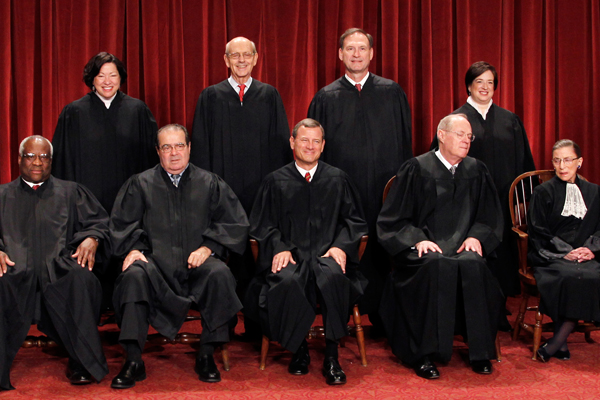
Stepping back from the devilish details of election law, this disturbing pattern emerges: Republican activists, with the backing of their party, have been successful in using the federal courts to rewrite—and to try to further rewrite—the rules of who participates and has the biggest megaphones in American elections. And they’re doing so as the Supreme Court has a Republican president-appointed majority that believes the wealthiest Americans and big businesses should spend freely in elections (suggesting they’ll rule for McCutcheon), and has previously said there were serious questions whether the Voting Rights Act’s Section 5 was needed.
To be fair, the Democrats and President Obama are not angels when it comes to campaign finance reform. The president has done nothing to clean up the system that he mastered to gain office. And the Democrats have copied the GOP’s big money tactics, notably super PACs. However, it is the GOP that is leading the attacks on the equalitarian structures remaining in U.S. elections.
Next week, it will be an amazing spectacle to watch the arguments unfold at the Supreme Court as Republicans argue that there are no race-based prejudices at play in American elections—and accuse the Democrats and civil rights groups of cynicism for saying the Voting Rights Act is still needed. This will be an example of lawyering at its worst—arguing anything on behalf of a client and hoping those on the bench are uninformed enough about the realities to believe it.
You might think that the Supreme Court is smarter than that, but its politicalniavete was on full display in the Citizens United ruling, where the conservative majority said that wealthy individuals, unions and corporations could 1) make unlimited donations to supposedly “independent” political committees—those not working with specific candidate campaigns; and 2) that the public would know who the big donors were because their identities and contributions would be fully disclosed.
Both assumptions were more than a little wrong. Many 2012 super PACs wererun by political consultants who previously had worked for the same candidates their super PACs backed; and donor identities were hidden by political non-profits run by Karl Rove and his ilk, shielded by federal tax law.
The Court’s pro-electioneering spending prejudice was seen in announcing that it would hear the McCutcheon case. Election law experts were not surprised and have said for some time that the Roberts Court is poised to dismantle modern campaign finance laws. Still, the decision to hear the case caused dismay in progressive circles because it threatened the one remaining legal pillar in federal campaign finance law—that contributions could be limited to prevent the appearance or occurance of corruption. Even though there are plenty of loopholes for big money in American elections, this case could set precedents to unravel those modest controls.
It’s noteworthy that these attacks on the legal underpinnings of how elections are run come from a political party whose largely white and aging base is shrinking when seen against America’s demographic changes.
The Republican Party may be in disarry and fighting among themselves—such as the Tea Party faction accusing and backtracking from calling Karl Rove a Nazi—and it may be increasingly unpopular among young voters and communities of color. But when it comes to targeting the rules that dictate who can participate in and influence American elections, it has been successful in bringing cases to the Supreme Court that have and can continue to further unbalance participation in American elections. The Republican Party may be declining, but it is not going quietly into the night.
