
Supreme Court: Racism deniers?

If the Scalia wing strikes down the Voting Rights Act, it thinks we're beyond our history of racial bias

Topics: Supreme Court, Race, Voting Rights Act, John Roberts, Antonin Scalia, Department of Justice,

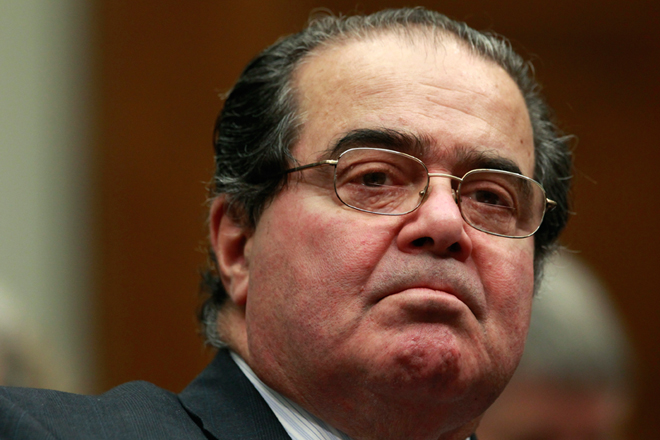
Supreme Court: Racism deniers?Supreme Court Justice Antonin Scalia (Credit: Reuters/Kevin Lamarque)

This morning, the Supreme Court heard arguments regarding the constitutionality of the pre-clearance provisions of the Voting Rights Act, which require certain states with a history of disenfranchising African-American voters to have any changes in their law regulating voting to be approved by the Department of Justice first.

Most observers expect the court to declare those provisions unconstitutional, even though they were extended by the Senate by a unanimous vote less than seven years ago, while facing only token opposition in the House. All in all, 488 of 521 members of Congress voted to renew the pre-clearance provisions.

The enthusiasm with which the court’s righter wing appears to be greeting constitutional attacks on provisions adopted and renewed by overwhelming legislative majorities could make a cynic suspect that “conservative” criticisms of judicial review can often be reduced to the axiom, “the democratic process should be respected, unless it produces a result we really don’t like.”  (Reportedly, during this morning’s oral argument, the increasingly egregious Justice Scalia likened congressional renewal of the Voting Rights Act to a “perpetuation of racial entitlement.”)

The policy arguments for getting rid of pre-clearance boil down to the claim that the sort of disenfranchisement motivated by racial bias that pre-clearance was designed to combat has largely if not completely disappeared. This may or may not be true, but it’s hard to see why unelected judges should decide whether or not it is rather than elected legislators.

But there’s a deeper problem with claims that America has “moved past” our history of racial discrimination to the point where a vigorously enforced Voting Rights Act is no longer necessary.

The Voting Rights Act, and its equally important cousin the Civil Rights Act, were both adopted in the mid-1960s, when, incredible as it may seem to today’s youth, Jim Crow still flourished throughout the American South. (My mother, who grew up in Mexico, attended the University of Texas in the 1950s, and was deeply shocked to encounter “colored” and “whites only” public facilities.)

These landmark pieces of legislation were passed, and have been renewed many times since, because the injustice they confronted was so unambiguous. Little more than a generation ago, African-Americans in much of the United States were quite literally second-class citizens, and the resistance to changing that came from very powerful people who were openly and indeed proudly racist.


Almost overnight, in historical terms, the sort of open racism that was the law of the land, if that land happened to be located in the old Confederacy, became illegal, and, to a lesser extent, socially unacceptable. But it would be naive in the extreme to assume that passing laws by itself changes the culture those laws were intended to combat.

As last November’s election illustrated so powerfully, the American electoral system is still as a practical matter designed to keep as many “undesirable” voters from voting as possible. The problem now is that we no longer confront a system in which powerful people openly advocate disenfranchising black voters, or poor voters, or voters with Spanish last names.

Instead we have a system in which the rules that govern voting just happen to have that effect. Why is Election Day in America a work day, unlike in almost every other Western nation? Why are the mechanics of voting a purely local matter, guaranteeing that people who live in poor neighborhoods are far more likely not to have access to accurate and efficient voting technology? Why must, in the age of the Internet, people stand for eight or more hours in line to do something as simple as cast a ballot?

The answer has little, if anything, to do with the sort of conscious political conspiracy against African-Americans that the Civil Rights and Voting Rights Acts were originally addressing. Such things are reflections of the fact that, contrary to the claims of those who say America has “moved past” our history of maintaining racial and economic caste systems, that past is still very much with us.

Paul Campos

Paul Campos is a professor of law at the University of Colorado at Boulder.

Featured Slide Shows

7 motorist-friendly camping sites

close X
  • Share on Twitter
  • Share on Facebook
  • Thumbnails
  • Fullscreen
  • 1 of 9

Sponsored Post

  • White River National Forest via Lower Crystal Lake, Colorado
    For those OK with the mainstream, White River Forest welcomes more than 10 million visitors a year, making it the most-visited recreation forest in the nation. But don’t hate it for being beautiful; it’s got substance, too. The forest boasts 8 wilderness areas, 2,500 miles of trail, 1,900 miles of winding service system roads, and 12 ski resorts (should your snow shredders fit the trunk space). If ice isn’t your thing: take the tire-friendly Flat Tops Trail Scenic Byway — 82 miles connecting the towns of Meeker and Yampa, half of which is unpaved for you road rebels.
    fs.usda.gov/whiteriveryou


    Image credit: Getty

  • Chattahoochee-Oconee National Forest via Noontootla Creek, Georgia
    Boasting 10 wildernesses, 430 miles of trail and 1,367 miles of trout-filled stream, this Georgia forest is hailed as a camper’s paradise. Try driving the Ridge and Valley Scenic Byway, which saw Civil War battles fought. If the tall peaks make your engine tremble, opt for the relatively flat Oconee National Forest, which offers smaller hills and an easy trail to the ghost town of Scull Shoals. Scaredy-cats can opt for John’s Mountain Overlook, which leads to twin waterfalls for the sensitive sightseer in you.
    fs.usda.gov/conf


    Image credit: flickr/chattoconeenf

  • Nordhouse Dunes Wilderness Area via Green Road, Michigan
    The only national forest in Lower Michigan, the Huron-Mainstee spans nearly 1 million acres of public land. Outside the requisite lush habitat for fish and wildlife on display, the Nordhouse Dunes Wilderness Area is among the biggest hooks for visitors: offering beach camping with shores pounded by big, cerulean surf. Splash in some rum and you just might think you were in the Caribbean.
    fs.usda.gov/hmnf


    Image credit: umich.edu

  • Canaan Mountain via Backcountry Canaan Loop Road, West Virginia
    A favorite hailed by outdoorsman and author Johnny Molloy as some of the best high-country car camping sites anywhere in the country, you don’t have to go far to get away. Travel 20 miles west of Dolly Sods (among the busiest in the East) to find the Canaan Backcountry (for more quiet and peace). Those willing to leave the car for a bit and foot it would be remiss to neglect day-hiking the White Rim Rocks, Table Rock Overlook, or the rim at Blackwater River Gorge.
    fs.usda.gov/mnf


    Image credit: Getty

  • Mt. Rogers NRA via Hurricane Creek Road, North Carolina
    Most know it as the highest country they’ll see from North Carolina to New Hampshire. What they may not know? Car campers can get the same grand experience for less hassle. Drop the 50-pound backpacks and take the highway to the high country by stopping anywhere on the twisting (hence the name) Hurricane Road for access to a 15-mile loop that boasts the best of the grassy balds. It’s the road less travelled, and the high one, at that.
    fs.usda.gov/gwj


    Image credit: wikipedia.org

  • Long Key State Park via the Overseas Highway, Florida
    Hiking can get old; sometimes you’d rather paddle. For a weekend getaway of the coastal variety and quieter version of the Florida Keys that’s no less luxe, stick your head in the sand (and ocean, if snorkeling’s your thing) at any of Long Key’s 60 sites. Canoes and kayaks are aplenty, as are the hot showers and electric power source amenities. Think of it as the getaway from the typical getaway.
    floridastateparks.org/longkey/default.cfm


    Image credit: floridastateparks.org

  • Grand Canyon National Park via Crazy Jug Point, Arizona
    You didn’t think we’d neglect one of the world’s most famous national parks, did you? Nor would we dare lead you astray with one of the busiest parts of the park. With the Colorado River still within view of this cliff-edge site, Crazy Jug is a carside camper’s refuge from the troops of tourists. Find easy access to the Bill Hall Trail less than a mile from camp, and descend to get a peek at the volcanic Mt. Trumbull. (Fear not: It’s about as active as your typical lazy Sunday in front of the tube, if not more peaceful.)
    fs.usda.gov/kaibab


    Image credit: flickr/Irish Typepad

  • As the go-to (weekend) getaway car for fiscally conscious field trips with friends, the 2013 MINI Convertible is your campground racer of choice, allowing you and up to three of your co-pilots to take in all the beauty of nature high and low. And with a fuel efficiency that won’t leave you in the latter, you won’t have to worry about being left stranded (or awkwardly asking to go halfsies on gas expenses).


    Image credit: miniusa.com

  • Recent Slide Shows

  • Share on Twitter
  • Share on Facebook
  • Thumbnails
  • Fullscreen
  • 1 of 9

Comments

37 Comments

Comment Preview

Your name will appear as username ( settings | log out )

You may use these HTML tags and attributes: <a href=""> <b> <em> <strong> <i> <blockquote>