
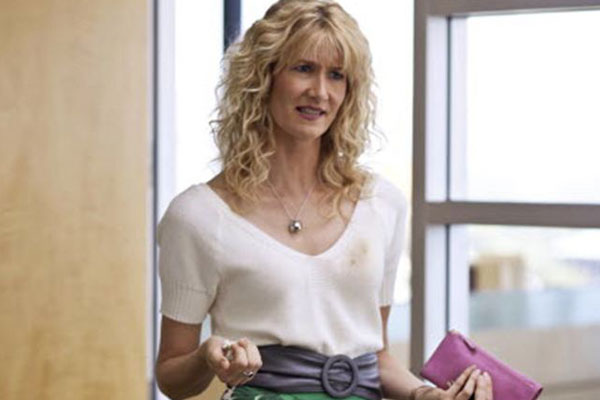

ENLIGHTENED — the television series co-created by Mike White and Laura Dern — opens with a scene of extreme disillusionment. Even prior to that first shot of Amy Jellicoe’s mascara-teared face, a close-up of which has become the show’s iconic image, the viewer senses that something is amiss. Just before we’re introduced to the face of our heroine, played by Dern, we’re aware of a sound. Someone is crying. Issuing from a blank screen, the crying already startles, but perhaps even more so because it’s a kind of irrepressible sobbing, verging on hysteria. Our reaction to the faceless weeping isn’t, and isn’t meant to be, one of sympathy or tenderness, but of disquiet, even fear. The disconnect lasts only seconds, as Amy’s contorted face floats into view. From there, Amy goes on a bridge-burning rampage through the office that — again, while lasting only minutes — becomes integral to how we will view the entire series. While most narratives proceed toward building connections, securing attachments, Enlightened begins by breaking them. During Amy’s path of detachment, however, the inverse was happening with me: I was falling in love with Enlightened.

White and Dern’s show is difficult to describe, with a plot that fluctuates in pace, and a deep occupation over its tone, extreme or subtle, regardless of who is directing. Those first few minutes of a manic, sobbing Amy, then, is all the more powerful as it not only conveys the show’s interest in expressing affect, but its narrative bones. Amy breaks down at the Abaddonn headquarters upon being fired for an affair with her boss. It’s a scene of rage and despair — a bang and a whimper — followed by a severe shift in tone. A calm voiceover — Amy now “speaking in her real voice” — floats over the next scene of beachside sunsets, and we see her in various meditative poses at what we learn is a holistic wellness retreat in Hawaii. Again, the camera doesn’t stay here long, and we soon find Amy in the present, newly at peace, returning to Riverside to live with her mother (Diane Ladd). We hardly recognize her when she walks back into Abaddonn, her beach-tangled hair tied in a loose clip, to ask for a job from the place that had caused her breakdown. The return might seem counterintuitive, even regressive, but Amy has plans to be “an agent of change”: this time, she thinks, will be different.
But for viewers, we’re barely a third into the pilot — so much has already changed — and Amy is back where she started, except this time without a job. What could Enlightened be about, and what is it clinging to? It’s a question White keeps us asking.
Instead of granting Amy’s proposal to be the company environment watchdog, her employers place her in the basement of Abaddonn, where rows of ostracized social misfits log data using a computer program called Cogentiva. The workspace — white windowless walls and reflective surfaces — is almost a complete reversal of where Amy has spent the past months getting well. But it’s not enough to quell her recently acquired optimism. Instead of epiphanic encounters with sea turtles, Amy hunkers over a computer screen, brows furrowed in attempt to mine the corrupt depths she knows are part of Abaddonn’s success. Gradually, she befriends her coworker Tyler (played by White), as well as the VP of Cogentiva, Dougie (Timm Sharp) — both outsiders, lonely and endearing, in their own ways. While Amy finds new attachments working at Cogentiva, she still hasn’t let go of her connections to those upstairs and it’s painful to see her stumbling around, conscious of the gossip and pity her insistent presence generates there, yet unwilling to absent herself regardless. The show is titled Enlightened but whatever Buddhist mantras Amy might have picked up in Hawaii only seem to get her so far.
Amy moves restlessly between upstairs and downstairs, home and office, as though to stay still would be to admit failure. A large portion of the show is devoted to periods where Amy is in literal transit — commuting from the suburbs of Riverside to the L.A. cityscapes of work, taking the bus when her car breaks down. Scenes in cars are endemic to stories about L.A., but they also give a sense that the person driving lies somewhere in-between states, as Amy surely does; it’s a position of incomplete commitment — a process of arriving and becoming — and one of the few realms where our heroine has control and a choice. Moving seems, at times, the only way of registering that one can still be capable of change. Amy often circumvents actual work in the Cogentiva offices to deliver messages elsewhere — all in the name of good, or at least “higher,” intentions. Sometimes refusing to stay still is all a person can do to feel enlightened.
How does one identify with a heroine that wants so shamelessly to be a hero? Amy’s fixation on doing good is so incessant that it becomes a difficult, as viewers have noted, to watch. Her interiority is a complex maze of narcissism, obliviousness, and insecurity, coupled with an optimism formidable enough to shield many realities of life — though those devastating moments of clarity, when life breaks through and Amy accepts it, are breathtaking when they do arrive. Amy isn’t lacking in compassion (though the viewers who disdain her might be): she is only sometimes overwhelmed, perhaps even blinded, by the fact of her compassion. When Amy lets go of the idea of her desire to be good is when she can harness the force behind that desire and do good. It’s a complex alchemy, and more often than not she stalls, falls back; sometimes she breaks down in cars.
This is where much of Enlightened’s narrative occurs: in those intimate and contemplative spaces between, through asides and brackets. During much of the first season, the plot remains deceptively simple, the majority of the “action” taking place in moments of characters’ realizations. An episode closes with Amy in bed, thinking of those lonely like her, and how much she still has to give:
Sometimes I think about someone else’s life. I imagine all the love they do not have, I see the passion that is missing, the friends they don’t know, and the awful pressures that crush them. In those moments, I realize how much I have and how much I have to give.
That such a moment of recognition both excites and moves us as viewers almost comes as an oddity. Airing amid a media landscape where violence, sex, and operatic drama reign, Enlightened is, from an emotional point of view, the riskiest show on television.
These past weeks, there’s been an upsurge in attention paid to Enlightened. HBO hasn’t yet renewed the series for a third season and, in a recent interview with Maureen Ryan, White admits: “Right now, we’re struggling for our lives.” This week, on Marc Maron’s WTF podcast, even White admitted there probably won’t be a third season. It’s been difficult to see the hopes for Enlightened dwindle in such a way that its own creator anticipates its cancellation, but the show — while drawing a small audience — draws the kind that remains ferociously faithful. White has come forward too, asking critics and journalists who loved Enlightened to promote it before it’s too late.
The response has been impassioned. New interviews and articles have appeared each day this week, and it’s hard for viewers not to make an association between Amy’s desire to make a change through social media, and what individual Enlightened fans have done with Twitter. White’s pleas, like those of his critics and fans, are almost ironically in keeping with the show’s dwarfed characters, such as all those who work in the basement of Abaddonn, toiling away to not much avail. For me, though, it’s a gift to knowEnlightened exists. I’m grateful.
Criticisms range from The Female Protagonist Is Aggravating to Nothing Happens, but at the center of all these judgments is the fact that Enlightened is a difficult show. It portrays mental illness and destructive co-dependent relationships without providing any easy perspectives on them, because White refuses to pathologize his characters. It moves among voice-overs and epistolary exchanges — a novelistic move, especially for television — to cinematic panoramas of L.A. reminiscent of Blade Runner, to slapstick comedy. One moment it’s deadly serious, and then Tyler needs to pee. (This happens more than once.) Nowhere else has HBO proven its adage to make “more than you imagined” than with Enlightened, a show buzzing with life and nerve. It’s one that is hard to pinpoint, because it forces you to jump among perspectives, genres, and modes of identification.
The laziest critique so far has been to come down on Amy as abrasive, socially deaf, or self-aggrandizing — all of which are true, at times, but which don’t come close to describing her character’s complexities, not to mention the sexism that underwrites many such opinions. Amy is overwhelmingly identifiable, and any recognition of how she makes one uncomfortable or embarrassed on her behalf only confirms this. To cringe at Amy’s social or romantic floundering is to recognize ourselves as perhaps once — or still — just as unaware. Amy’s character might even be a source of viewer vicariousness — a character so wholly flawed and vulnerable that to watch her live out, and live through, her mistakes allows us to avoid confronting ours.
As viewers critique Amy at the individual level, they might miss the more general critique the show presents. “People are living under the illusion that the American Dream is working for them,” says Amy in a moment of frustration. It’s a dream that has gone on too long. To see Amy face her past on a personal level is also to see her come to terms with it on a historical one. Criticisms of Amy as a person seem to ignore the environment that has formed her, and the show takes pains to illustrate how difficult it is to escape our past.
Enlightened in many ways is haunted by the ghost of the 1990s, the decade when White and many of the show’s supporting cast and guest directors began their careers. From the looming Abaddonn high-rise, as though literally standing for The Corporation, to Amy’s holistic New Age mentality, Enlightened can sometimes feel oblivious to the fact of the 21 Century. Often, the show presents montages where the camera drifts between the empty rooms of Helen’s Riverside bungalow, with its pastel décor and hazy California lighting, like a scene from the past where all the actors have departed, perhaps the set of an Altman film. “Consider Helen,” told from the perspective of Amy’s mother, is literally about the ghosts that once inhabited these rooms, and there isn’t a more apt word to describe that especially atmospheric episode than “haunting.” In ways, Amy’s attachment to the past echoes her mother’s, and it’s one both women are working to contend with present lives too full of last century’s ghosts. Further, the enervated visage of Luke Wilson, as Amy’s ex-husband Levi, keeps pressing upon us memories of his role in Wes Anderson’s The Royal Tenenbaums. But unlike the sunken and stagnant Richie Tenenbaum, Wilson’s character in Enlightened is not yet defeated. Like Amy, Levi is somewhere in between. Elsewhere, other echoes of the 1990s work more than as references and architecture, for they are crucial to understanding Amy: a woman whose consciousness was so clearly formed during that decade, and whose reliance on its themes keep her continually out of step with the contemporary world.
This is not to say that the series is not keyed to the present moment. A recurring theme of Enlightened has been the role of technology in everyday life, and the show has truly been a tutorial in The Way We Attach Now. What’s more, its focus on technology works at both a micro and macro level, emphasizing the networked quality of the world Amy now inhabits. In Hawaii, Amy’s experiences start and end with her, but at Abaddonn, she compromises her coworkers when forgetting that her actions have consequences (bad, as well as good) that extend far beyond her person. (The revelation, in the middle of season one, that Cogentiva is actually tracking worker productivity and determining layoffs accordingly is a major turning point.) Accidents ramify differently when on a computer; to move one piece is to alter the entire system. It’s a mistake, or lesson, Amy contends with throughout the series. After a sudden conversion to techno-utopianism, Amy creates her own Twitter account this season, only to find herself buttonholing coworkers and begging them to follow her back. The directness of her requests will horrify seasoned social media users, but Enlightened’s portrayal of technology succeeds precisely because it shows us how its users fail. (And, of course, it anticipates the desperation of White’s own recent tweets; one especially despondent one about losing interest in everything, written during the Oscars, has since been deleted.)
Though Amy has increasingly embraced an anti-corporatist, progressive ethos, it’s clear how much she is a creature of Abaddonn, and how unimaginable her life is outside that environment. While she works to overturn the company through its own tools, Amy’s attempt to explode Abaddonn from within emphasizes how ultimately, she remains tied to and dependent on it. Already a noted social parasite of the offices, Amy is attached to Abaddonn in a more integral way. Her co-dependency runs deep, as she feeds upon the technology and information extracted from the company — the source — she hopes to destroy. As CEO Charles Szidon suggested in the most recent episode, Abaddonn might need Amy now, but Amy definitely still needs Abaddonn. Taking down the company will mean taking down a part of herself with it.
As Enlightened builds to its second season finale, so does its atmosphere of ambivalence and uncertainty, its potential to slide in any direction at any moment. With the Todd Haynes directed episode last week, “All I Ever Wanted,” Amy begins to get exactly that, yet even this realization pushes her toward more uncertain ground. Does Amy want, like her new love interest, the muckraking journalist Jeff Flender, to reject a domestic life of “kids and dogs and Christmas trees” — or does she want exactly that, with a supposedly reformed and drug-free Levi? This episode, with all its melodramatic tensions, shows Amy getting to have it both ways, if only briefly. Its ending, with her driving away in Jeff’s car, leaving Levi alone on the sidewalk, already gestures at the idea that both ways is a difficult thing to maintain at once. Yet if both Jeff and Levi have their ideals for what it means “to live in this world,” is it possible that Amy’s might not have to be consistent with either? It’s a question we may not get to find out the answer to.
With only one episode left to air for season two, there’s little time left to save Enlightened. This realization has incited my own form of dissolution, as I attempt to detach from the show before the consequences of its cancellation prove too much. My own hope for the future of Enlightened increasingly resembles the cruel optimism of the characters in the show. At moments, Amy inhabits pristine moments of hope, her warm voiceover telling us that “there is so much time” left; the next she’s frantic, or despairing, eyeing those around her with disdain. This week, Dougie finally gets the official confirmation that his entire department is to be dissolved. After angrily smoking a joint in his office (and pressuring Tyler to partake as well), Dougie emerges to offer a gesture of solidarity and connection in a speech to his employees:
Maybe you knew all along that we were just serfs toiling away down here until we’re voted off the fucking island. Or maybe you were like me and thought you had a career here, thought that somebody fucking respected you, or that maybe life was looking out for you. Well, life is a sneaky bitch and she’ll pull the rug out from under you every fucking time, just when you build your castle here comes the fucking tidal wave! You can’t count on life for anything, so fucking be free, Cogentiva. Be fucking free. Live for today. Love each other, y’know? And for whatever it’s worth, I’m sorry for each and every one of you and it’s been my pleasure and my honour to be your VP. And if you want to talk to me about anything you can talk to me in my office.
It’s difficult not to see White’s own hand and voice behind Dougie’s frustrated monologue. He’s built his castle, and here comes the fucking tidal wave.
In a Fresh Air interview, White responds to the nihilism of the postmodernism so popular during his college years: “If everything is false and it’s all a lie, even our personalities are fraudulent. How do you live a constructive and creative and positive life?” It’s not an easy question — it might even be the philosophical question, however endless — but Enlightened has made great strides trying to answer it. No matter when the tidal wave hits, we’ll have had two perfect seasons. Meanwhile, I’m still holding out hope.
