
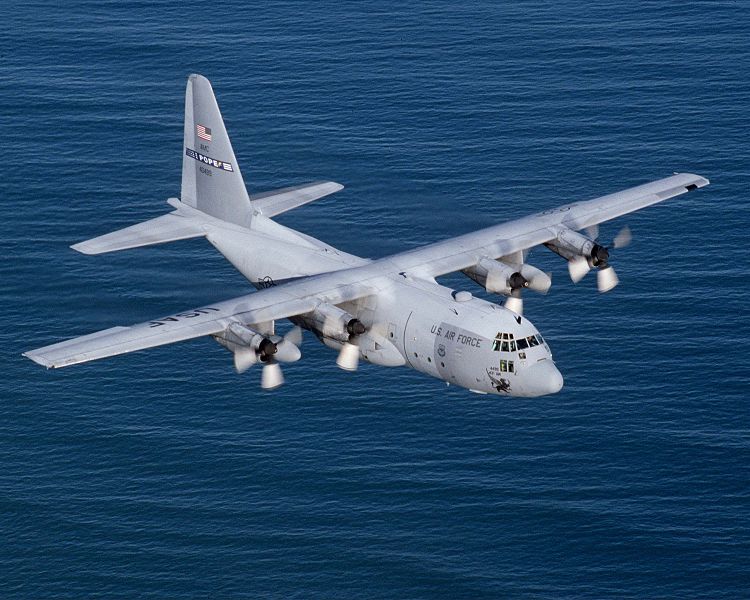

When I was a kid obsessed with military aircraft, I loved Chicago’s O’Hare airport. If I was lucky and scored a window seat, I might get to see a line of C-130 Hercules transport planes parked on the tarmac in front of the 928th Airlift Wing’s hangars. For a precious moment on takeoff or landing, I would have a chance to stare at those giant gray beasts with their snub noses and huge propellers until they passed from sight.
What I didn’t know then was why the Air Force Reserve, as well as the Air National Guard, had squadrons of these big planes eternally parked at O’Hare and many other airports and air stations around the country. It’s a tale made to order for this time of sequestration that makes a mockery of all the hyperbole about how any spending cuts will “hollow out” our forces and “devastate” our national security.
Consider this a parable to help us see past the alarmist talking points issued by defense contractor lobbyists, the public relations teams they hire, and the think tanks they fund. It may help us see just how effective defense contractors are in growing their businesses, whatever the mood of the moment.
Meet the Herk
The C-130 Hercules is a mid-sized transport airplane designed to airlift people or cargo around a theater of operations. It dates back to the Korean War, when the Air Force decided that it needed a next generation (“NextGen”) transport plane. In 1951, it asked for designs, and Lockheed won the competition. The first C-130s were delivered three years after the war ended.
The C-130 Hercules, or Herk for short, isn’t a sexy plane. It hasn’t inspired hit Hollywood films, though it has prompted a few photo books, a beer, and a “Robby the C-130” trilogy for children whose military parents are deployed. It has a fat sausage fuselage, that snub nose, overhead wings with two propellers each, and a big back gate that comes down to load and unload up to 21 tons of cargo.
The Herk can land on short runways, even ones made of dirt or grass; it can airdrop parachutists or cargo; it can carry four drones under its wings; it can refuel aircraft; it can fight forest fires; it can morph into a frightening gunship. It’s big and strong and can do at least 12 types of labor — hence, Hercules.
Too Much of a Good Thing
Here’s where the story starts to get interesting. After 25 years, the Pentagon decided that it was well stocked with C-130s, so President Jimmy Carter’s administration stopped asking Congress for more of them.
Lockheed was in trouble. A few years earlier, the Air Force had started looking into replacing the Hercules with a new medium-sized transport plane that could handle really short runways, and Lockheed wasn’t selected as one of the finalists. Facing bankruptcy due to cost overruns and cancellations of programs, the company squeezed Uncle Sam for a bailout of around $1 billion in loan guarantees and other relief (which was unusual back then, as William Hartung points out his magisterial Prophets of War: Lockheed Martin and the Making of the Military-Industrial Complex).
Then a scandal exploded when it was revealed that Lockheed had proceeded to spend some $22 million of those funds in bribes to foreign officials to persuade them to buy its aircraft. This helped prompt Congress to pass the Foreign Corrupt Practices Act.
So what did Lockheed do about the fate of the C-130? It bypassed the Pentagon and went straight to Congress. Using a procedure known as a congressional “add-on” — that is, an earmark — Lockheed was able to sell the military another fleet of C-130s that it didn’t want.
To be fair, the Air Force did request some C-130s. Thanks to Senator John McCain, the Government Accountability Office (GAO) did a study of how many more C-130s the Air Force requested between 1978 and 1998. The answer: Five.
How many did Congress add on? Two hundred and fifty-six.
As Hartung commented, this must “surely [be] a record in pork-barrel politics.”
Standard Operating Procedure
Lockheed made this happen by putting its lobbyists to work. They focused on legislators in key committee positions and in states where Lockheed, like others in the defense industry, had strategically located their operations and subcontracts. The company poured millions of dollars into lobbying and political donations.
Tracking lobbying is hard to do, but to give a sense of the scope of the numbers, Lockheed has reported$22,289,859 in political donations since 1990 and millions in lobbying expenses every year, peaking in 2008 at$16,181,506, according to the Center for Responsive Politics. And that doesn’t include what it paid its PR people or the work of defense and aerospace industry advocacy groups or the think tanks those industries fund. As an example of the latter, consider the boldly titled “research study,” C-130J: How the Best Military Aircraft Became Even Better, written by Lockheed consultantLoren Thompson and published by the Lexington Institute, which was founded by a Lockheed lobbyist. Of course, the puff piece mentions no affiliations with the company. For these reasons, Dina Rasor of the Project on Government Oversight, which ranks the company #1 on its Federal Contractor Misconduct Database, calls Lockheed “the ultimate pay-to-play contractor.”
Most of the dollars the company spends on lobbying are tax dollars. According to its 2011 annual report, “82% of our $46.5 billion in net sales were from the U.S. Government, including 61% from the Department of Defense.” And don’t forget that a significant part of the 17% of its sales that went to international customers in 2011 were actually paid for by Uncle Sam under the rubric of foreign military aid. Only 1% of its sales that year were to “U.S. commercial and other customers.” Its CEO made $20,538,981, while the company paid only $722 million in net federal and foreign taxes in that same year.
When it came to the C-130, the process worked like a dream. “By following this strategy from year to year,” writes a team of scholars of lobbying, “Lockheed has been able to turn what was to be the C-130’s doom in the 1970s into a regularly funded military spending program, all without a single request having been sent by the administration to Congress.” Lockheed was so successful on Capitol Hill that its work even garnered a name in honor of the 50 planes bought for every one requested: “C-130 math.”
John McCain complained that “we’re going to have a C-130 for every schoolyard in America before this is over.” The “add-on” legislators were unabashed. Senator Max Cleland of Georgia — where Lockheed assembles the C-130 — responded, “I’m for schoolyards being able to be moved anywhere in the world on a moment’s notice.”
I felt that way, too — when I was five.
How to Win Friends in the States and Influence People in Congress
So what happened to those extra planes? The Air Force didn’t have the space for them, so they retired some older models that still had plenty of life in them and shunted most of the rest off to the Air Force Reserves and Air National Guard. That’s why I used to see them at O’Hare.
The reason I usually saw them parked in front of the hangars is that sufficient operating and maintenance funds didn’t always come with the planes, which mattered even more after Lockheed introduced a new version, the C-130J Super Hercules, in the mid-1990s.
The Air Force’s approach of passing unwanted Herks off to the Air Guard and Reserves worked out nicely for Lockheed. The company allied with Air Guard and reservist advocacy groups to lobby Congress further. In an era of base closures, heavily lobbied governors would use the arrival of new planes to argue for the continuing life of bases in their states. In turn, states and their congressional delegations would fight to get new planes or hang onto existing ones. It was a veritable Lockheed feedback loop. Washington Post reporter Walter Pincus quoted a Pentagon official as seeing C-130 politics as a twist on the old military-industrial complex: “a triangle of the Guard, Lockheed, and politicians.”
The result: the military was often prevented from retiring the oldest Herks, the ones that really needed to be put out to pasture. For example, as Pincus reported, the Joint Chiefs and the Air Force concluded in 1996 that they had 50 more C-130s than they needed, but Congress stymied efforts to retire any of them. One tactic used was to hold nominees hostage: a Kentucky senator repeatedly held up Air Force promotions until four Kentucky Air Guard C-130s were taken off the chopping block.
And it hasn’t ended yet. In its FY2013 budget, the Pentagon planned to retire 65 older C-130s to save a little money. However, National Guard groups successfully mobilized state governors and congressional delegations from states like Alaska to, in the words of Alaska Senator Mark Begich “fight this action every step of the way.” Congress managed to save all of them for a year, and half of them permanently.
The Not-So-Super Hercules, or the Program That Just Won’t Die
Air Force attempts to replace the C-130 with a new generation of transport planes also have a habit of dying or getting rerouted. The Herk’s turf has generally proved remarkably sacrosanct. The “Advanced Medium STOL” (short takeoff and landing) program of the 1970s, for instance, fizzled, possibly due to Lockheed’s lobbying. The competing C-27J is being cancelled in favor of more C-130s. The C-130 Avionics Modernization Program (AMP), which in a surprise move was handed to competitor Boeing — as one of several gifts from a senior Pentagon procurement official shortly before she took a high-paying job there (en route to prison) — is being cancelled, too. (Though a new congressional C-130 Modernization Caucus spawned by Boeing and led by the congressman in whosedistrict the AMP’s training program is located, is doing its best to cancel the cancellation.)
Knowing that it could keep the C-130 alive through congressional add-ons and foreign sales well into the future, Lockheed took the unusual step of developing the next generation of the plane without new funding from the Pentagon. It invested $1 billion of its profits from government contracts in the new C-130J Super Hercules. This has kept the factory in Marietta, Georgia, humming, and with over 2,400 C-130s already built, Lockheed calls it “the longest continuously operating military aircraft production line in history.”
Humming, yes, but not always in tune. The C-130J has been plagued by problems. In 2004, after the military had acquired 50 of the planes, the Pentagon’s Inspector General found that, even while the Air Force and Congress kept ordering more of the planes, they didn’t meet contracted standards. The weather chasers couldn’t chase storms because propellers would crack in bad weather. The military wouldn’t use C-130Js for air drops in Iraq or Afghanistan because they didn’t think they were safe. “The design of the C-130J is not stable and the C-130J aircraft has not passed operational testing,” the Inspector General concluded. It “is not operationally effective or suitable.”
To fix these problems, the unit cost rapidly ran up to $81 million per plane. The problems proved so daunting that Secretary of Defense Donald Rumsfeld axed the C-130J program in 2005 — or tried to.
For the lobbyists and the plane’s fans in Congress, it was once more unto the breach. Lockheed also got help on the inside. The Air Force made up some numbers indicating that it would be far more expensive to cancel the program than to just keep buying — overstating the possible cancellation cost by at least $1.1 billion. In the end, Rumsfeld surrendered. In 2006, in a relatively rare step, the Pentagon forced Lockheed to take a hit on its profits and negotiate a new contract reducing the sticker price of the planes by several million dollars. But that didn’t last long. The unit cost soon bounced back; the basic C-130J now costs $93.6 million.
When it comes to military contracting like this, it doesn’t seem to matter which party occupies the White House or controls Congress. It doesn’t even seem to matter how many planes the Air Force puts on its additional “unfunded” wish list beyond the Pentagon’s official request, because Congress so often buys more. Sure, some years Congress doesn’t provide. In 2010, the Air Force asked for 12Herks in its main request and put two more on its unfunded wish list, yet Congress only gave it six. And sometimes money is pushed around from one year to another or from one bucket to another, making it challenging to track through the intentionally hard-to-understand (and not even auditable) Pentagon labyrinth.
At the present time, the military is asking both for more standard C-130Js (to replace old or heavily used Herks) and for new AC-130 gunships as well as Special Operations MC-130 variants on the plane in the questionable belief that these will be “invaluable” for fighting insurgents and terrorists. This means that theabolition of earmarks isn’t all that big a deal for Lockheed.
But that doesn’t stop it. Even with the threat of sequestration looming, and the Pentagon asking for seven new Herks in 2013, the House still inserted funding for14.
What will happen in this year’s request? We don’t know yet, because it’s late in coming thanks to sequestration. But Lockheed isn’t worried: even while threateningsequestration layoffs, the company forecasts record profits this year.
And why should it worry? As of last October, it had contracts to build 337 more Herks for the Pentagon and a variety of foreign countries. In November, it scored the program’s biggest foreign military sale ever, $6.7 billion to build 25 of the planes for the Royal Saudi Air Force. It has three NextGen models in the works, including a wider version (suitably named the XL) to carry oversized new Army equipment. And with the Air Force starting to think about replacing the C-130 (again), Lockheed has already secured a spot as one of the two companies developing prototypes for that future plane with its nifty “Speed Agile” design. Besides, judging by the Pentagon’s ongoing experiences with Lockheed’s F-22 and F-35 advanced fighters, whose costs have hit the stratosphere, any next generation “trash hauler” is bound to carry a strikingly higher initial sticker price than the C-130J — and that, of course, is before the inevitable cost upticks begin.
Out the Window
C-130s have a special place in my heart. The first military aircraft I got to ride in was a Coast Guard Herk. An Air Force C-130 got me out of Iraq. Now that the 928th Airlift Wing is no more, I get a little wistful when I fly through Chicago and all I see out the window are private cargo hangars.
Or at least I did before I wrote this story.
But not to worry. There are plenty of other airports around the country with excess C-130s just sitting out there on the tarmac, gathering dust.
