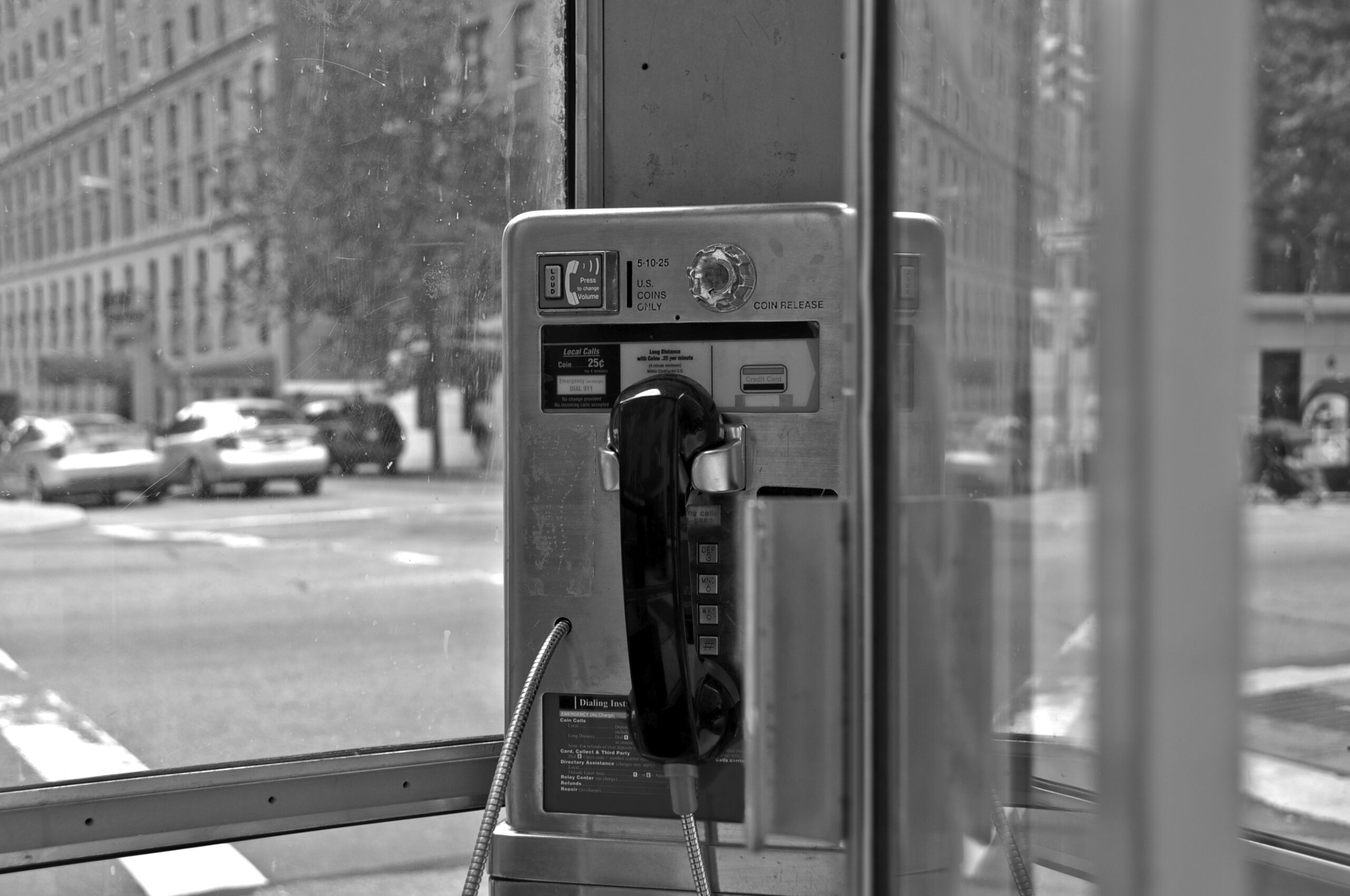

New York pay phones’ new calling

Sleek digital kiosks, complete with wifi and weather forecasts, will replace the city's outdated telephone booths

Topics: Hyperallergic, New York City, payphone, Design, WiFi, ,

New York pay phones' new calling (Credit: iStock/JayLazarin)
This article originally appeared on Hyperallergic.

Hyperallergic

The winners of a city-sponsored contest to redesign New York’s payphones have been announced, and it looks like the clunky yet iconic — and these days, often broken — booths of decades past will soon be replaced by slim, digital screens offering wifi, summaries of weather conditions, a chance to pay your parking tickets, and much more.

Smart Sidewalks (click to enlarge)

Smart Sidewalks

From more than 100 submissions, a panel of judges selected six winners in the categories of connectivity, creativity, visual design, functionality, and community impact (two-way tie). The designs vary in terms of their physical look and the specifics of what the kiosks can do, but the overall aesthetic is definitely sleek and minimal. Smart Sidewalks, for instance, the winner for Best Functionality, is a half-foot-wide strip “that folds up from the sidewalk,” according to the designers. It features a touchscreen above ground that would let users send emails, get subway directions, and more — “a location tethered smart-phone,” they say — and a below-the-sidewalk component that would include a sensor to read weather data and a system to collect and filter storm runoff.

Windchimes, one of the winners for Best Community Impact, picks up on this idea of weather sensors, ostensibly “providing real-time and hyper-local records of the city’s rain levels, pollution and other environmental conditions” through a spare, wooden, folded booth. The other community impact winner, The Responsive City, also echoes the form of the old-school phone booth with a curved exterior shell. That design offers to let you pay or dispute your parking tickets or call a cab right from where you stand.

Windchimes

Windchimes’s design for a phone booth


The winner of the Best Visual Design is Beacon, a slim, two-part tower that offers the city ad space on top and gives users access to community message boards, among other functions, on bottom. This one’s solely voice- and gesture-controlled, though, which seems like a disaster waiting to happen in New York City, even if the creators promise “directional microphones and noise canceling speakers …, and an array of sensors to track gestures.” One cool feature is that the screens would adapt for big city events, like becoming mileage markers for the NYC marathon, and would also offer helpful info in case of emergencies, such as directions to nearby shelters (the creations promise “uninterruptible power supply … on a regular and consistent basis, even during a blackout”).

Despite the Best Visual Design win, the Beacon, I think, leaves something to be aesthetically desired: the upper and lower halves of the tower are set in a perpendicular twist — a functional but, in my opinion, sort of dull and unimaginative look. Same with the winner for Best Connectivity, NYFi, which is just a tall, glowing rectangular slab. NYFi does two different heights, though, depending on whether the kiosk is in a residential or commercial district, and it promises to be “a hub for free wireless internet access” as well as a catch-all for buying MetroCards, paying for parking, and other amenities. My favorite design, hands down, is the Loop, winner of the Creativity Award, which features a scalable loop emerging from the ground that encases the user in a stylish mini-phone booth — a bit of privacy, plus a nod to its predecessor.

Loop

Loop

The city will award a special Popular Choice award to one of these six winners, so you can vote for the one you like best through tomorrow at 5 pm on the City of New York’s Facebook page. After that, the next step will be for the city to solicit a Request for Proposals from companies interested in working on and building the new payphones … all 11,000 of them.

Featured Slide Shows

7 motorist-friendly camping sites

close X
  • Share on Twitter
  • Share on Facebook
  • Thumbnails
  • Fullscreen
  • 1 of 9

Sponsored Post

  • White River National Forest via Lower Crystal Lake, Colorado
    For those OK with the mainstream, White River Forest welcomes more than 10 million visitors a year, making it the most-visited recreation forest in the nation. But don’t hate it for being beautiful; it’s got substance, too. The forest boasts 8 wilderness areas, 2,500 miles of trail, 1,900 miles of winding service system roads, and 12 ski resorts (should your snow shredders fit the trunk space). If ice isn’t your thing: take the tire-friendly Flat Tops Trail Scenic Byway — 82 miles connecting the towns of Meeker and Yampa, half of which is unpaved for you road rebels.
    fs.usda.gov/whiteriveryou


    Image credit: Getty

  • Chattahoochee-Oconee National Forest via Noontootla Creek, Georgia
    Boasting 10 wildernesses, 430 miles of trail and 1,367 miles of trout-filled stream, this Georgia forest is hailed as a camper’s paradise. Try driving the Ridge and Valley Scenic Byway, which saw Civil War battles fought. If the tall peaks make your engine tremble, opt for the relatively flat Oconee National Forest, which offers smaller hills and an easy trail to the ghost town of Scull Shoals. Scaredy-cats can opt for John’s Mountain Overlook, which leads to twin waterfalls for the sensitive sightseer in you.
    fs.usda.gov/conf


    Image credit: flickr/chattoconeenf

  • Nordhouse Dunes Wilderness Area via Green Road, Michigan
    The only national forest in Lower Michigan, the Huron-Mainstee spans nearly 1 million acres of public land. Outside the requisite lush habitat for fish and wildlife on display, the Nordhouse Dunes Wilderness Area is among the biggest hooks for visitors: offering beach camping with shores pounded by big, cerulean surf. Splash in some rum and you just might think you were in the Caribbean.
    fs.usda.gov/hmnf


    Image credit: umich.edu

  • Canaan Mountain via Backcountry Canaan Loop Road, West Virginia
    A favorite hailed by outdoorsman and author Johnny Molloy as some of the best high-country car camping sites anywhere in the country, you don’t have to go far to get away. Travel 20 miles west of Dolly Sods (among the busiest in the East) to find the Canaan Backcountry (for more quiet and peace). Those willing to leave the car for a bit and foot it would be remiss to neglect day-hiking the White Rim Rocks, Table Rock Overlook, or the rim at Blackwater River Gorge.
    fs.usda.gov/mnf


    Image credit: Getty

  • Mt. Rogers NRA via Hurricane Creek Road, North Carolina
    Most know it as the highest country they’ll see from North Carolina to New Hampshire. What they may not know? Car campers can get the same grand experience for less hassle. Drop the 50-pound backpacks and take the highway to the high country by stopping anywhere on the twisting (hence the name) Hurricane Road for access to a 15-mile loop that boasts the best of the grassy balds. It’s the road less travelled, and the high one, at that.
    fs.usda.gov/gwj


    Image credit: wikipedia.org

  • Long Key State Park via the Overseas Highway, Florida
    Hiking can get old; sometimes you’d rather paddle. For a weekend getaway of the coastal variety and quieter version of the Florida Keys that’s no less luxe, stick your head in the sand (and ocean, if snorkeling’s your thing) at any of Long Key’s 60 sites. Canoes and kayaks are aplenty, as are the hot showers and electric power source amenities. Think of it as the getaway from the typical getaway.
    floridastateparks.org/longkey/default.cfm


    Image credit: floridastateparks.org

  • Grand Canyon National Park via Crazy Jug Point, Arizona
    You didn’t think we’d neglect one of the world’s most famous national parks, did you? Nor would we dare lead you astray with one of the busiest parts of the park. With the Colorado River still within view of this cliff-edge site, Crazy Jug is a carside camper’s refuge from the troops of tourists. Find easy access to the Bill Hall Trail less than a mile from camp, and descend to get a peek at the volcanic Mt. Trumbull. (Fear not: It’s about as active as your typical lazy Sunday in front of the tube, if not more peaceful.)
    fs.usda.gov/kaibab


    Image credit: flickr/Irish Typepad

  • As the go-to (weekend) getaway car for fiscally conscious field trips with friends, the 2013 MINI Convertible is your campground racer of choice, allowing you and up to three of your co-pilots to take in all the beauty of nature high and low. And with a fuel efficiency that won’t leave you in the latter, you won’t have to worry about being left stranded (or awkwardly asking to go halfsies on gas expenses).


    Image credit: miniusa.com

  • Recent Slide Shows

  • Share on Twitter
  • Share on Facebook
  • Thumbnails
  • Fullscreen
  • 1 of 9

Comments

7 Comments

Comment Preview

Your name will appear as username ( settings | log out )

You may use these HTML tags and attributes: <a href=""> <b> <em> <strong> <i> <blockquote>