
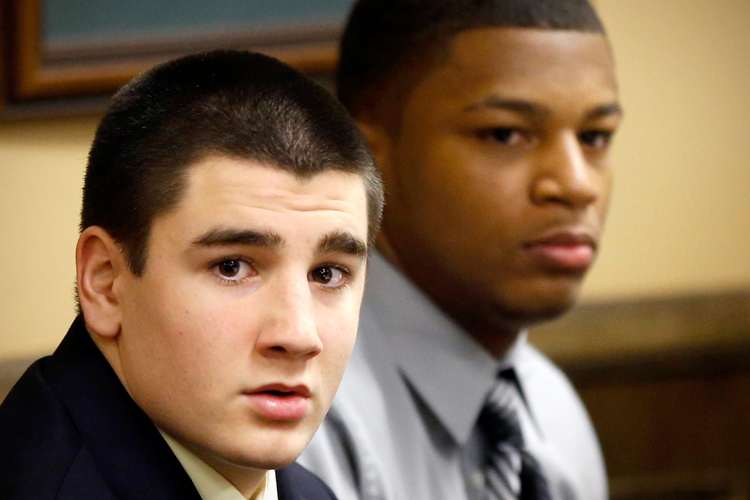

“I wouldn’t say she was completely passed out but she wasn’t in any state to make a decision for herself.” That’s what one of the witnesses in the Steubenville, Ohio, trial told police of the 16-year-old girl at the center of the case, according to ABC News. Perhaps that witness was one of the three football players who have not been charged but are expected to testify for the prosecution in the trial, which began Wednesday.
Since it still needs to be said, not being “in any state to make a decision for herself” meets the legal definition for rape across the U.S. So here’s a question for that guy: What did he do to try to stop it?
According to the prosecutor’s opening statement Wednesday, these witnesses saw one of the defendants, Trent Mays, try to force oral sex on the girl, but her mouth wouldn’t open. They saw the other defendant, Ma’Lik Richmond, digitally penetrate the girl while she was passed out on a couch. Though the girls’ friends apparently tried to prevent her from continuing on with the boys, so far there’s been no indication the witnesses intervened with the boys who no one has disputed were capable of decision-making. And preliminary research shows that the intervention of such bystanders could make the difference in preventing rape.
Last week, an inexcusable torrent of abuse was hurled at commentator Zerlina Maxwell after she appeared on Sean Hannity’s Fox News show and sensibly pointed out that arming women is not effective rape prevention tactics, for multiple reasons. (“If firearms are the answer, then the military would be the safest place for women,” she said.) It was her message of “tell men not to rape” that seemed to most inflame the trolls. Hannity found it self-evidently ridiculous: “You think you can tell a rapist to stop doing what he’s doing? He’s going to listen to an ad campaign to stop?” He also said, “Knowing there are evil people, I want women protected, and they’ve got to protect themselves.”
It was a clash of ideas of who commits crimes in the world. For Hannity and his ilk, rape is committed by “evil people,” an immutable fact that can’t be educated away, that isn’t about social norms. For feminists who are weary of victim-blaming — including blaming women for not just shooting their rapists in the moment — and who have for decades been pushing against the idea that rape is only committed by strangers lurking in the bushes, this is tantamount to giving up the fight. Or, as Jessica Valenti recently put it, you’re “saying that rape is natural for men. That this is just something men do. Well I’m sorry, but I think more highly of men than that.”
But the problem with saying “tell men not to rape” is that the majority of rapists probably won’t listen. That’s because the majority of them are repeat offenders who don’t care about consent. Research consistently shows that while any kind of man can be a rapist, not every man is one.
David Lisak, a leading forensic researcher who has done research on sex offenders in Boston and specializes in “undetected rapists,” has written that such men, whose behavior falls into what’s still commonly called “date rape,” are “accurately and appropriately labeled as predators. This picture conflicts sharply with the widely-held view that rapes committed on university campuses are typically the result of a basically ‘decent’ young man who, were it not for too much alcohol and too little communication, would never do such a thing. While some campus rapes do fit this more benign view, the evidence points to a far less benign reality,” of serial offenders. He continued, “Prevention efforts geared toward persuading men not to rape are very unlikely to be effective. Lessons can be drawn from many decades of experience in sex offender treatment, which have demonstrated that it is extremely difficult to change the behavior of a serial predator even when you incarcerate him and subject him to an intensive, multi-year program.” He has argued that bystander programs tailored to specific contexts — say, a military base — hold more promise in stopping those predators in their track, by encouraging others to recognize the signs.
In an interview with Salon, Lisak said, “I think it’s important to not get locked into the idea that somehow you can convince those serial, committed sex offenders, that if you’ll just deliver the right message they’ll stop and think ‘I really shouldn’t rape.'” As for strategies that focus on women’s behavior, such as telling them to watch their drinks, Lisak said, “There’s nothing wrong with risk reduction. But it doesn’t prevent sexual assault or change the overall rate; it shifts risk from one person to another.”
Lisak added, “All of this is not to say that there’s no value in a kind of blanket way of educating an entire community about consent and sexual violence. There are men who are not serial offenders who in certain kinds of situations and circumstances might commit a sexual assault and that’s also something we want to prevent.” And educating the entire community also trains them to be bystanders who might intervene with those serial offenders.
Victoria Banyard, a professor in the Department of Psychology at the University of New Hampshire who has been doing research on interpersonal violence prevention, including a bystander program, says the aim of such programs is to “try to find ways to get people to be more aware so that they have the skill set and the support to find safe ways to do something about it. It’s a component of prevention that gives everyone a role to play.”
It also provides some guidelines in situations that meet the legal definition of rape but are considered less clear-cut. Take the disturbing scene near the end of this week’s “Girls.” There is a model sexual negotiation early in the episode, in which the character of Natalia’s clear elucidation of her limits leads to her partner saying, “I like how clear you are with me.” Natalia says, “What other way is there?” If you haven’t seen the episode, the “other way” has been painstakingly described by Amanda Hess in Slate.
The confusion evident in discussions about that scene is instructive: “There is no question left in the viewer’s mind that Natalia didn’t want to have sex like that. She says ‘no’ multiple times and at the end she says, ‘That was not OK’ and ‘I really didn’t like that,'” wrote Samhita Mukhopadhyay at Feministing. And yet, she continued, “there is a good chance that the majority of the viewing public will see this scene and be horrified but without the vocabulary to express or understand what happened.” If repeatedly and clearly saying no to specific proceedings, as well as evident reluctance to participate in them at all, is considered merely “bad sex,” the conversation about consent — which in the vast majority of cases will never even reach a court of law — has a long way to go. That conversation includes an awareness that consenting to some sexual activity does not mean one has withdrawn the right to consent to any of it. As Hess put it, “When you care even one bit about how your partner feels while you are actually having sex with them, it’s impossible to be so confused.” Adam may not care — he seems to deliberately want to violate Natalia to externalize the anger and self-loathing that has also led him to fall off the wagon — but viewers in and around those “ambiguous” situations might.
We don’t know enough about the Steubenville alleged offenders to say whether they fit the serial predator model or not. But it’s possible the boys around them, who were teenagers, had no idea that if the girl was repeatedly vomiting and unable to walk or generally communicate, what they were seeing met the legal definition of rape and they should have done everything they could to stop it. That it didn’t matter that, as Richmond put it to “20/20,” “She had her arm wrapped around me and one hand on my chest. It just felt like she was coming on to me,” if she was unable to consent.
Education about rape and consent also functions to change what Banyard calls “the real experiences of victims who are unsupported by the community. Those are the people who are in the position to say to victims, ‘I believe you.'” In order for offenders, including serial offenders, to be apprehended, those victims have to be believed — and to believe anyone will care what happened to them.
