
United Nations’ pot hypocrisy

Science says marijuana is safer than alcohol. So why is the U.N. trying to stop legalization laws?

Topics: United Nations, marijuana, Marijuana Legalization, Alcohol, Colorado, ,

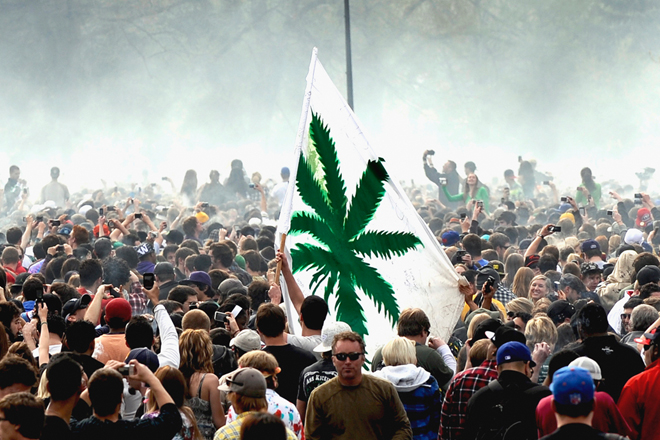
United Nations' pot hypocrisyA crowd of people all exhale marijuana simultaneously at the University of Colorado in Boulder on April 20, 2010. (Credit: Reuters/Mark Leffingwell)

The notion of alcohol consumers piously demanding that others stop using pot probably makes you think of the beer-swilling World War II generation berating weed-smoking hippies during the 1960s. Now, thanks to the United Nations, that caricature gets an update, and the hypocrisy is at once amusing and depressing.

You may have read the headline-grabbing news that in advance of its conference on drug policy this week, the U.N. issued a report urging the United States government to block Colorado and Washington state from moving forward with voter-approved laws that allow adult citizens to use marijuana as a less harmful alternative to alcohol. What you may not have heard is that on the very same day the U.N. released that report, U.S. ambassador Joseph Torsella slammed his U.N. colleagues for drinking too much on the job. Apparently, binging at the U.N. is so commonplace and excessive that it is hindering the organization from conducting its most basic work.

As hypocrisy humor goes, this is pretty funny. An international body immersed in one drug (alcohol) yet telling governments to outlaw an objectively less harmful drug (marijuana) is biting comedy. It hilariously exemplifies the double standards and contradictions that still define many global leaders’ views of drugs.

Yet before you laugh too hard, remember that it is actually a tragedy for members of the U.N. to be simultaneously drinking too much alcohol and too much anti-pot Kool-Aid. It is a tragedy because the blatant hypocrisy saps the organization’s credibility on the drug issue at a time when the world needs it to be supporting the international political momentum generated by Colorado and Washington state.

That reform momentum is now building as lawmakers in Mexico, Uruguay and Chile are citing the states’ votes as reason for their nations to consider legislation to legalize marijuana. Likewise, according to the Associated Press, presidents of Mexico, Belize, Honduras and Costa Rica called “for the Organization of American States to study the impact of the Colorado and Washington votes and said the United Nations’ General Assembly should hold a special session” to debate the continued prohibition of marijuana.

Their rationale is simple: Having seen their nations torn apart by the militarized fight against the drug cartels that rely on prohibition and its attendant black market, Latin American leaders see the Colorado and Washington victories as a way to finally start deescalating the blood-soaked war on marijuana.


“Everyone is asking, ‘What sense does it make to keep up such an intense confrontation, which has cost Mexico so much, by trying to keep this substance from going to a country where it’s already regulated and permitted?’” one Mexican lawmaker told Time magazine in describing a bill he is pushing that is modeled off the Washington state measure.

The flip side, of course, is that legalization could deal a serious blow to the cartels. That’s because, according to Mexico’s Institute for Competitiveness, up to a third of the cartels’ revenues come from the black-market marijuana trade — a trade that would be curtailed if cannabis was legalized and brought into the regulated economy. Meanwhile, if more American states follow Colorado and Washington, the cartels could “lose 24 percent of their gross export revenues,” says Alejandro Hope, a former top intelligence official in Mexico.

Put it all together — thousands dead in a failed drug war, a massive black market for marijuana, and science that says pot is safer than alcohol — and the U.N. should be using its pivotal position to help the world move away from destructive prohibitionist policies and toward legalization and strict regulation.

In order for it to play such a constructive role, though, the U.N. clearly needs to sober up — both literally and politically.

David Sirota

David Sirota is a nationally syndicated newspaper columnist, magazine journalist and the best-selling author of the books "Hostile Takeover," "The Uprising" and "Back to Our Future." E-mail him at ds@davidsirota.com, follow him on Twitter @davidsirota or visit his website at www.davidsirota.com.

Featured Slide Shows

7 motorist-friendly camping sites

close X
  • Share on Twitter
  • Share on Facebook
  • Thumbnails
  • Fullscreen
  • 1 of 9

Sponsored Post

  • White River National Forest via Lower Crystal Lake, Colorado
    For those OK with the mainstream, White River Forest welcomes more than 10 million visitors a year, making it the most-visited recreation forest in the nation. But don’t hate it for being beautiful; it’s got substance, too. The forest boasts 8 wilderness areas, 2,500 miles of trail, 1,900 miles of winding service system roads, and 12 ski resorts (should your snow shredders fit the trunk space). If ice isn’t your thing: take the tire-friendly Flat Tops Trail Scenic Byway — 82 miles connecting the towns of Meeker and Yampa, half of which is unpaved for you road rebels.
    fs.usda.gov/whiteriveryou


    Image credit: Getty

  • Chattahoochee-Oconee National Forest via Noontootla Creek, Georgia
    Boasting 10 wildernesses, 430 miles of trail and 1,367 miles of trout-filled stream, this Georgia forest is hailed as a camper’s paradise. Try driving the Ridge and Valley Scenic Byway, which saw Civil War battles fought. If the tall peaks make your engine tremble, opt for the relatively flat Oconee National Forest, which offers smaller hills and an easy trail to the ghost town of Scull Shoals. Scaredy-cats can opt for John’s Mountain Overlook, which leads to twin waterfalls for the sensitive sightseer in you.
    fs.usda.gov/conf


    Image credit: flickr/chattoconeenf

  • Nordhouse Dunes Wilderness Area via Green Road, Michigan
    The only national forest in Lower Michigan, the Huron-Mainstee spans nearly 1 million acres of public land. Outside the requisite lush habitat for fish and wildlife on display, the Nordhouse Dunes Wilderness Area is among the biggest hooks for visitors: offering beach camping with shores pounded by big, cerulean surf. Splash in some rum and you just might think you were in the Caribbean.
    fs.usda.gov/hmnf


    Image credit: umich.edu

  • Canaan Mountain via Backcountry Canaan Loop Road, West Virginia
    A favorite hailed by outdoorsman and author Johnny Molloy as some of the best high-country car camping sites anywhere in the country, you don’t have to go far to get away. Travel 20 miles west of Dolly Sods (among the busiest in the East) to find the Canaan Backcountry (for more quiet and peace). Those willing to leave the car for a bit and foot it would be remiss to neglect day-hiking the White Rim Rocks, Table Rock Overlook, or the rim at Blackwater River Gorge.
    fs.usda.gov/mnf


    Image credit: Getty

  • Mt. Rogers NRA via Hurricane Creek Road, North Carolina
    Most know it as the highest country they’ll see from North Carolina to New Hampshire. What they may not know? Car campers can get the same grand experience for less hassle. Drop the 50-pound backpacks and take the highway to the high country by stopping anywhere on the twisting (hence the name) Hurricane Road for access to a 15-mile loop that boasts the best of the grassy balds. It’s the road less travelled, and the high one, at that.
    fs.usda.gov/gwj


    Image credit: wikipedia.org

  • Long Key State Park via the Overseas Highway, Florida
    Hiking can get old; sometimes you’d rather paddle. For a weekend getaway of the coastal variety and quieter version of the Florida Keys that’s no less luxe, stick your head in the sand (and ocean, if snorkeling’s your thing) at any of Long Key’s 60 sites. Canoes and kayaks are aplenty, as are the hot showers and electric power source amenities. Think of it as the getaway from the typical getaway.
    floridastateparks.org/longkey/default.cfm


    Image credit: floridastateparks.org

  • Grand Canyon National Park via Crazy Jug Point, Arizona
    You didn’t think we’d neglect one of the world’s most famous national parks, did you? Nor would we dare lead you astray with one of the busiest parts of the park. With the Colorado River still within view of this cliff-edge site, Crazy Jug is a carside camper’s refuge from the troops of tourists. Find easy access to the Bill Hall Trail less than a mile from camp, and descend to get a peek at the volcanic Mt. Trumbull. (Fear not: It’s about as active as your typical lazy Sunday in front of the tube, if not more peaceful.)
    fs.usda.gov/kaibab


    Image credit: flickr/Irish Typepad

  • As the go-to (weekend) getaway car for fiscally conscious field trips with friends, the 2013 MINI Convertible is your campground racer of choice, allowing you and up to three of your co-pilots to take in all the beauty of nature high and low. And with a fuel efficiency that won’t leave you in the latter, you won’t have to worry about being left stranded (or awkwardly asking to go halfsies on gas expenses).


    Image credit: miniusa.com

  • Recent Slide Shows

  • Share on Twitter
  • Share on Facebook
  • Thumbnails
  • Fullscreen
  • 1 of 9

Comments

23 Comments

Comment Preview

Your name will appear as username ( settings | log out )

You may use these HTML tags and attributes: <a href=""> <b> <em> <strong> <i> <blockquote>