
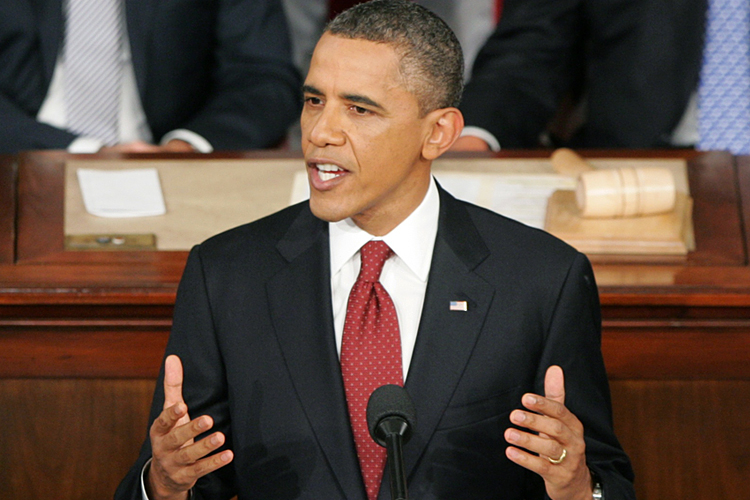

You will recall that in his last State of the Union address, President Obama announced a policy idea that makes a whole lot of sense for our times: universal preschool. It’s easy to describe why this is a good idea, and I’ll do so in a moment, but in recent debates, I’ve noticed some opposition talking points creeping in that—surprise—don’t have much at all to do with what the White House appears to be proposing. So let’s clarify a few things and raise a very big question that will shortly be answered (how to pay for it).
Why do this? Easy: because so much research shows how important it is, especially for kids from less-advantaged households, to get the cognitive boost that quality early-learning programs provide. For a readable review of a broad literature in support of that claim, see here. But I can assure you that experts from left, right and middle agree on this.
The president noted the oft-cited statistic that “every dollar we invest in high-quality early childhood education can save more than seven dollars later on” and the link above shows that might actually be low-balling the net benefits a bit. The $7/$1 estimate comes from a highly regarded study that “… assumed there is no value to preventing what they call “victimless” crimes–selling drugs to children or heroin use.” It also left out benefits like reductions in abortions.
I’ve argued the case for quality preschool for all on equity grounds. The revealed preferences of higher income parents show they know how important this is. But forget that–put on the green eye-shade and explain to me why it’s better for society to leave positive net benefits of this magnitude on the table.
Why make it universal? I was recently on a panel with a conservative scholar who very much supports pre-K for kids from families with less means but objects to a new, big, fat universal program run by the government. He’s got a point but in fact, what the White House seems to be proposing is targeted at precisely those families of modest means—below 200 percent of poverty (about $45,000 for married couple with two kids).
Here’s the White House fact sheet, but Jon Cohn thinks the proposal will ultimately look like one from CAP:
That proposal actually has several components, including financial assistance to help parents pay for infant and toddler care as well as additional investment in the Early Head Start program. But the biggest component is a proposal to partner with states, matching their investments dollar-for-dollar, with a goal of subsidizing preschool based on income. For children in families with household income below twice the poverty line, or about $46,000 for a family of four, preschool would be free, just like public education.
What have the critics got wrong? So, first of all, the proposal won’t be universal in the sense that it’s free to everyone. In fact, that would engender significant waste, since it would be subsidizing investments that higher income parents have shown that they will make without the new program.
Second, the president is not simply proposing to extend Head Start. An evolving talking point against the idea is “Head Start’s a failure—why would we want to pour a bunch more money into it?”
As the first link above shows, that’s not a correct assessment of Head Start. Some Head Start evaluations have found its benefits to fade after a few years, but some of those studies are flawed and objective critics will tell you that Head Start’s outcomes are far more varied than “it doesn’t work.”
But the more germane important point is that putting a bunch more kids in Head Start is not what’s being proposed here. The main proposal is a partnership with states to ensure that all 4-year-old kids from moderate and low-income families have access to quality preschool, with “quality” defined quite carefully (see fact sheet).
How’s he going to pay for it? Ugh. So here’s the ugly part. The president has been clear that the program, which could run about $10 billion per year, would not add to the deficit. He’s also signed on to pretty deep cuts in the discretionary part of the budget that funds Head Start and similar programs (e.g., Pell Grants). And of course, his cuts are a fraction of Ryan’s.
So there will have to be a “payfor,” some revenue source that’s either a new tax or a cut elsewhere. This will all be made clear in the president’s budget, which is expected to be out in early April, but need I say that any payfor will be very tough to get through this Congress.
Still, those of us who’ve been waiting for this idea to get high-level backing like this knew it wouldn’t be easy. We’re in it for the long haul, and I hope you are too. In an economy where so much inequality is sapping so much opportunity from so many kids, it’s hard to think of a better cause.
