
SCOTUS: No sniffs without a warrant

The Court ruled police need a warrant to investigate private property and its surroundings with sniffer dogs

Topics: police dogs, SCOTUS, Privacy, Warrant, Drugs, sniffer dogs,

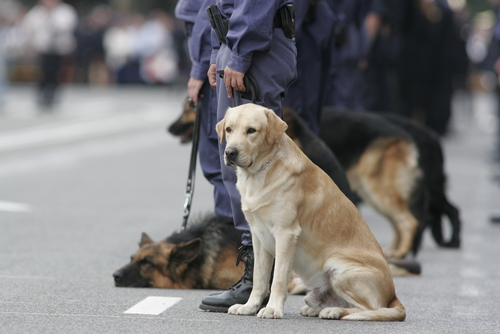
SCOTUS: No sniffs without a warrant (Credit: Shutterstock/ Ruben Paz)

The Supreme Court ruled Tuesday that police could only use sniffer dogs to investigate a property and its surroundings if they first obtained a warrant. “A police officer not armed with a warrant may approach a home and knock, precisely because that is no more than any private citizen might do,” Justice Antonin Scalia wrote for the 5-4 majority decision.

The decision upheld a 2011 ruling by the Florida Supreme Court suppressing evidence uncovered at Joelis Jardines’ home with the help of Franky, a chocolate Labrador retriever with a strong record of sniffing out drug stashes. The Economist explained the justices’ reasoning, the decision and its relevance to privacy laws more broadly:

“The home”, Justice Scalia wrote in the Court’s opinion, “is first among equals”, and for fourth-amendment purposes the curtilage is part of the home. The police need not divert their gaze from private homes as they walk down the street, and they can even knock on the front door and ask questions, just as anyone else might do. But they cannot bring drug-sniffing dogs onto the porch without invitation or a warrant. This distinction, Justice Scalia notes, “does not require fine-grained legal knowledge; it is generally managed without incident by the Nation’s Girl Scouts and trick-or-treaters.” Justice Kagan wrote a similarly plain-spoken concurrence. The police bringing a drug-sniffing dog onto the porch uninvited and unwarranted is as much a trespass as a stranger walking up to your front door, not knocking or saying hello, and peering through your window with high-powered binoculars. Justices Alito, Roberts, Kennedy and Breyer dissented, arguing that the majority’s definition of trespass is unsupported in precedent, and that “odors emanating from a house may be detected from locations that are open to the public”. That the member of the public detecting those odors happened to be a dog rather than a human was neither here nor there.

Civil-libertarians will rightly celebrate this decision, but it deserves only two cheers. It pertains strictly to physical property, and to domestic physical property (ie, the home), which as Justice Scalia noted already enjoys strong fourth-amendment protection. The third cheer will come when the Court extends similarly robust protection to data and metadata. That, alas, still seems a long way off.


Natasha Lennard is an assistant news editor at Salon, covering non-electoral politics, general news and rabble-rousing. Follow her on Twitter @natashalennard, email nlennard@salon.com.

Next Article

Related Stories

Featured Slide Shows

The week in 10 pics

close X
  • Share on Twitter
  • Share on Facebook
  • Thumbnails
  • Fullscreen
  • 1 of 11
  • This photo. President Barack Obama has a laugh during the unveiling of the George W. Bush Presidential Center in Dallas, Tx., Thursday. Former first lady Barbara Bush, who candidly admitted this week we've had enough Bushes in the White House, is unamused.
    Reuters/Jason Reed

  • Rescue workers converge Wednesday in Savar, Bangladesh, where the collapse of a garment building killed more than 300. Factory owners had ignored police orders to vacate the work site the day before.
    AP/A.M. Ahad

  • Police gather Wednesday at the Massachusetts Institute of Technology to honor campus officer Sean Collier, who was allegedly killed in a shootout with the Boston Marathon bombing suspects last week.
    AP/Elise Amendola

  • Police tape closes the site of a car bomb that targeted the French embassy in Libya Tuesday. The explosion wounded two French guards and caused extensive damage to Tripoli's upscale al-Andalus neighborhood.
    AP/Abdul Majeed Forjani

  • Protestors rage outside the residence of Indian Prime Minister Manmohan Singh Sunday following the rape of a 5-year-old girl in New Delhi. The girl was allegedly kidnapped and tortured before being abandoned in a locked room for two days.
    AP/Manish Swarup

  • Clarksville, Mo., residents sit in a life boat Monday after a Mississippi River flooding, the 13th worst on record.
    AP/Jeff Roberson

  • Workers pause Wednesday for a memorial service at the site of the West, Tx., fertilizer plant explosion, which killed 14 people and left a crater more than 90 feet wide.
    AP/The San Antonio Express-News, Tom Reel

  • Aerial footage of the devastation following a 7.0 magnitude earthquake in China's Sichuan province last Saturday. At least 180 people were killed and as many as 11,000 injured in the quake.
    AP/Liu Yinghua

  • On Wednesday, Hazmat-suited federal authorities search a martial arts studio in Tupelo, Miss., once operated by Everett Dutschke, the newest lead in the increasingly twisty ricin case. Last week, President Barack Obama, Sen. Roger Wicker, R.-Miss., and a Mississippi judge were each sent letters laced with the deadly poison.
    AP/Rogelio V. Solis

  • The lighting of Freedom Hall at the George W. Bush Presidential Center Thursday is celebrated with (what else but) red, white and blue fireworks.
    AP/David J. Phillip

  • Recent Slide Shows

  • Share on Twitter
  • Share on Facebook
  • Thumbnails
  • Fullscreen
  • 1 of 11

Comments

4 Comments

Comment Preview

Your name will appear as username - log out

You may use these HTML tags and attributes: <a href=""> <b> <em> <strong> <i> <blockquote>