
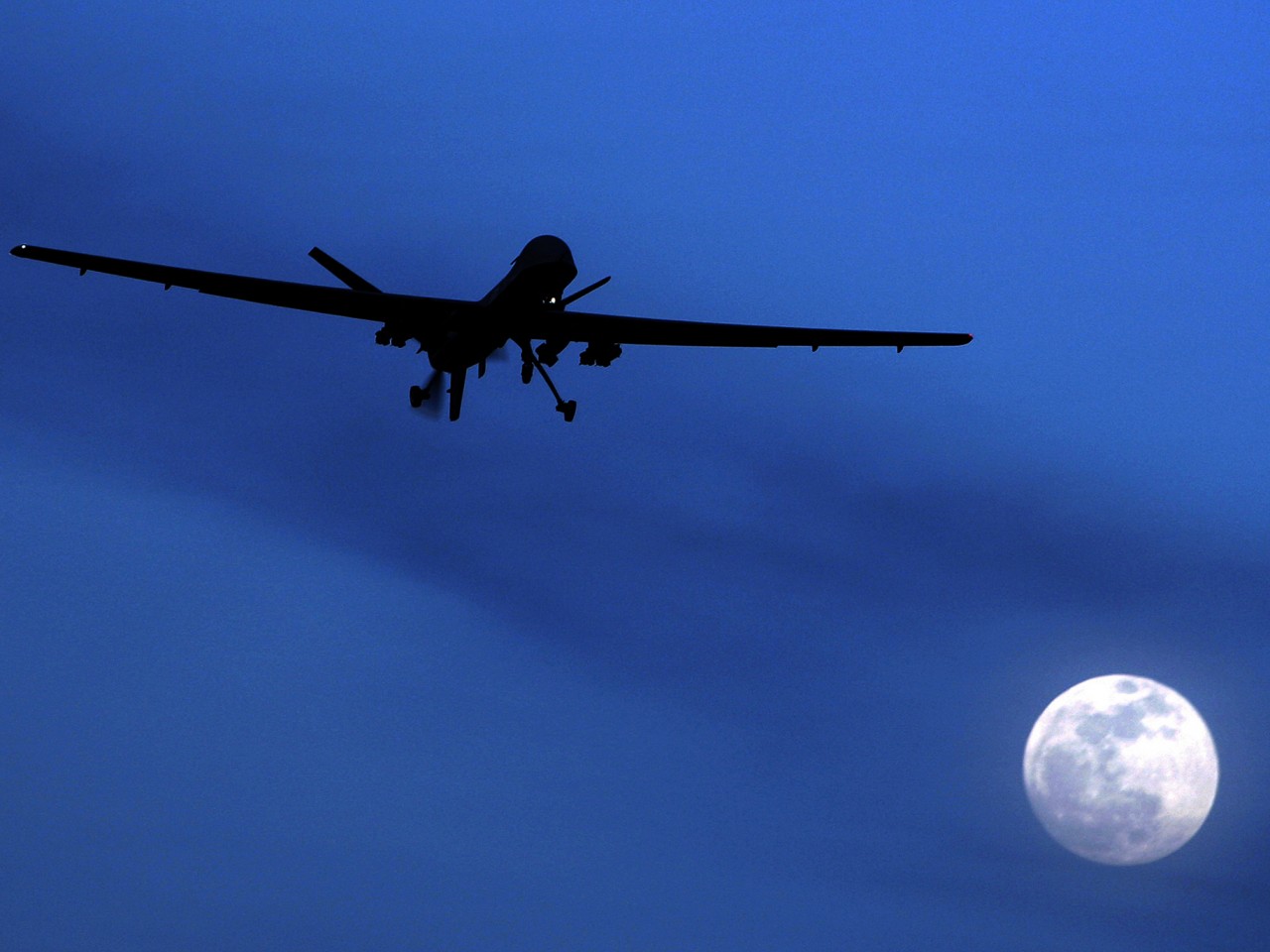

KHALIS FAMILY VILLAGE, Afghanistan — Barely able to walk even with a cane, Ghulam Rasool says he padlocked his front door, handed over the keys and his three cows to a neighbor and fled his mountain home in the middle of the night to escape relentless airstrikes from U.S. drones targeting militants in this remote corner of Afghanistan.
Rasool and other Afghan villagers have their own name for Predator drones. They call them benghai, which in the Pashto language means the “buzzing of flies.” When they explain the noise, they scrunch their faces and try to make a sound that resembles an army of flies.
“They are evil things that fly so high you don’t see them but all the time you hear them,” said Rasool, whose body is stooped and shrunken with age and his voice barely louder than a whisper. “Night and day we hear this sound and then the bombardment starts.”
The U.S. military is increasingly relying on drone strikes inside Afghanistan, where the number of weapons fired from unmanned aerial aircraft soared from 294 in 2011 to 506 last year. With international combat forces set to withdraw by the end of next year, such attacks are now used more for targeted killings and less for supporting ground troops.
It’s unclear whether Predator drone strikes will continue after 2014 in Afghanistan, where the government has complained bitterly about civilian casualties. The strikes sometimes accidentally kill civilians while forcing others to abandon their hometowns in fear, feeding widespread anti-American sentiment.
The Associated Press – in a rare on-the-ground look unaccompanied by military or security – visited two Afghan villages in Nangarhar province near the border with Pakistan to talk to residents who reported that they had been affected by drone strikes.
In one village, Afghans disputed NATO’s contention that five men killed in a particular drone strike were militants. In the other, a school that was leveled in a nighttime airstrike targeting Taliban fighters hiding inside has yet to be rebuilt.
“These foreigners started the problem,” Rasool said of international troops. “They have their own country. They should leave.”
From the U.S. perspective, the overall drone program has been a success.
While the Pentagon operates the drones in Afghanistan, the CIA for nearly a decade has used drones to target militants, including Afghans, in Pakistan’s border regions. CIA drones have killed al-Qaida No. 2 Abu Yahya al-Libi and other leading extremists.
Still, criticism of the use of drones for targeted killings around the world has been mounting in recent months. The U.N. Special Rapporteur on Counter Terrorism and Human Rights has launched an investigation into their effect on civilians.
Rasool said his decision to leave his home in Hisarak district came nearly a month ago after a particularly blistering air assault killed five people in the neighboring village of Meya Saheeb.
The U.S.-led International Security Assistance Force, or ISAF, confirmed an airstrike on Feb. 24 at Meya Saheeb, but as a matter of policy would neither confirm nor deny that drones were used.
Rasool said that he, his son, half a dozen grandchildren, and two other families crammed into the back of a cart pulled by a tractor. They drove throughout the day until they found a house in Khalis Family Village, named after anti-communist rebel leader Maulvi Yunus Khalis, who had close ties to al-Qaida.
The village is not far from the Tora Bora mountain range where in 2001 the U.S.-led coalition mounted its largest operation of the war to flush out al-Qaida and Taliban warriors.
“Nobody ever comes here. It’s a little dangerous sometimes because of the Taliban,” said Zarullah Khan, a neighbor of Rasool’s.
But the historic significance of his newfound refuge was lost on Rasool.
“Who’s Khalis? We stopped when we found a house for rent,” he said, grumbling at the monthly $200 bill shared among the three families packed into the high-walled compound where he spoke with the AP.
Standing nearby, Rasool’s 12-year-old grandson, Ahmed Shah, recalled the attack in Meya Saheeb. The earth shook for what seemed like hours and the next morning his friends told him there were bodies in the nearby village. A little afraid, but more curious, he walked the short distance to Meya Saheed.
“I wanted to see the dead bodies,” he said. And he did – three bodies, all middle-aged men.
ISAF reported five militants were killed, but Rasool claimed they were businessmen. One of the dead had a carpet shop in the village, he said.
Disputes over the identities of those killed have been a hallmark of the 12-year war.
In Pakistan, an AP investigation last year found that drone strikes were killing fewer civilians than many in that country were led to believe, and that many of the dead were combatants.
In Afghanistan, the U.N. has reported that five drone strikes in 2012 resulted in civilian casualties, with 16 civilians killed and three wounded. It reported just one incident in which civilians were killed the previous year.
At the other end of the province from Meya Saheeb and Khalis Family Village lies the village of Budyali. To get there, one must drive along a long, two-lane highway often booby-trapped by militants, before turning turning off onto a narrow, dusty track and finally cross a rock-strewn riverbed.
A Budyali resident, Hayat Gul, says the sound of “benghai” is commonplace in the village. He says he was wounded nearly two years ago in a Taliban firefight with Afghan security forces at a nearby school that led to an airstrike.
Tucked in the shadow of a hulking mountain crisscrossed with dozens of footpaths, the school now is in ruins.
The early morning strike on the school took place on July 17, 2011, hours after the Taliban attacked the district headquarters and the Afghan National Army appealed to their coalition partners for help.
Gul said he and a second guard, 63-year-old Ghulam Ahad, were asleep in the small cement guard house at one end of the school. They awoke to the sound of gunfire as more than a dozen Taliban militants scaled the school walls around midnight, chased by Afghan soldiers.
A bullet struck Gul in the shoulder. Frightened and unsure of what to do, Ahad stepped outside the guard house and was killed. Bullet holes still riddle the badly damaged building.
Village elders and the school’s principal, Sayed Habib, said coalition forces responded to the army’s request for help with drones, fighter jets and rockets.
The air assault, which residents say began about 3 a.m. and likely included drone strikes, flattened everything across a vast compound that includes the school. Habib said 13 insurgents were killed.
ISAF confirmed that airstrikes killed insurgents in the Budyali area on that day but would not say what type of airstrikes or provide any other details.
Habib and a local malik or elder, Shah Mohammed Khan, said that in the days leading up to the airstrikes the sound of drones could be heard overhead.
“Everyone knows the sound of the unpiloted planes. Even our children know,” Habib said.
The elders were critical of the U.S. attack. They said they would have preferred that the Afghan soldiers try to negotiate with the Taliban to leave the school and surrender.
Habib and the village elders recalled the attack while sitting in the middle of the devastated school, where debris was still scattered across a vast yard. They pointed toward a blackboard, pockmarked with gaping holes.
“Shamefully they destroyed our school, our books, our library,” said Malik Gul Nawaz, an elder with a gray beard and a pot belly.
Habib said that in an attempt to rebuild the school, a contractor constructed a boundary wall before another Taliban attack. He fled with nearly $400,000 in foreign funds.
The roughly 1,300 students now take classes at a makeshift school made up of tents provided by UNICEF. Gul, who was taken to a U.S. military hospital at Bagram Air Base after the attack and treated for the bullet wound to his left shoulder, is now a watchman at the new school.
He held a small photograph of his dead colleague, Ahad, in his trembling left hand.
“We want to end this war,” Gul said. “Enough people have been killed now. We have to find unity.”
