
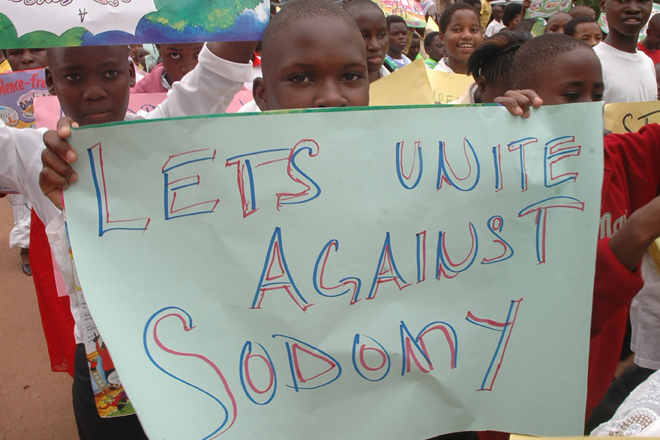

 While conservative evangelical and Catholic leaders complain loudly about the “persecution” they suffer in the United States, the culture wars they are igniting and supporting around the world subject LGBT people and their allies to very real persecution.
The role that American religious right leaders have played in fomenting anti-gay bigotry in Uganda has been well-documented, but never before with the emotional punch delivered by God Loves Uganda, a new documentary by Academy Award-winning director Roger Ross Williams that premiered at this year’s Sundance Film Festival.
“I love Uganda,” says Kapya Koama in the film’s opening words. But, “something frightening is happening that has the potential to destroy Uganda.”
Filmmaker Williams was given remarkable access to leaders and missionaries affiliated with the International House of Prayer (IHOP) movement based in Kansas City, and he makes the most of it. Dominionist Lou Engle describes Africa as a “firepot of spiritual renewal and revival,” and be believes Uganda has a special prophetic destiny. Engle has tried to distance himself somewhat from the infamous “kill the gays” bill that is pending in Uganda’s legislature, but here he is on film, at his TheCall rally in Uganda, standing with speakers calling for passage of the bill.
Engle tells the crowd he was “called” to encourage the Ugandan church for taking a stand for righteousness in the face of pressure from the United Nations and non-governmental aid organizations. Uganda, he says, is “ground zero.” The film also includes footage of Engle’s pro-Prop. 8 rally in California at which he warned that allowing same-sex couples to get married would unleash “sexual insanity” and a spirit “more demonic than Islam.”
Williams does not delve deeply into IHOP’s dominionist worldview, but IHOP officials tell him about the ambitious goals they have for their 1,000-person staff: a vision of one million new Christian soldiers who will win one billion souls—and raising one trillion dollars to make it happen. They tell young followers, “You’re going to take over the world by the power of the Holy Spirit.”
It’s clear that much of the power American culture warriors have in Uganda comes from the money their ministries pour into the country along with their missionaries. At the massive Miracle Center Cathedral, the biggest megachurch in Uganda, the high-living pastor is quite frank that “American money helped us build this church,” adding, “whatever you see here is the fruit of American labor.” In another clip, a pastor marvels that aid from U.S. evangelicals increased threefold when they started attacking homosexuality. Churches’ financial success brings added clout to anti-gay pastors like Martin Ssempa—who drives his congregation into a frenzy by showing explicit and extreme gay pornography—and the politicians allied with them, like David Bahati, the sponsor of the kill-the-gays bill.
Also appearing in the film is American anti-gay activist Scott Lively, who blames homosexuals for the Nazi movement and Holocaust. In the U.S., Lively is a marginalized and discredited figure, but in Uganda, he has not only had the platform of Martin Ssempa’s TV show, he was invited to speak before the Parliament. Lively has been working for years to convince people in Uganda and other countries that gay people are out to recruit their children and destroy their societies. Lively prays that Uganda will be the first country to stop them. Many politicians and preachers have taken up that challenge. At one rally a speaker asks for a show of hands—who’s willing to go kill gay people?
One loving religious voice in the film belongs to Bishop Christopher Senyonjo, whose public support for LGBT people cost him his position in the Church of Uganda. Ugandan gay rights activist David Kato was murdered while the film was being made; at Kato’s funeral, when the presiding pastor began denouncing homosexuality and causing a commotion, Senyonjo went to Kato’s graveside with the activist’s friends and assured them that God knew and loved David, and knows and loves them.
Williams spends a good amount of time with cheerful young IHOP missionaries who are sent to Uganda for a few months. They are having the adventure of a lifetime while serving orphans and preaching Jesus to people on the streets. But their missionary work and message comes with that clear threat of a lifetime in hell for nonbelievers. And their hearts appear hardened to the impact that their movement might be having on LGBT people in Uganda. The film follows one young missionary, Jesse Digges, and his wife Rachelle. At one point the filmmaker asks them about the anti-homosexuality law. Their smiles stiffen, and they say they don’t really know what’s in the law. Whether or not you believe them, their lack of concern, or willful ignorance, comes across as shameful. They portray controversy over the legislation as a Western media creation. But the documentary’s footage of anti-gay histrionics at churches, rallies, and on the floor of the parliament make it clear that the threat is all too real.
Joanna Watson, a longtime missionary in Uganda affiliated with IHOP, says she was attracted to women when she was younger but that she was healed. She tells pastors-in-training that people have a choice to resist the desires of the flesh and she urges them not to “walk in compromise.” She is seen in the documentary saying it is right for the government to outlaw homosexuality.
Getting American evangelicals to consider the impact of their words and deeds is a major goal for director Williams. In recent weeks he has screened the film at Fuller Theological Seminary in Pasadena and in New York.*
At Fuller, he says, people were sharply critical of IHOP’s training and missionary style. The people at IHOP, he said, are planning to release a statement in response to the film. While he knows the people running IHOP are not going to change their view of the Bible, Williams hopes they may be able to agree on a human rights perspective, and rethink how they go into countries and deliver their message. Engle did not attend the screening at IHOP, but Williams says Engle told him he thinks going to Uganda was the worst decision he has ever made.
At screenings of God Loves Uganda at the Creating Change conference in January and at the Human Rights Campaign headquarters in March, the film generated strong emotional responses. At the HRC screening, Albert Ogle of St. Paul’s Foundation for International Reconciliation asked the crowd of activists and government and NGO staff, “Why has it taken us so long to expose this poison?”
Williams says he is encouraged by the kinds of conversations that God Loves Uganda is provoking, and he is excited that hundreds of churches—affirming and not—have inquired about holding screenings and hopes that number will continue to grow. He believes that seeing and hearing these stories can change people’s hearts. He says he was changed in the process of making the movie; getting to know some of the missionaries and IHOP staff as people made it harder to think of them as simply “evil fundamentalists.” And, he says, that after spending so much time with missionary Joanna Watson, he has come to consider her a friend. He says she recently told him that getting to know him has changed her as well, and that she no longer believes gays should be imprisoned.
While God Loves Uganda is a powerful look at the impact that anti-gay evangelizing is having in that country, it is of course a much larger phenomenon. The Center for Constitutional Rights, which has brought a novel lawsuit against Lively for what it calls his conspiracy to deprive LGBT people in Uganda of their fundamental rights, notes that Lively is proud that his work has been characterized as “a nuclear bomb” against gay rights in Uganda. He says “I hope the nuclear bomb spreads across the whole world, against the gay movement.”
Researcher Kopya Koama, who narrates much of God Loves Uganda, authored Politicial Research Associates’ 2012 report, “Colonizing African Values: How the U.S. Christian Right is Transforming Politics in Africa,” which among other things examines the African activities of the American Center for Law and Justice, the legal organization established by Pat Robertson and run by Jay Sekulow with the assistance of his son Jordan. A more recent article by PRA researcher Jandira Queiroz discusses the launch of the ACLJ’s Brazilian branch and the growing political power of Brazil’s evangelical minority which is resisting efforts to expand legal protections for LGBT people; Queiroz wrote recently in RD about the selection of an anti-gay Pentecostal minister as the head of the Brazilian House of Representatives’ Human Rights and Minorities Commission.
