
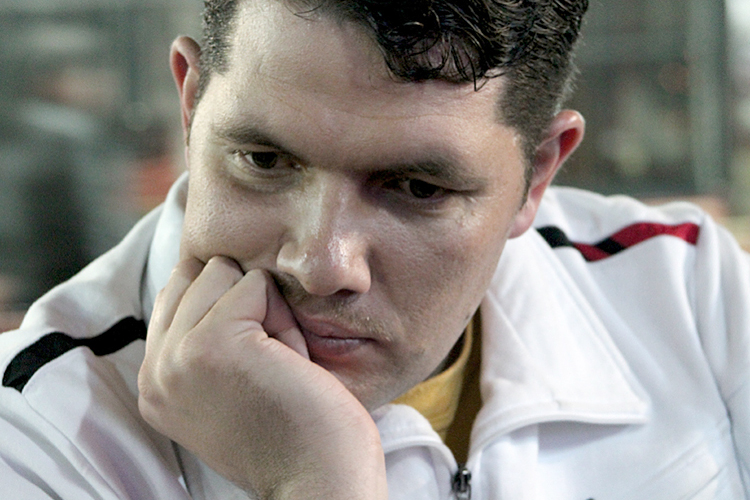

Two years ago Ahmed Shihadeh enjoyed a peaceful, if routine, life as a married young man living and working in the suburbs of Damascus. A master’s student in economics at Damascus University, he, like everyone else around him, never accounted for a popular revolution or subsequent government crackdown to abruptly upend his world.
Only one of the millions of ordinary Syrians whose day-to-day existence has been dramatically altered by the conflict in the country, Ahmed was suddenly compelled by the extraordinary circumstances around him to change from an ordinary student working at a local bank into an activist fighting to undermine a violently repressive government. Amid the increasing chaos, Ahmed left his studies to join a group of peaceful activists to found a citizens’ newspaper named Enab Baladi, created to disseminate local news on the revolution.
Ahmed found himself thrust into a world where he lived under constant threat and had to operate in secret, printing and distributing physical newspapers with the knowledge that he would be tortured and killed were his work discovered. The contrast with the normal life he enjoyed two years ago could not be starker, but as much as the situation deteriorated and the world he inhabited slowly ceased to exist, he refused to leave his home or his aspirations for a democratic Syria. Ahmed would write of the revolution he fought for:
This is a revolution we have carried on as Syrians who believe in freedom – both word and deed, and who realize the importance of free speech and who have given all soul to fight for what we deserve.
Ahmed, the student and husband, was killed this past week.
A barrage of government shells fired indiscriminately into his neighborhood struck him in his home and put an end to another promising life, in a conflict that has already claimed 70,000 others. After two years of the psychological trauma of war, he once reflected on his activism in an email by saying: “I think it is the same with all our dreams and nightmares … we have to keep feeding them to keep them alive.”
Ahmed’s story – of ordinary people compelled to heroism by extraordinary circumstances – is the story of the Syrian revolution, and it is one that is sadly being drowned out in media coverage that, to the benefit of the Assad regime, has almost exclusively focused on the more salacious stories of terrorists and extremists attempting to fill the power vacuum in the country.
In a speech this year to the American-Israeli Public Affairs Committee, Vice President Joe Biden said of the revolution in Syria: “We are not signing up for one murderous gang replacing another in Damascus.” Biden’s comments reflect a growing public perception that the Syrian uprising is one dominated by extremist groups and militants: potentially more threatening and retrograde than the regime they are fighting against. While there have been condemnable acts of violence committed by certain elements of the opposition – including a recent bombing against a mosque in Damascus that killed, among others, a senior pro-Assad cleric – this narrative is a distortion of the true nature of the revolution and those behind it. The Syrian uprising is one that has predominantly been led by grass-roots civilian activists from across the country – in short, the everyday people of Syrian society who have been forced into an impossible situation.
However, the media focus on extremists – themselves mostly foreigners and unpopular in Syria – has obfuscated the true picture and played into the hands of the Syrian government. The development of this false narrative has been regrettable, and a cursory exploration of the events of the past two years shows a markedly different picture.
The Damascus suburb of Daraya, Ahmed’s hometown, has been the site of some of the worst atrocities of the uprising. In the summer of 2012 a single massacre claimed the lives of hundreds of Syrian civilians, including dozens of children. In leaflets dropped over the town and its environs the government sent a chilling warning to resistors:
No one will help you. They have implicated you in taking up arms against your compatriots. They drown in their pleasures while you face death. Why? And for whom?
Despite a relentless campaign of suppression by the government — including torture, kidnapping and murder — the people of Daraya have continued to persevere in their opposition campaign. The town is situated next to a Syrian Air Force intelligence command notorious for abuse, and has been the site of several publicized government massacres. One of the most iconic figures of the revolution – a 26-year-old Syrian named Ghiath Matar best known for distributing roses to government soldiers during protests – was from Daraya and was killed there last year.
Matar was not a fighter, but a tailor by profession, and his story of nonviolent civil disobedience is overwhelmingly the story of his country’s uprising. Contrary to media descriptions of the uprising as being dominated by militants — and, most sensationally, by extremist groups aligned with al-Qaida – the core of the revolution to this day continues to be overwhelmingly centered around nonviolent activists.
Typical among such activists are the Syrians behind the publication Ahmed helped found: the citizens newspaper Enab Baladi. Published for the most part anonymously by local Daraya residents, the activists behind it began their paper as a means to document the events of the revolution and to give voice to their own aspirations as young Syrians. Started by ordinary citizens from all walks of life, Enab Baladi began publishing at the outset of the uprising and has continued even as their city was ripped apart around them. Furthermore, by publishing a physical paper Enab Baladi has served and continues to serve a vital purpose in providing information to the poor and the elderly – the two groups least likely to be able to procure independent information online. Printing in secret and with the knowledge that the discovery of their involvement with the publication would mean certain death, the activists behind the paper have managed to continue with their work despite all odds. Lama (a pseudonym), a 28-year-old university graduate said of her own involvement with the paper and her family’s reaction:
My dad was very against my involvement when this all started saying “we don’t want to get involved with this sort of thing” because he was very, very worried for our safety … So it’s funny – we are worried for our parents because they are worried for us and we are worried for them for their involvement with us!
Being detained and being repeatedly threatened by security forces has not stopped Lama or others from their activism, nor has it changed their outlook on the revolution. In one instance government police raided her neighborhood and she and her mother were forced to quickly destroy several flash drives, cameras and computers that contained information from Enab Baladi:
We had to break all this stuff because my mother was afraid they would raid the apartment, see this stuff, and do something to me – kill me, arrest me or what have you … we had to do this all in a matter of moments as the security forces were just outside, entering homes
Days later, one of Lama’s neighbor was killed by a sniper. However, despite the detention, torture and death of many of the activists and fellow citizens around them, the principled position of Lama and other activists like her in Enab Baladi has not changed. Far from being an outlet for extremism or sectarianism their paper and many others like it across the country have remained unequivocal in advocating for universal human rights and democratic freedoms in Syria — and have not hesitated to criticize the excesses of either the regime or its opponents. For this they have come under threat and have seen many of their number killed or disappeared by the Syrian government as well as threatened by extremist groups. This fear, however, has not dissuaded them from their mission or allowed the paper to be subverted toward the agenda of any faction. In Lama’s words:
In the end, we took to the streets against all that is wrong and we are not going to stay quiet about another kind of wrong and we are not going to stay quiet about any other groups aiming to be dictator
For this dozens of their number have been imprisoned and tortured – including Ahmed who served as the paper’s managing director. Enab Baladi has continued publishing unabated after Ahmed’s passing, a testament to the relentless desire for freedom and dignity embodied within young Syrians, which Ahmed himself spoke of before his death.
While the stories of peaceful activists such as Ahmed and Lama are not as sensational as those of fearsome militants, they tell the true narrative of the Syrian revolution: citizens and activists who took to the streets in protest and were met with the full violence of the state’s repression. That many later were forced to take up arms does not diminish their cause but speaks to the danger of their situation – the notoriously brutal regime they were faced with gave them little choice otherwise. Two years into a vicious civil war it would seem that for the most part the media has accepted Bashar Assad’s cynical claim to be fighting “extremists and terrorists.”
While the power vacuum in the country has made it a destination for many foreign fighters, the revolution itself continues to be fought by grass-roots activists and ordinary Syrians struggling against incredible odds to give their country a measure of freedom and dignity. Faithfully citing the shortcomings and dangers of the uprising is the duty of both Syrians and outside observers; but in the midst of spectacular depictions of a violent, extremist minority, the stories of everyday revolutionaries like Ahmed Shihadeh must be remembered. Ordinary Syrians such as him are the protagonists of this revolution – and despite the claims of the Syrian government and its allies, they are the real story.
