

CAIRO — “Don’t Laugh,” reads the cover of the Egypt Independent, an opposition English weekly. The headline stands above an image of Egyptian president Mohamed Morsi in Pakistani academic regalia, topped off with a bulky cylindrical hat crowned with gold trimming. The photograph of Morsi receiving an honorary degree from Pakistan’s National University of Science and Technology has come to epitomize a leader who is out of touch with his country. His headwear and the attendant absurdity of arresting Egypt’s most popular comedian, have most of Egypt in stitches.
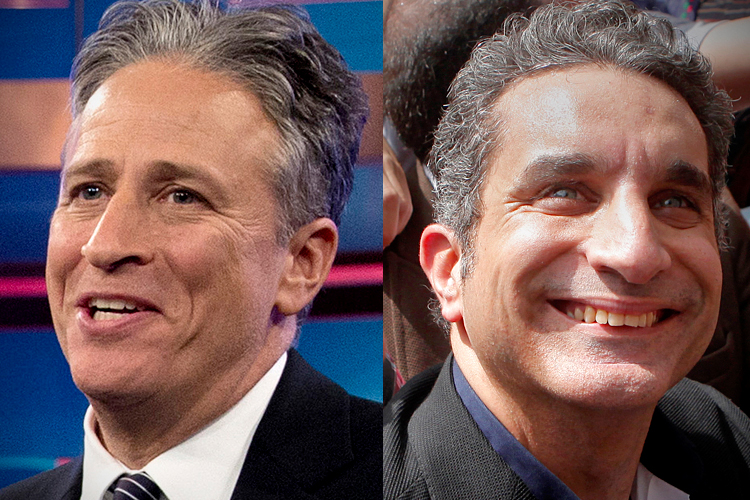
Satirist Bassem Youssef, who hosts “The Program” (in Arabic, “El-Bernameg”), a weekly production modeled on Jon Stewart’s “The Daily Show,” has been snickering at that enormous hat, too. Earlier this week, when Youssef was summoned by the country’s top prosecutor in response to legal changes of insulting Morsi and Islam, Youssef himself wore a massive, to the point of ridiculous, replica of the hat in question. But why arrest Youssef now? Will the legal action trigger a chilling effect on freedom of expression in Egypt?
Morsi’s office has denied any role in the investigation and asserted “the importance of freedom of expression.” But in a country that was ruled by a would-be Pharaoh for three decades, the once-illegal and now ascendant Muslim Brotherhood is taking cues from the deposed dictator’s playbook. In November, Morsi assumed broad powers in an aggressive, constitutional maneuver, including the appointment of the prosecutor who has targeted Youssef and his team.
On Tuesday, U.S. Secretary of State John Kerry voiced “real concerns” about “the lack of inclusivity with respect to the opposition in public ways that make a difference to the people of Egypt.” But what Kerry didn’t mention is that satirists are still gunning — against all odds.
Still laughing
On Thursday, the board of directors of Media Production City, Egypt’s TV trade association, met to discuss the previous warnings directed at the Egyptian broadcaster of Youssef’s show, CBC. The board is monitoring how the channel has responded to complaints against “El-Bernameg,” which is accused of employing “improper words and allusions.” There’s something a bit Orwellian about it, most of all that the Youssef’s show is just called, “The Program,” which means that many times when a newspaper here refers to the legal trouble, the reporter must write, “the program, ‘The Program.’” It’s a nice meta-joke.
But Youssef must have seen the uproar coming. This December’s season premiere began with the host slouching on the couch, rewatching the previous season. Though the show had (and has) been a smash hit, Youssef sat lamenting over the purported show’s cancellation — not due to censorship but due to unpopularity. It was a humble brag par excellence. The next segment featured some “Daily Show”-style vox pop, asking random folks if they had seen the infamous host. “Oh, yeah, Bassem Youssef,” says a woman idling her car’s motor to speak to an interviewer. “I saw him selling tissues on the street once.”
But then Youssef gets up from his couch and after some computerized animation, instantly appears on “El-Bernameg’s” new set in a revamped theater and before a live audience whose hands must have hurt from applauding so loud. “This show might be our last. You know what freedom of the press is like around here,” he joshed, four months prior to this week’s brouhaha. “No, really we do have freedom of the press. They say, ‘no pen shall be broken.’ And they were right: The pens are safe even though TV channels are being shut down.” Youssef might have been referring to an anti-Brotherhood, ultra-nationalist “Freedom Channel” that was taken off air in August — or he may have predicted an administrative court’s shuttering of the belly-dancing channel in February.
Despite official intimidation this week, Youssef is rolling with the punches. He handles interviews with major U.S. networks with the same swagger and one-eyebrow-raised charisma that has propelled him to Egypt’s national stage. Immediately following his interrogation, the title of his weekly newspaper column was, “With the Brotherhood, It’s So Much Better.” Of course the article was an indictment of Egypt’s ruling party. That the piece was written with a smile depicts Youssef’s unmitigated capacity to poke fun.
Meanwhile, Jon Stewart’s 11-minute “Daily Show” segment on the persecution of Bassem Youssef went viral in Egypt. “What are you worried about?” was the question Stewart directed to Morsi. “You’re the president of Egypt; you have an army. [Youssef] has puns and a show, you have tanks and planes. We should know; we still have the receipts.” Stewart’s defense of his “brother,” made the front page of opposition newspapers, which transcribed and translated the pejorative jokes into Arabic; major TV networks here followed suit. But it wouldn’t be real news without a Twitter fight.
The U.S. Embassy in Cairo, which has a reputation for snarky social media interactions, posted the “Daily Show” link on its Facebook and Twitter pages. What ensued was the kind of diplomatic row that satirists would have only dreamed of during the early years of the Internet. “It’s inappropriate for a diplomatic mission to engage in such negative political propaganda,” responded the Egyptian presidency’s official account. The feed of the Freedom and Justice Party, the Muslim Brotherhood’s political arm, disparaged the U.S. embassy for “taking sides in an ongoing investigation & disregarding Egyptian law & culture.” The provocative link to Stewart has since been deleted, the embassy’s feed was briefly deactivated, and the State Department spokeswoman attempted to massage the situation in Wednesday’s press briefing. Jon Stewart must be thrilled.
New red lines
Since January 2011, every moment of Egypt’s drawn out political transition has been accompanied by a punch line. The real revolution is happening in the form of humor: the tongue-in-cheek chants against Mubarak in Tahrir Square; Facebook memes; Cairo’s ubiquitous (and raunchy) graffiti; political cartoons. Everyone is testing the formal and informal restrictions that demarcate what is an acceptable joke. Today, the red lines are still blurry.
While mockery of the Egyptian head of state was effectively a fault line for humorists during the Mubarak era — and it seems that some inertia in this regard still remains — today religion has emerged as the primary taboo. But just what constitutes defamation of religion is up in the air.
In addition to Youssef’s case, the public prosecutor has also leveled charges against Ali Kandil, a stand-up comedian who appears regularly on “El-Bernameg.” Kandil’s crime: mocking religion in his 20-minute bit” last week. Specifically Kandil poked fun at the abrasive voices broadcasted from Cairo’s minarets, the five-times-a-day call to prayer. To much applause, Kandil went on about how prayer is supposed to be beautiful. Yet the Friday sermons that echo from loudspeakers across Egypt actually sound like threatening screams.
Kandil, standing accused of blasphemy, waited hours for his interrogation to begin. In the interrogation, a team of twelve lawyers played the segment for Kandil, pausing the video every so often to ask the comedian what he thought of it. (Similarly, Youssef told CNN’s Christiane Amanpour on Tuesday that the prosecutor sat with him as they watched the show “joke by joke,” stopping to answer questions.)
But in summoning Kandil, the attorneys only focused on the religious part of his monologue. The lawyers didn’t probe the comedian about a candid anti-presidential remark — “I am absolutely against Morsi” — from that very routine.
Kandil responded to the intrusive questioning like a good, self-deprecating humorist: “The second half of the video is funnier,” referring to his pastiche of various preachers and religious leaders that landed him in the prosecutor’s office. “I take responsibility for every word I said,” he proudly declared in a video he published online the subsequent day.
“The people who were questioning him didn’t even know what stand-up comedy is, and that kind of sums everything up,” explained Ali’s brother Muhammed, himself a political cartoonist who has drawn more than a couple of portraits of Morsi wearing that larger-than-life cap. “What Ali was saying [about religion] was in defense of the rituals and out of love for it.
Ali was released on bail after paying 5,000 Egyptian pounds (about $730). Despite the fallout, “[Ali] is in good spirits,” added his brother.
Others outside the Bassem Youssef controversy have taken heat, perhaps none more so than Doaa El-Adl. One of the few women cartoonists in the Egyptian scene, El-Adl also faces of a blasphemy charge; a lawyer from the Islamist-affiliated watchdog group, the National Center for Defense of Freedoms, has filed a suit against her for drawing a biblical scene in a cartoon, though there has been little movement the case.
“There were no freedoms under Mubarak. Now there is freedom,” a spokesman for the National Center for Defense of Freedoms explained to me by phone. The organization has no problems with Youssef’s mockery of the presidency, but claims to draw the line at disrespecting religion, whether Islam, Christianity or Judaism. But how El-Adl’s depiction of Adam and Eve constitutes blasphemy is less than clear.
“We’re not scared”
“The second Bassem says something, Egyptians laugh,” noted Amro Selim, the cartoon editor for the popular Shorouk newspaper. A friend of Youssef, Selim has appeared on “El-Bernameg” a couple of times and is widely known as a prolific caricaturist: Selim draws up to seven political cartoons a day, every day.
Four months ago, Selim drew a cartoon that exemplifies “El-Bernameg’s” mass appeal.
A woman in nikab — the head-to-toe black robes that are worn across the Middle East — enters her mother’s home and says, “I’m getting divorced … because my husband walked in on me watching Bassem Youssef.”
In Egypt’s rich spectrum of newspapers, political cartoons are a battleground where artists are exploring how far they can go. During the reign of Mubarak, drawings of the president himself were rare and cartoonists learned work-arounds to depict his despotic policies. But now, the game has changed. Opposition newspapers publish demeaning caricatures of the president above the fold at least once a week. (Tahrir newspaper published a cartoon of Morsi driving a sedan, just below the folio, in which the president remarked, “By the way, I have no idea how to drive.”)
“He wants to scare us,” said Selim on the Morsi’s policies of repressing comedy. “[The Brotherhood] thinks that, by moving forward with this case, people will be scared. But we’re not scared. We’re just going to draw more.” For Selim, the major challenge is the expanded role of religion in the political sphere, as he explained to me that “church” and state were effectively detached from one another during the Mubarak years. But now, the two domains have been conflated. “So when Bassem says that [the Brotherhood’s] politics is wrong, then Bassem is against religion,” in the eyes of the ruling party.
In contrast, Freedom and Justice, the newspaper of the Brotherhood’s political party, publishes cartoons that tow the official line and mirror the president’s speeches and press releases. Moreover, the paper has avoided overt mentions to the Youssef case in its daily cartoons. Cartoonist Shafik Salah has instead focused on the media. On Thursday, a cartoon juxtaposed “the corrupt media” and a young boy meant to represent Egypt. The boy holds an apple and says, “Let’s do good for Egypt,” while a newsman beside, donning a top hat, is aghast, and his speech bubble contains a grenade. If the cartoon is intended as a swipe at Bassem Youssef, then the message is too sunny to be effective. Also, it’s not very funny.
The attempt to silence Youssef hasn’t bullied jokers here in the slightest. If anything, opposition cartoons in Egyptian papers have grown more strident since the Egyptian president’s consolidation of power in November 2012, and they didn’t let up this week. Makhlouf, a cartoonist and comic editor for a left-of-center opposition daily, Al-Masry Al-Youm, has recently revised his caricature of Morsi. The president is no longer a man in a suit behind a desk. In Makhlouf’s latest renderings, Morsi is simply a fuzzy, bearded face with arms and legs, wearing a crown.
“We must continue to make fun of the ruling and the government,” was how Selim put it. “We must.”
Perhaps the joke is on the president’s office, for Youssef’s good-humored nature means that he has spun the legal case as a passing triviality. Crowds of supporters accompanied Youssef as he entered his interrogation appointment. And on Wednesday Youssef set off to his personal theater to record a new episode of “El-Bernameg”
