
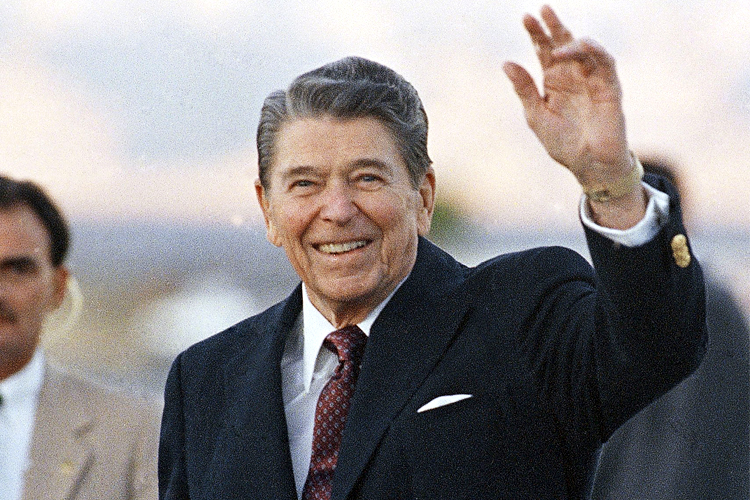

The reason the Onion’s spoof about Ronald Reagan being raised from the grave to lead today’s Republican Party still remains one of the funniest political satires in recent memory is because it rings so true. With the GOP in such disarray, you get the sense that the only thing that unifies the conservative movement is a visceral hatred of America’s first African-American president and a cultlike worship of the Gipper. You also get the sense that if Republican leaders could have, they would have done exactly what that Onion spoof suggested — reanimate the corpse of Ronald Reagan and run him for president in 2012 — and for good reason. According to a stunning new national poll released today by the National Geographic Channel, Reagan would have demolished Obama in a head-to-head match-up.
As the coverage of Margaret Thatcher’s death this week reminds us, the 1980s still define us in so many ways. The National Geographic Channel poll, timed to the Sunday premiere of the channel’s three-night “The ’80s: The Decade That Made Us,” is chock-full of revealing findings about why exactly that is.
Some of the survey’s findings are fun but trivial (83 percent of us do not want shoulder pads to make a comeback), some are confounding (men like Harry and Sally as a couple way more than women do), and some are downright important to understanding the present political moment.
For instance, the vast majority of the country thinks things were better back then than they are now, and almost 4 in 5 believe the government ran better in the 1980s than it does now. That 4 in 5 disproportionately comprises those who actually lived in the 1980s, likely because back then — as opposed to now — more Americans could still personally remember past eras when the government successfully accomplished things and took on major high-profile challenges.
Consistent with such general nostalgia for the 1980s is the eye-opening finding that 58 percent of Americans say they would vote for Reagan over Obama in a hypothetical presidential match-up. Amazingly, Reagan would win against Obama in every age, gender and income group.
The first question these results evoke is why does Reagan remain so well known, venerated and relevant almost a quarter-century after he left office? It’s a vexing question, considering the fact (as evidenced by the latest round of Reagan headlines this week) that he somehow remains more relevant to today’s politics than the other presidents who left office far more recently. So again, why?
Part of it has to do with the incredible amount of resources poured into constructing and sustaining all the collective efforts of the so-called Ronald Reagan Legacy Project. Thanks to that effort, Reagan is now constantly invoked in the present moment’s political squabbles.
Through this legacy-building process, Reagan has also posthumously benefited from two factors that have convinced many to see him as a rare example of a transpartisan statesman.
First, thanks to the propaganda of the legacy building efforts, his record has been gradually sanitized — when Reagan appears on our television now, he is most often saying laudable stuff like “Mr. Gorbachev, tear down this wall!” and isn’t decrying welfare queens, blowing the racist dog-whistle of states’ rights or evading questions about the Iran-Contra scandal.
Second, because today’s post-Reagan Republican Party has moved so far to the extreme right, Reagan now in retrospect looks like a pragmatist — a uniter, not a divider.
Indeed, as a tax-raising, pro-deficit-spending, Social Security-protecting, pro-gun control, pro-amnesty president who spoke out for the right of workers to organize unions, and who diplomatically engaged America’s most feared international enemies, Reagan today looks like an admirable moderate in comparison to the wildly unpopular fringe conservative elements that run today’s GOP.
Because of that, a guy who used to be seen as a divisive conservative firebrand now benefits from a convergence: He is at once still loved by nostalgic rank-and-file Republican partisans but is now also admired by many independents and Democrats because his positions in retrospect seem centrist — or even liberal — by today’s standards.
In that sense, conservative activists behind the Reagan Legacy Project may have created a monster for themselves. By keeping Reagan front-and-center in almost every political debate at the very moment today’s Republican Party has so obviously discarded actual Reagan policies and positions, those conservatives have created a constant reminder to voters who love Reagan that today’s GOP is, in fact, not the party of Reagan.
If you need a timely reminder of how that dynamic plays out in real time, consider this week’s aforementioned Reagan headlines — the ones about the politics of gun control and same-sex marriage.
On the former issue, news organizations reported on an ad blitz reminding Americans that Ronald Reagan was an outspoken supporter of the popular background check policy that Senate Republicans are threatening to filibuster. On the latter issue, Reagan’s daughter made news noting that her father would find himself at odds with today’s GOP, which still officially refuses to support legalizing civil unions, much less same-sex marriage. And because Reagan Legacy activists have so successfully kept Reagan relevant to current politics, those news items generate big headlines, thus reiterating a negative message about the extremism of today’s Republican Party.
This gets to the second and even more important question. Even though Reagan represents so much of what the GOP no longer is, he is still branded as a Republican and could defeat a relatively popular sitting Democratic president. So, then, why haven’t today’s Republicans figured out a way to somehow turn that reality into big national victories at the polls?
One straightforward answer is race and geography. As the National Geographic survey shows, though Reagan wins against Obama in every age, gender and income group, when the Reagan-Obama match-up is broken down specifically along racial/ethnic and geographic lines, a whole new picture emerges. In urban America, Obama beats Reagan by 51-49 and even more tellingly, among non-whites, Obama beats Reagan by a 62-38 gap.
As the victims of so many Reagan policies, city-dwellers and people of color clearly do not forget or willfully ignore the ugliest parts of Reagan’s record, and with this country becoming both more urban and more non-white, that’s a big problem for the Republican Party. So even if the GOP could, in fact, reanimate the corpse of Reagan himself or somehow find a current Republican politician to embody the Reagan zeitgeist, that still might not be enough to win them elections in an ever more citified and diverse America.
But, then, in trying to leverage Reagan’s memory for its own benefit, the GOP faces an even bigger obstacle: the party has obviously abandoned what about Reagan is now so appealing to so many Americans. Regardless of whether today’s memory of the 40th president is historically accurate, many nonetheless perceive Reagan to have at least been a mature compromiser not bound by a hard-edged ideology that is out of step with mainstream public opinion.
Polls show America rightly sees today’s GOP as exactly the opposite of that — petulant, ideologically driven and inflexible. Thus, no matter how much voters may pine for the 1980s and Reagan’s “morning in America,” they are not likely to see today’s iteration of the Republican Party as the flux-capacitor-powered DeLorean that’s going to get us there.
In a lot of ways, that’s good news. Having spent years writing and researching the 1980s for my book “Back to Our Future,” I relearned why we shouldn’t want to go back to the 1980s — and why our continued obsession with the 1980s is fraught with problems. I’m as much of a fan of 1980s movies, TV shows, video games and other kitsch as anyone, but the 1980s sowed the seeds of many of the biggest crises we face today – so I’m hardly bummed out by the Republicans being unable to figure out how to capitalize on nostalgia for Reagan and the 1980s.
What I am bummed out about is the fact that our politics have become so polarized that Reagan is seen as a moderate with broad appeal. That, more than anything, is a frightening commentary on just how extreme American politics has become since the 1980s. Maybe it will also be a wake-up call warning the country that if Reagan is now a moderate, then we’re further away from “morning in America” than we may think.
