
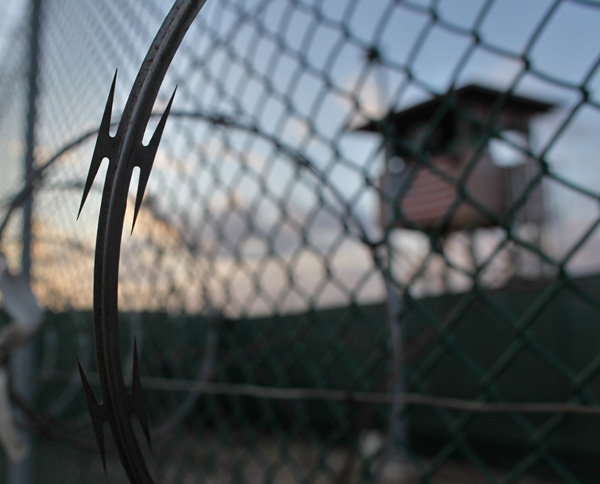

Guantánamo Bay prisoners have been on a hunger strike for over two months. Some of them have, in that period, been subjected to forced feeding by medical staff in the prison. But a new report that examines the United States government’s recent history of torture and abuse of detainees in the global war on terrorism highlights hunger strikes in the prison camps and recommends that forced feeding come to an end because it is abuse.
The report comes from a “Task Force on Detainee Treatment” formed by the Constitution Project, which describes itself as “a national watchdog group that advances bipartisan, consensus based solutions to some of most difficult constitutional challenges of our time.” The co-chair of the “Task Force” was Asa Hutchinson, a Republican who worked in the Department of Homeland Security under President George W. Bush. James R. Jones, who helped President Bill Clinton pass the North-American Free Trade Agreement (NAFTA), was the other co-chair.
The Task Force took two years to develop a report on “the past and current treatment of suspected terrorists detained by the US government” during the administrations of President Bill Clinton, President Bush and President Barack Obama.
During a press conference on the report on April 16, Dr. Gerald Thomson, a professor of medicine emeritus at Columbia University and former president of the American College of Physicians, stated, according to “Democracy Now!”:
We do not believe that force-feeding should be an approach to the hunger strike. If you can imagine being a detainee and using refusal to eat as a form of protest, and then you are forced to eat, forced physically to eat by being strapped into a specially made chair, and restrained—having restraints put on your limbs, your arms, your legs, your body, your head, so that you cannot move, having a tube inserted into your throat that extends into your stomach, and you’re trying to resist that with the only muscles that are free in your throat—pain, discomfort, obviously. But in addition to that, food is then forced, in a liquid form, into your stomach. You’re kept in the chair for at least two hours, usually more than two hours, to prevent you from vomiting and undermining the force-feeding. You can’t go to the bathroom during that time. Your dignity is taken away. The World Medical Association and international officials have clearly identified that process as cruel, inhuman and degrading treatment. And whatever the—given the level of brutality, it could extend to torture.
Hunger strikes have been taking place at Guantánamo since right after it opened. The report notes, “The first reported incidents of detainees being force-fed occurred in May 2002, after 60 or 70 days of hunger strikes.” A major hunger strike took place in the summer of 2005. By September, 131 prisoners were being denied food.
“In October 2005, prison officials told a delegation of visiting medical organizations that 25 prisoners were currently on a hunger strike, 22 of whom were being fed by nasogastric tube,” according to the Task Force’s report. Prisoners’ lawyers “filed motions asking federal courts to stop the involuntary feeding, which they claimed was carried out in a punitive, brutal fashion.” The prisoners alleged that “excessively large feeding tubes” were being inserted through prisoners’ noses and were causing “bleeding, vomiting and loss of consciousness in some cases.”
Sami al-Hajj, a journalist for Al Jazeera, who was detained by the U.S. for seven years in Afghanistan and Guantánamo, told the Task Force about the force-feeding he experienced:
They’re supposed to feed you [with] two cans, small cans … but they feed us 24 cans and 24 bottle of water, continuous. And we [were] throwing up, it continues and we throwing up and it continues. This is one feeding; [it] would take 8 hours like that, you are in chair. Until your cell become full of [vomit]. And after that, when they come and [remove the feeding tube from the esophagus], they [would grab the tube and just walk away with it]. Then there was blood coming. And [the guard] takes it from you and he goes to another [detainee] directly and [inserts it] … without cleaning.
By November 2005, prison authorities began to believe prisoners had “too much control over their feeding.” Prisoners were said to be negotiating for less formula or “deliberately vomiting” after feeding. Consultants with the Federal Bureau of Prisons (BOP) and a forensic psychiatrist visited the prison and recommend a change to protocol — the introduction of a “restraint chair.”
The report describes how the ”restraint chair” was manufactured by ERC Inc., in Iowa. The company advertises the chairs as perfect for “combative or self-destructive” persons. “It’s like a padded cell on wheels.”
The company sent five chairs to Guantánamo in December 2005 and 20 more chairs on Jan. 10, 2006. They were used to immobilize and strap down prisoners. Dr. Emily Keram, a physician who evaluated hunger striker Ahmed Zuhair, recounted for the Task Force:
When the restraint chairs were first introduced, Mr. Zuhair was kept in the restraint chair for two hours after feeding ended. His requests to use the bathroom were refused. He soiled himself with urine and feces. Guards started putting diapers on Mr. Zuhair, refusing to allow him to do this himself. Some detainees ended their hunger strike. Mr. Zuhair was once kept in a restraint chair for six hours, exceeding the two hour maximum time limit recommended for the detainee’s safety. … Mr. Zuhair expressed his conviction that the restraint chairs were introduced as a means of punishing hunger striking detainees and forcing them to end their hunger strikes.
The military maintains the “restraint chair” has not been used to punish detainees. However, Zuhair, who is one of two prisoners who were force-fed for “close to four years,” said the chair made him feel like he was an “animal.” It caused him ”physical pain and hemorrhoids due to pressure on the tailbone.”
Keram evaluated him in 2009 and found he was suffering from post-traumatic stress disorder (PTSD) “worsened by the restraint chair.” She recommended he be force-fed in a medical bed. However, compliant detainees like Zuhair were not fed in hospital beds.”There was no behavioral reward system by which a detainee could work his way up to another venue.” And, as one guard put it, “It’s their decision. It’s like smoking.”
* * *
With the current hunger strike, prison authorities have sought to suppress the protest. Guards raided the prison on April 13 to relocate striking prisoners from communal confinement to single-cell confinement. It was an escalation of tactics designed to intimidate and harass those resisting their continued detention.
British prisoner Shaker Aamer, who has been detained for over 11 years without charge or trial, previously described to Reprieve executive director and lawyer Clive Stafford Smith, how guards were engaging in brutal “forced cell extractions” or FCEs, where they would brutally manhandle prisoners as they moved them to other areas of the prison. Aamer alleged a “new practice” of using a dog leash on prisoners and recounted how the night shift had grown obnoxious and was now making loud noises to keep prisoners awake. Another prisoner, Younus Chekkouri, told Smith there is now a supposed Islamic expert advising prison staff on “how to break Muslims.” And, Yemeni prisoner Musa’ab Omar al Madhwani alleged prisoners are being denied access to potable drinking water.
The Task Force’s report shows it is not unfounded to suspect the Pentagon is using abusive tactics to break the hunger strike. When Task Force staff spoke to then Joint Task Force Guantánamo commander Rear Adm. David Woods, in January 2012, he characterized hunger strikes as “a tool used by [detainees] to stay in the fight.” A Pentagon official, who accompanied the Task Force staff, added, hunger strikes are in “the Manchester Manual,” an alleged al-Qaida training document. This is “why they do it.”
Woods was asked to clarify how prison authorities would distinguish “between detainees who engage in hunger strikes to protest their indefinite detention and detainees who have been found to have links to Al Qaeda and the Manchester Manual.” The answer he gave was, “We consider anyone undertaking hunger strikes to be continuing the fight against the US government.”
Furthermore, the Task Force report adds Woods’ statement:
…[E]choes a 2007 press document issued by JTF-GTMO that discusses the Manchester Manual and asserts that “[a]lthough many of the detainees are illiterate and have not read the manual, a JTF source said there is a segment of the detained population who were trainers in the various terrorist camps and that these trainers have either, by example or through different modes of communication, disseminated the document’s principles to the larger detainee population.” The JTF release additionally acknowledges that “[a]lthough not all detainees held in detention centers here are directly associated with al Qaeda, the manual is believed to be intended as a guide for all extremist Islamic fighters engaged in paramilitary training. … [A JTF source added that] whether the detainees here are directly affiliated with al Qaeda or not is irrelevant. What is relevant, he said, is that they have paramilitary combat skills and the willingness to apply those skills when they are so inclined to use them.” [emphasis added]
Therefore, it is reasonable to presume that Army Col. John Bogdan, who now heads the prison camps, and other authorities view the hunger strike as another front in a war against al-Qaida and its affiliates. It must break prisoners or else al-Qaida is handed a victory.
The latest report from the Pentagon is that 52 prisoners are on hunger strike. That number is up from 45 prisoners yesterday. Fifteen are now being force-fed. (These numbers are much lower than numbers that have been offered by prisoners’ attorneys and prisoners, who have spoken out about the strike through attorneys.)
Many of the men on hunger strike are weak and have lost a lot of weight. As Samir Naji al Hasan Moqbel, a hunger-striking prisoner who has been subject to forced feeding through a tube, described in a recent Op-Ed for the New York Times, “I had never experienced such pain before. I would not wish this cruel punishment upon anyone.” But, despite such treatment, prisoners will continue their strike because they know this massive show of resistance is one of the few hopes they have.
Avenues of due process that could end the nightmare they are experiencing have been closed off by Congress or the Obama administration. To end the cruelty and force an end to indefinite detention, they must endure more abuse and, in some instances, more torture, and keep up their hunger strike.
