
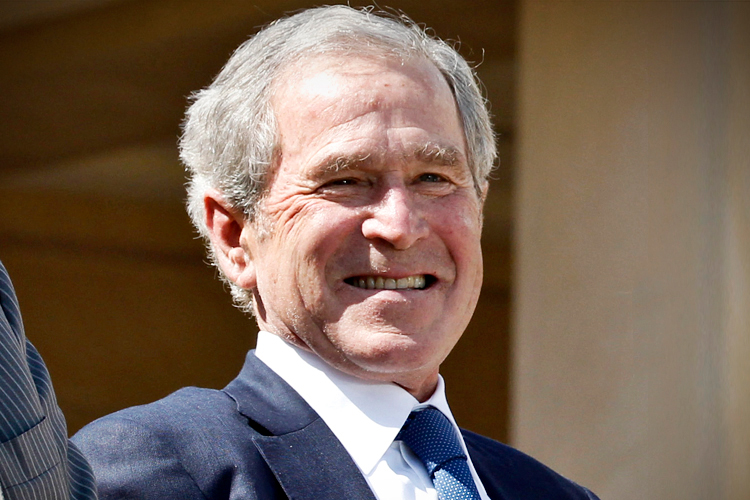

Every dog goes to heaven and every former president should get a shot at repairing his legacy, especially when it’s as tattered as George W. Bush’s. With the opening of his presidential library and museum this week, observers from former Bush officials to mainstream outlets were taking a fresh, rosy look at the Bush legacy. Some offered dopey and facially ridiculous cheerleading, while others offered more compelling suggestions to return to the Bush era with an open mind. After all, other presidents left office in a cloud only to be redeemed by history years later.
So, is this week making you feel a bit nostalgic for the Bush era? Don’t. It’s been almost half a decade since the 43rd president left office, and he’s looking as bad as ever. Of course, that won’t stop a small circle of admirers (many of whom used to be on his payroll) from trying, so here’s your guide to taking on the five biggest specious pro-Bush talking points put forward this week:
1) Bush kept us safe: The biggest myth of the Bush presidency, by far, is that the president kept the country safe. As Charles Krauthammer wrote this week in the Washington Post in a typical example: “It’s important to note that he did not just keep us safe. He created the entire anti-terror infrastructure that continues to keep us safe … Which is why there was not one successful terror bombing on U.S. soil from 9/11 until last week.”
Just no. First of all, why does 9/11 not count? It’s not like the U.S. government was completely unaware of the threat from al-Qaida and Osama bin Laden until 9/11. After all, bin Laden had already helped orchestrate the U.S. Embassy bombings in Kenya and Tanzania that killed hundreds in 1998, and Bill Clinton launched cruise missiles into Sudan and Afghanistan to try to kill bin Laden three years before 9/11. And then there’s that CIA briefing that warned Bush: “Bin Laden Determined to Strike in U.S.” — 36 days before Sept. 11. Bush’s response to the briefer giving him the news? To say, “All right. You’ve covered your ass, now.” Then he went fishing. Literally.
As for the claim that there were no terror attacks on U.S. soil after 9/11 under Bush — also bogus. Conor Friedersdorf writes:
“Bush’s tenure included anthrax attacks that killed five people (more than died in the Boston marathon bombing) and that injured between 22 and 68 people. Bush was president when Hesham Mohamed Hadayet killed two and wounded four at an LAX ticket counter; when the Beltway snipers killed 10 people; when Mohammed Reza Taheri-azar injured six driving his SUV into a crowd; and when Naveed Afzal Haq killed one woman and shot five others in Seattle.”
Also, there was the bombing of the USS Cole in Yemen, just before the 2000 election, which should have brought an extra warning about the al-Qaida threat, and later on, bombings in London, Madrid, and Jordan. Meanwhile, thanks to the wars there, much of the attention from international terror went to Iraq and Afghanistan, where al-Qaida and sympathetic groups found it easier to kill American soldiers than to attack Americans on U.S. soil.
2) Bush was fiscally responsible: Here’s Republican strategist Ed Gillespie, writing in the National Review this week, “Over Mr. Bush’s tenure, our national debt averaged 38 percent of GDP, a result of holding average annual deficits to 2 percent of GDP, and federal spending remained below 20 percent of GDP in six of his eight years in office. (Only one other president in the past 40 years was able to reach such a low level, and for fewer years).” Jennifer Rubin added in the Washington Post: “He is responsible for one of the most popular and fiscally sober entitlement plans, Medicare Part D.”
Former Bush White House Chief of Staff Andy Card even had the chutzpah to claim that President Bush “probably has the best track record of any modern president in terms of fiscal discipline.”
The only way to make that claim is to be willfully dishonest, as the numbers are cut and dried. Notice that Gillespie cites the average debt over the course of the eight years, instead of the progression. Here’s another way of looking at Bush’s fiscal legacy: When he entered office, the U.S. government was running a surplus (and was projected to do so for the next several decades) and when Bush left office, the government was running its biggest deficit since World War II.
Part of this can be attributed to the collapse in tax revenue during the Great Recession, and even if we don’t blame Bush for letting Wall Street collapse the economy, you can certainly blame him for ruining the fiscal bulwark built up under the Clinton years with massive tax cuts that mostly benefited the rich and two hugely expensive wars. Here’s a chart from the Center for Budget and Policy Priorities about what’s driving the debt:

As for Medicare Part D, which helps seniors pay for prescription drugs, while the cost of the program is less than was originally projected, it’s still higher than it should be. The savings came from lower drug spending overall, but while overall spending is 35 percent lower than expected, Medicare Part D spending was only 22 percent below expectations. And drug costs are still higher under Medicare Part D than they should be.
And during most of this time, there was no reason for the debt to explode; the economy was doing pretty well (unless you were poor). Much of the debt raised under Bush was purely elective. Even Republicans say this all the time. “Many of us, myself included, got into politics because we were appalled at the Bush record on spending,” South Carolina Rep. Mick Mulvaney told the Hill.
3) Iraq wasn’t so bad: While even the people who were responsible for executing it admit there were problems with the Iraq War, they always blame it on faulty intelligence. And who could have predicted the uprising following the invasion? Meanwhile, Afghanistan wasn’t so bad, they say.
Here’s Krauthammer: “Bush’s achievement was not just infrastructure. It was war.” He goes on to note that Democrats voted for the Iraq War, and that while there were no nuclear weapons, the war did prevent Saddam Hussein from regaining his “full economic and regional power.” Karl Rove added, “I do believe that the Iraq War was the right thing to do and the world is a safer place for having Saddam Hussein gone.”
More whitewashing. Bush officials threw the CIA under the bus for allegedly misleading them on weapons of mass destruction, but what seems more likely is that the White House and other key officials “cherry-picked” key pieces of intelligence to bolster their claim and discarded the rest. Intelligence is messy and produces lots of divergent and sometimes conflicting information from sources of varying reliability, but the White House pushed the boundaries of intellectual honesty in building the case for the war. While many argue it’s a bridge too far to say he lied and knew there were no nuclear weapons, it’s clear that officials chose an outcome they wanted and then found the evidence to get them there, and then misled the American people and world by not honestly representing the doubts in the intelligence.
As for the aftermath, as James Fallows wrote in his seminal 2004 account, “The U.S. occupation of Iraq is a debacle not because the government did no planning but because a vast amount of expert planning was willfully ignored by the people in charge.”
Is Iraq better off without Saddam Hussein? One could make the argument, but the country is hardly the model of peace and democracy. The war tipped off a brutal civil war that left an estimated 125,000 dead and millions displaced. Bombings and attacks continue to this day and the country seems to be heading back toward widespread violence. Meanwhile, the government the U.S. installed is trending toward autocracy.
And while Iraq may no longer be the regional powerhouse it once was, the war served to empower Iran, its longtime rival, by eliminating the main check on Tehran’s power. Now it’s Tehran’s nuclear program that we’re worrying about.
The fact that Democrats also supported the war does not make it right; it means that they were wrong too.
4) Bush is Back — and popular now! At the beginning of the Week of Bush Revisionism, the Washington Post and ABC News released a poll showing that Bush’s poll numbers have recovered since leaving office. As Dan Balz wrote, “Days before his second term ended in 2009, Bush’s approval rating among all adults was 33 percent positive and 66 percent negative. The new poll found 47 percent saying they approve and 50 percent saying they disapprove.”
This has been a jumping-off point for every Bush revisionist article and argument of the past five day and presented as proof positive that Americans are finally realizing that Bush was OK. As Rubin wrote, “It took less than 4 1/2 years of the Obama presidency for President George W. Bush to mount his comeback.” Her phrasing suggests this is an unusually short amount of time for a former president to stage a comeback, as if presidents inevitably leave office in disgrace, as hundreds of thousands of people sing “Kiss Him Goodbye.”
But this simply isn’t the case. Americans are a pretty forgiving people and generally like their presidents, so if it takes almost five years for fewer than half of Americans to like you, the problem isn’t the public — it’s you. When Bill Clinton left office, he had a 65 percent approval rating (reminder: This is the guy who was impeached). Today, according to a Fox News poll from last week, 71 percent of Americans view Clinton favorably and just 25 hold an unfavorable view of the former president.
And the poll is just a single data point, hardly enough to say definitively that Bush has bounced back. A Wall Street Journal/NBC News poll from earlier in April found that only 35 percent of Americans view Bush in a positive light, while 44 percent viewed him negatively.
Even the relatively positive Washington Post poll found that Bush’s approval rating on key decisions is still deep underwater. And as recently as November, most Americans still blamed Bush for recession, almost four years after he left office.
5) Bush was a historically great president: Karl Rove went for the big picture, saying at the dedication of the Bush Center in Dallas, “I’d put [Bush] up there” with “George Washington, Abraham Lincoln, Ronald Reagan, FDR.”
Hmm. Is that really where Bush ranks in the history of American presidents? If you ask historians, it’s somewhere near the very bottom. A Siena College survey of 238 presidential scholars in 2010 put Bush at 39th out of 43 presidents. A 2009 C-SPAN ranking put him at 36th.
If you ask the American people, they say something similar. In 2012, Gallup asked Americans how former presidents will go down in history. Nearly half — 47 percent — said Bush will be remembered poorly or below average. Just 25 said above average or “outstanding.” By contrast, just 12 percent said Clinton would go down as below average or poor.
If you ask the data, they paint an ugly picture. Unemployment, federal debt, consumer debt and poverty all went up, while income equality, GDP, wages, tax revenues all went down. Here’s what Neil Irwin wrote in 2010:
For most of the past 70 years, the U.S. economy has grown at a steady clip, generating perpetually higher incomes and wealth for American households. But since 2000, the story is starkly different. The past decade was the worst for the U.S. economy in modern times, a sharp reversal from a long period of prosperity that is leading economists and policymakers to fundamentally rethink the underpinnings of the nation’s growth.
Add to that the bungled wars in Iraq and Afghanistan, the preventable failure to catch Osama bin Laden at Tora Bora, the absolutely horrendous handling of Hurricane Katrina, the outing of a covert CIA officer in a political vendetta, the illegal wiretapping of Americans’ phones, the improper firing of U.S. attorneys for political reasons, the use of taxpayer dollars to pay columnists, and “misrepresenting and suppressing scientific knowledge for political purposes,” to name a few — and, well, then you know why Dana Perino, Bush’s former press secretary, was forced to lead her ode to the ex-president by recounting that he “shar[ed] his peanut butter and honey sandwiches with me.”
