
Rise of the conservative revolutionaries

Almost half of Republicans think an armed revolution may be needed soon. What does it mean for guns and democracy?

Topics: Republicans, Guns, Gun Control, revolution, Voting Rights, Filibuster, 2000 Election, Obamacare, Taxes, Civil Liberties, Editor's Picks,

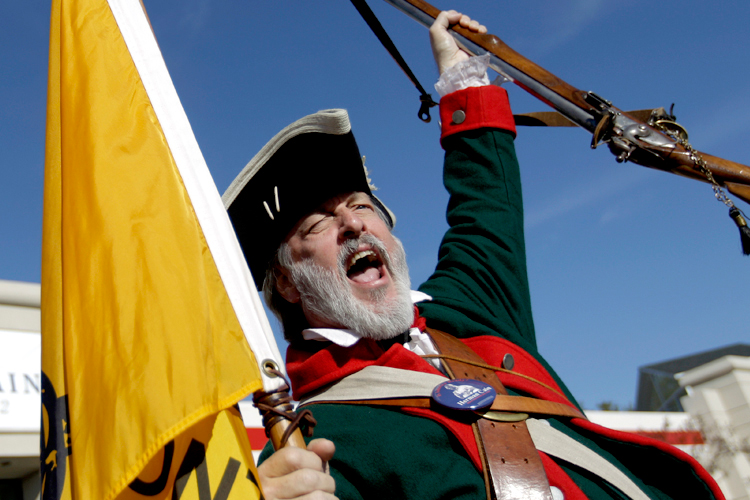
Rise of the conservative revolutionaries Tea Party supporter William Temple of Brunswick, Ga. (Credit: AP/David Goldman)

There’s plenty of proof of an authoritarian streak and animus toward democratic ideals in today’s conservative movement. There was the movement’s use of its judicial power to halt a vote recount and instead install a president who had lost the popular vote. There is the ongoing GOP effort to make it more difficult for people to cast a vote in an election. There is the GOP’s record use of the Senate filibuster to kill legislation that the vast majority of the country supports. There is a GOP leader’s declaration that what the American people want from their government simply “doesn’t matter.”

Up until today, you might have been able to write all that anti-democratic pathology off as one infecting only the Republican Party’s politicians and institutional leadership, but not its rank-and-file voters. But then this morning Fairleigh Dickinson University released this gun control-related pollshowing that authoritarianism runs throughout the the entire party.

Take a look at the cross-tabs on page 3 of the national survey. That’s right, you are reading it correctly: Almost half (44 percent) of all self-described Republican voters say they believe “an armed revolution might be necessary to protect our liberties.” Just as bad, more Republicans believe an armed revolution might be necessary than believe one isn’t necessary.

This poll raises two obvious questions, each more disturbing than the next.

The first question is about gun control and gun ownership, and more specifically, what the latter is all about.

Typically, GOP leaders say that their opposition to minimal gun regulations has nothing to do with helping arm those who want to commit acts of violence, and everything to do with wanting to make sure people can defend themselves. Based on the poll, of course, it is certainly likely that many are buying such weapons in an effort to defend themselves, both for day-to-day life and in the event of a sudden armed revolution. But here’s the scary part: How many are buying weapons to arm themselves in order to foment an armed revolution? Maybe none, but maybe a lot. I don’t have an answer, but this poll suggests the question should at least be aired.


The other question is about republican democracy: Can it survive in an age when almost one-half of one of the major parties seems to support the concept of violently thwarting it?

“Politics is war by other means”: That aphorism sums up the democratic theory undergirding the American idea for two centuries. Though we haven’t always lived up to that ideal, it is a pretty simple one: A civilized society should solve disputes through a democratic process and democratic institutions, rather than through the barrel of a gun. And while our democracy has been corrupted by Big Money, it still functions better than autocracy. In that sense, Churchill had it right when he said “democracy is the worst form of government, except for all the others.”

Incredibly, though, almost half of Republicans don’t seem to necessarily see it that way. According to the Fairleigh Dickinson poll, 44 percent of rank-and-file Republicans seem to believe that because they aren’t getting their way through the ballot box, bloodshed may be justified to impose their will on everyone else. Think of it as sore loser-ism juiced by violence.

Of course, GOP apologists will say that the poll just asked specifically about armed revolution “to protect liberties,” the idea being that almost half of Republican voters don’t support using violence to advance their own political agenda, they only support it in the face of a future dystopian nightmare whereby the population is terrorized by police-administered drone bombings and Waco-esque invasions of private homes.

But that’s the thing: We can’t be so sure that’s really true when conservative media voices and politicians are using the broad and incendiary language they now regularly employ. Today, those voices often claim that almost everything in the Democratic/liberal agenda — from Obamacare to taxes to environmental regulations to contraception policy — is an assault on “liberty.”

That means the poll might indicate something much more significant than understandable opposition to Big Brother turning our country into Oceania. It might show us that all the vitriolic language employed by the right is undermining the most basic nonviolent democratic ideals that are supposed to define America.

David Sirota

David Sirota is a nationally syndicated newspaper columnist, magazine journalist and the best-selling author of the books "Hostile Takeover," "The Uprising" and "Back to Our Future." E-mail him at ds@davidsirota.com, follow him on Twitter @davidsirota or visit his website at www.davidsirota.com.

Featured Slide Shows

7 motorist-friendly camping sites

close X
  • Share on Twitter
  • Share on Facebook
  • Thumbnails
  • Fullscreen
  • 1 of 9

Sponsored Post

  • White River National Forest via Lower Crystal Lake, Colorado
    For those OK with the mainstream, White River Forest welcomes more than 10 million visitors a year, making it the most-visited recreation forest in the nation. But don’t hate it for being beautiful; it’s got substance, too. The forest boasts 8 wilderness areas, 2,500 miles of trail, 1,900 miles of winding service system roads, and 12 ski resorts (should your snow shredders fit the trunk space). If ice isn’t your thing: take the tire-friendly Flat Tops Trail Scenic Byway — 82 miles connecting the towns of Meeker and Yampa, half of which is unpaved for you road rebels.
    fs.usda.gov/whiteriveryou


    Image credit: Getty

  • Chattahoochee-Oconee National Forest via Noontootla Creek, Georgia
    Boasting 10 wildernesses, 430 miles of trail and 1,367 miles of trout-filled stream, this Georgia forest is hailed as a camper’s paradise. Try driving the Ridge and Valley Scenic Byway, which saw Civil War battles fought. If the tall peaks make your engine tremble, opt for the relatively flat Oconee National Forest, which offers smaller hills and an easy trail to the ghost town of Scull Shoals. Scaredy-cats can opt for John’s Mountain Overlook, which leads to twin waterfalls for the sensitive sightseer in you.
    fs.usda.gov/conf


    Image credit: flickr/chattoconeenf

  • Nordhouse Dunes Wilderness Area via Green Road, Michigan
    The only national forest in Lower Michigan, the Huron-Mainstee spans nearly 1 million acres of public land. Outside the requisite lush habitat for fish and wildlife on display, the Nordhouse Dunes Wilderness Area is among the biggest hooks for visitors: offering beach camping with shores pounded by big, cerulean surf. Splash in some rum and you just might think you were in the Caribbean.
    fs.usda.gov/hmnf


    Image credit: umich.edu

  • Canaan Mountain via Backcountry Canaan Loop Road, West Virginia
    A favorite hailed by outdoorsman and author Johnny Molloy as some of the best high-country car camping sites anywhere in the country, you don’t have to go far to get away. Travel 20 miles west of Dolly Sods (among the busiest in the East) to find the Canaan Backcountry (for more quiet and peace). Those willing to leave the car for a bit and foot it would be remiss to neglect day-hiking the White Rim Rocks, Table Rock Overlook, or the rim at Blackwater River Gorge.
    fs.usda.gov/mnf


    Image credit: Getty

  • Mt. Rogers NRA via Hurricane Creek Road, North Carolina
    Most know it as the highest country they’ll see from North Carolina to New Hampshire. What they may not know? Car campers can get the same grand experience for less hassle. Drop the 50-pound backpacks and take the highway to the high country by stopping anywhere on the twisting (hence the name) Hurricane Road for access to a 15-mile loop that boasts the best of the grassy balds. It’s the road less travelled, and the high one, at that.
    fs.usda.gov/gwj


    Image credit: wikipedia.org

  • Long Key State Park via the Overseas Highway, Florida
    Hiking can get old; sometimes you’d rather paddle. For a weekend getaway of the coastal variety and quieter version of the Florida Keys that’s no less luxe, stick your head in the sand (and ocean, if snorkeling’s your thing) at any of Long Key’s 60 sites. Canoes and kayaks are aplenty, as are the hot showers and electric power source amenities. Think of it as the getaway from the typical getaway.
    floridastateparks.org/longkey/default.cfm


    Image credit: floridastateparks.org

  • Grand Canyon National Park via Crazy Jug Point, Arizona
    You didn’t think we’d neglect one of the world’s most famous national parks, did you? Nor would we dare lead you astray with one of the busiest parts of the park. With the Colorado River still within view of this cliff-edge site, Crazy Jug is a carside camper’s refuge from the troops of tourists. Find easy access to the Bill Hall Trail less than a mile from camp, and descend to get a peek at the volcanic Mt. Trumbull. (Fear not: It’s about as active as your typical lazy Sunday in front of the tube, if not more peaceful.)
    fs.usda.gov/kaibab


    Image credit: flickr/Irish Typepad

  • As the go-to (weekend) getaway car for fiscally conscious field trips with friends, the 2013 MINI Convertible is your campground racer of choice, allowing you and up to three of your co-pilots to take in all the beauty of nature high and low. And with a fuel efficiency that won’t leave you in the latter, you won’t have to worry about being left stranded (or awkwardly asking to go halfsies on gas expenses).


    Image credit: miniusa.com

  • Recent Slide Shows

  • Share on Twitter
  • Share on Facebook
  • Thumbnails
  • Fullscreen
  • 1 of 9

Comments

280 Comments

Comment Preview

Your name will appear as username ( settings | log out )

You may use these HTML tags and attributes: <a href=""> <b> <em> <strong> <i> <blockquote>