

 Nothing scrambles the conventional wisdom on contemporary class politics in the US like a white-collar strike. In our neoliberal era, we’re told that unions might have once been appropriate for the soot-faced and burly proletarians of the 1930s. But since most of those workers have long since disappeared, labor unions — the logic follows — are also no longer necessary.
But not all skilled (and deeply exploited) laborers go to work with a hardhat and a lunch pail. And just like their union brothers and sisters in warehouses and factory floors across the country, the struggle for real union representation is every bit as radicalizing.
Eliza Skinner has spent the past year writing jokes for the E! television show Fashion Police. Skinner pens about 200 jokes per episode (almost a full work week’s as far as ‘hours worked’), pitching them at a weekly meeting with the host, Joan Rivers, and the show’s producers. For this, she is paid roughly $500 a week.
What is unique about this arrangement, in comparison with Hollywood norms, is the intensity of the work (the 30-40 hours of work are usually compressed into 3 days), and the meagerness of the compensation. Fashion Police writers’ paychecks say: “Hours worked: 8” every week, regardless of the actual time spent on crafting their contributions to the show. This exploitation is especially galling because the tempo of TV production often requires marathon stretches on the writer’s part: as long as 17 hours in a row, in the case of awards specials. “8 hours. $500,” Skinner marvels. “To write a hit TV show–– one of the top rated shows on the network.”
So on April 13, Skinner and her fellow writers at Fashion Police went on strike.
Events like this as well as the Writers Guild of America strike of 2007 and 2008 remind us also how unreliable is the usual equation of “skilled worked = complacent business unionist; industrial unskilled worker = revolutionary radical.” As the work of labor historian David Montgomery has emphasized, skilled workers frequently have more direct control over the production process than their unskilled counterparts, and more to lose as managers attempted to increase productivity by taking away control of the production process.
In the case of skilled workers in the culture industries — writers, musicians, photographers, dancers, actors, directors, and many varieties of teachers — there’s been a marked tendency towards more radical forms of resistance, as in the neo-Luddism of musicians and newspaper workers who launched long, media-blackout-inducing strikes and wrote redundant “make-work” clauses into their contracts in the face of “technological unemployment.”
Thus, the walkout by the Fashion Police writers is of greater significance — as both a product of a long legacy of struggle, and as an exception to conventional wisdom — than might initially seem to be the case. In a moment marked by staggeringly low rates of union density and declining militancy, the push by the Fashion Police writers for union recognition and industry-standard contracts is even more impressive.
Twelve Fashion Police writers are seeking over $1 million in back wages from the show’s producers and Joan Rivers’s Rugby Productions. The Writers Guild of America-West’s statement alleges that the show “ignores the California laws that require an employer to pay hourly employees their regular wage rate for all time worked in an eight-hour period” and flouts the law requiring payment of overtime “for employment beyond eight hours in any workday or more than 40 hours in any workweek.”
Fundamentally, the Fashion Police writers are seeking to gain a union shop. The WGA-West has framed the strike as revolving around the question of E!’s open shop skullduggery: “There are two possible endings to this conflict. Either E! will agree to cover the writers under a Guild contract, or it will no longer benefit from the writing talents of the current staff of Guild members.”
“Unions,” Skinner stresses, “are often our only hope for health insurance or retirement benefits.” She brings up the example of a Fashion Police writer who is a world-famous drag queen, who nevertheless had to raise money himself for a double hip replacement. As he put it, “there is no drag queen union.”
Similarly, there is also no stand-up comic union. Another “Fashion Police” writer “has been on more USO tours than anyone but Bob Hope, but he can’t afford to get off the road to spend time with his daughter if he also wants to pay for his rent and her health insurance.” Finally securing a day job writing for a hit TV show, which traditionally would have guaranteed access to minimal security, instead delivered only 8 hours of pay per week.
In 2002, comedian Ted Alexandro (a great stand-up who was also integrally involved with Occupy Wall Street) wrote a petition asking New York’s comedy clubs for a pay raise, the first since 1985. With the signatures of 85 follow comedians in-hand, Alexandro won the pay raise, an astonishing labor victory in a sector known for Darwinian competition and managerial sleaze. In 2007, Alexandro helped organize a second comedians’ campaign for greater remuneration, forming the NY Comedians Coalition with Russ Meneve, Tom Shillue, and Buddy Bolton.
While it was not formally a union, Alexandro notes, it was nevertheless a “collective voice,” one that proved to be effective. “With the help of experienced union representatives from AFTRA,” Alexandro recalls, “we were able to once again get a second pay raise.”
The political economy of the entertainment industry preys on this systemic insecurity. “Since we don’t know where the next paycheck will come from,” Skinner observes, “we are often willing to take whatever we can get––so producers will only offer the bare minimum.” Comedy writers are “reminded constantly of how many people would be happy to step in and take our jobs.” Performers hear constantly that they should consider it an honor to appear on this talking-head pop-culture show, for free, that it would be great for their visibility to create content for this website, for free, and that the rewards of establishing big-name contacts by working for a famous person, for free, would necessarily outweigh any monetary compensation.
The logic, as with so much of the casualized work of the contemporary precariate, is that comedians work a variety of part-time jobs and thereby cobble together a living. “Most of the jobs we have are short,” Skinner says, “pilots, web series, movies, etc. So there is very, very little job security. Even if you are successful and doing well, you often don’t know where you’ll be working next month.”
Skinner emphasizes that most people “have no idea how much time and skill goes into writing comedy.” Being funny for a living, she suggests, isn’t just about having a humorous outlook or a quick wit. “It starts with a natural talent that is developed by years of training and practice,” Skinner emphasizes. “Once we reach the level of a professional writer, we deserve to be properly compensated for it.”
The WGA-West has also issued stern reminders to its members that they are prohibited from scabbing at Fashion Police under the Guild’s “Working Rule 8,” and members of the comedy community have been spreading the word to newcomers and the politically unaffiliated that what might look like a foot in the door––a chance to write for Joan Rivers––would actually be a career killer.
As the unionization push proceeded over the winter months, work at Fashion Police became increasingly difficult. Management attempted to squeeze the writers, no doubt hoping they would quit. Instead, the writers gamely continued to do their jobs, showing up to work in WGA T-shirts and keeping track of hours of unpaid work. Rivers remained steadfastly unwilling to talk to the writers, refusing to take any calls about the matter, even when WGA representatives contacted her to appeal to her as a longstanding WGA member.
With both Rivers and E! stonewalling, the writers decided to prepare a final batch of work, email the producers, and declare that the writing would not be made available until a union contract was in hand. Thus began the Fashion Police walkout.
For those familiar with the history of talent guilds in Hollywood, the Fashion Police writers’ militancy does not come entirely as a surprise. As Gerald Horne demonstrates in The Class Struggle in Hollywood, the Screen Writers Guild (the forerunner of today’s WGA) — formed in the early 1930s under the leadership of the radical writer John Howard Lawson — was among the reddest of all of the New Deal-era unions.
The expansive royalties and attribution rights enjoyed by writers in film and TV today can be traced back to Lawson and the SWG’s early agitation. That agitation was also a key source of animus on the part of the Hollywood studios (20th Century Fox head Daryl F. Zanuck famously said that in the event of a writers’ strike he would mount a machine gun on the studio’s roof and mow the writers down), and drove, in large part, the persecution of writers like Lawson by anticommunists in the 1940s, the imprisonment of the Hollywood Ten, and the infamous blacklists and greylists.
The legacy of the SWG and militants like Lawson led, over the decades, to the corporate imperative to create an entity like E! in the first place. Scripted network television requires a unionized workforce of writers, and under such conditions, both financial and ideological control of the production process remains elusive. That was not such a big problem during the “Golden Age of Hollywood” — the years when the major New York banks owned the Hollywood studios. As C.L.R. James argued in American Civilization, so long as the profits were steady, capital could tolerate Hollywood’s consistent liberalism and even the occasional foray into leftism.
But as multinational corporations began to buy up the entertainment industry in the 1970s, the old accord no longer held. In the era of the blockbuster franchise, the corporate tie-in, and the multiplex, culture industry CEOs saw no need to keep the old system in place, and increasingly came to regard the unionized Hollywood writer as a barrier to corporate hegemony.
This process was more obvious in the movie business than in TV, but with the rise of the videocassette, time-shifted viewing, and cable in the 1980s, writers for television became increasingly anxious that their union’s main achievement — a solid contract with a mechanism for residuals as the shows they wrote for went into syndication — would soon be on the chopping block. These new technologies would inevitably lead to renegotiation of the intellectual property-related clauses of the writers’ contracts, and writers correctly worried that the studios would seize the initiative for a broad counteroffensive.
While some controversy surrounds the notion that the WGA strike of 1988 led directly to the invention of “reality television,” there is no question that the rise of the Kardashians has everything to do with the decades-long quest by the major studios to rid themselves of their reliance on WGA members that culminated in the labor-management clashes of the late 1980s.
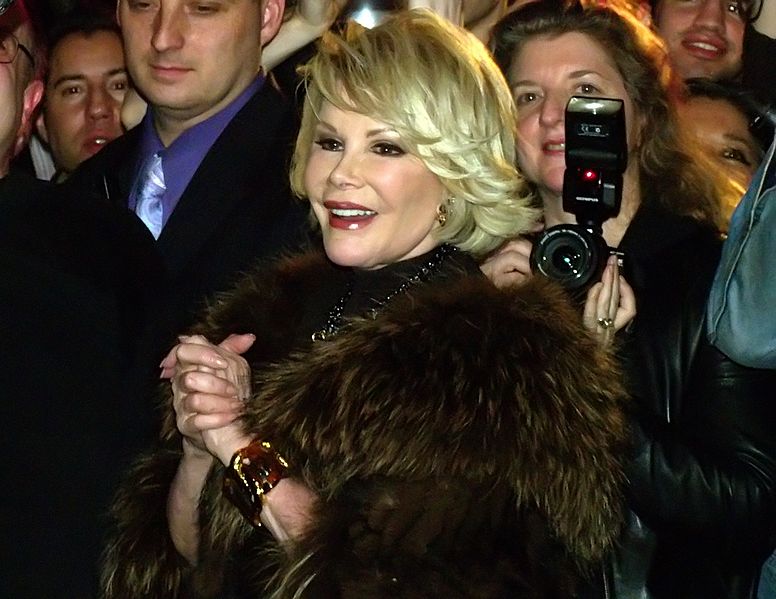
And with the rise of reality TV, the bosses more or less won. It is fitting that Fashion Police, which debuted in September 2010, should be at the center of the current labor struggle. Its star, Joan Rivers, is the prototypical reality star, appearing alongside her daughter Melissa in a 1994 TV movie dramatization of the tragic events surrounding the death of her husband and later became one of the most prominent faces on the home shopping channel QVC.
One of Rivers’s costars, Kelly Osbourne, gained fame on the pioneering MTV domestic reality show, “The Osbournes.” Another, Giuliana Rancic, has appeared in virtually every permutation of the reality TV form, and serves — especially as a red-carpet interviewer––as a living embodiment of the tactless, preening, empty narcissism that critics tend to associate with the reality TV genre writ large.
At the same time, Fashion Police has always struck me as a little more radical than most of the other fare on E! Rivers is a comic genius, a feminist icon, and one of the last living exemplars of the Popular Front-era Jewish refinement of morbid irony; her one-liners are often brutally irreverent and lacerating in a manner that can’t help but register as subversive. There is a pervasive queer/camp sensibility to the show, missing from much of the rest of reality TV.
On a channel as slavishly devoted as E! is to sycophancy, nepotism, and vulgar success-worship, there is something politically appealing about the anarchic misanthropy of Fashion Police. Of course, the show’s relentless misogyny tends to recuperate all but a few stray embers of radical affect. But those stray embers nonetheless do sometimes escape. In a media landscape with so minimal a margin for dissent, that might not be meaningless.
The question now — as in the Fashion Police strike — is not whether writers will be able to keep their hard-won guarantees to revenues from the shows they helped to create. Rather, the question is a decidedly old-fashioned one: will the writers even be allowed to join a union of their choosing in order to secure a living wage, health benefits, and some retirement security?
At the moment, the Fashion Police writers have an Unfair Labor Practice complaint filed against management for intimidation and threatened retaliation — the message received by the writers over the past weeks was that they would lose their jobs if they sought union contracts. As the legal process works its way through the system, Skinner urges her fellow comedians to voice their support for the strikers, get in touch with advertisers, and avoid watching the show. Most importantly, of course, is the need to discourage any potential scabs from crossing the picket lines.
Thus far, it seems that the “Fashion Police” writers are succeeding in winning public support and disincentivizing scabbing. With any luck, actions such as this might even lead to a radicalization of the underpaid creatives who provide so much of the content of the current media landscape.
For labor intellectuals who often reside in the intemperate zone that Jodi Dean calls “left melancholia,” it is a wonder to behold the resurgence of labor politics in a location that we usually presume to be a hotbed of toxic individualism. “Unions,” as Skinner stresses, “are our only hope for setting and maintaining standards, so that we can live off of our work.”
Interestingly, for a show with a mostly-female panel and overlap with the feminist fashion gossip culture of sites like Jezebel.com, Skinner is the only female writer for Fashion Police, aside from Rivers herself. (The producers of Fashion Police, however, are all women). Skinner asserts that gender politics have not played a big part in her experience of bringing grievances to the table, and ultimately going on strike.
At the same time, the standard “How dare you? We’re like a family” talk, so often used to silence women in the workplace, has reared its head. Skinner, however, fails to find it persuasive: “I’ve got a mom. She lives in Virginia, not Malibu.”
