
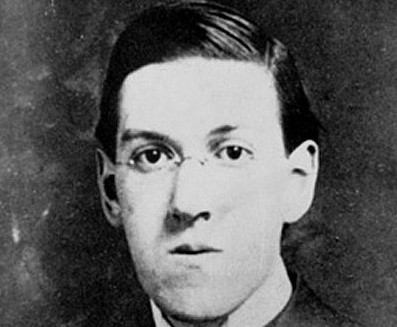

 WHY LOVECRAFT?
Why has Howard Phillips Lovecraft, the elitist, eccentric, racist New England writer of that specialized brand of fear literature known as “cosmic horror,” lasted and prospered where other, better writers have been forgotten.
After all, Lovecraft was not the best of his era in any of the genres he wrote in. Clark Ashton Smith was a better stylist. Algernon Blackwood wrote better horror. Olaf Stapledon wrote better science fiction. Yet it is Lovecraft who has been canonized with a Library of America edition, who has provided the source material for academic writings, comic books, and even game shows like Jeopardy, and who has been assimilated by capitalist culture to the point that there are plushies made of his characters.
One would never have guessed this fate for Lovecraft at the time of his death in 1937. He had had some success publishing his stories in the pulps, including Amazing Stories and Astounding Science Fiction, but he was poor, ailing, and obscure when stomach cancer took him. Roger Luckhurst calls him “an unknown and unsuccessful pulp writer” whose last work had appeared the year before, in 1936, and whose best work was years behind him. Only eight years after his death, Edmund Wilson wrote a savage piece of criticism dismissing Lovecraft as a “hack.”
So why has Lovecraft survived? Why not Smith, or Blackwood, or Fritz Leiber, or the many other, better writers of his time? What separates Lovecraft from Nictzin Dyalhis, to take one name among many from the Weird Tales stable?
This is one of the questions Roger Luckhurst attempts to answer in his introduction to The Classic Horror Stories, the best critical edition to date of Lovecraft’s major stories. One might argue that it is past time for a short form, one-volume critical edition — the Library of America reproduces a number of Lovecraft’s lesser stories in addition to his classics. Luckhurst’s decision to limit himself to the stories Lovecraft wrote from 1926 to 1931, after his departure from New York City, is a sound one, as only Lovecraft’s best are included: “The Horror at Red Hook,” “The Call of Cthulhu,” “The Colour Out of Space,” “The Dunwich Horror,” “The Whisperer in Darkness,” “At the Mountains of Madness,” “The Dreams in the Witch House,” “The Shadow Over Innsmouth,” and “The Shadow Out of Time.” Luckhurst wisely includes “The Horror at Red Hook,” written in 1925, because it is a seminal work for Lovecraft, the fictionalization of Lovecraft’s Primal Scene, his exposure to the immigrants among the teeming masses of New York City. As a one-volume introduction to Lovecraft’s work, The Classic Horror Stories excels, and Luckhurst’s explanatory notes, covering Lovecraft’s many allusions and inventions, are exhaustive and informative.
But of course the first thing one turns to in a critical edition of an author as commented-upon as Lovecraft is the introduction. It’s here that Luckhurst really shines, with a couple of important exceptions. Luckhurst’s biography of Lovecraft is sympathetic and extensive; his coverage of Lovecraft’s posthumous career is solid, though too brief; his explanation of Lovecraft’s philosophy is insightful; and, critically, Luckhurst covers the knotty problem of Lovecraft’s racism with admirable balance, erudition, and concision. For Luckhurst, Lovecraft’s racism is “typical of its age, but driven towards pathological intensity by Lovecraft’s perception of himself as the last scion of New England civilization.” Luckhurst neither downplays Lovecraft’s racism nor exaggerates it compared to his contemporaries — an anecdote about the racism of Henry James is used to telling effect.
Best of all is Luckhurst’s analysis of what he calls the “charged question” of Lovecraft’s style. Luckhurst’s explanation of Lovecraft’s deliberate misuse of language (“adjectives move in packs, flanked by italics and exclamation marks that tell rather than show”) hinges on the astute observation that Lovecraft uses catachresis (“the deliberate misuse of language, such as mixed metaphors”). Luckhurst explains that Lovecraft was actually precise in his deployment of vocabulary — that “the power of the weird crawls out of these sentences because of the awkward style. These repetitions build an incantatory rhythm, tying baroque literary form to philosophical content. Conceptually, breaking open the world requires the breaking open of language and the conventions of realism.”
Luckhurst’s essay is not without its problems, however. Luckhurst does not address the issue of Lovecraft’s appeal, either to critics or the public. He spends little time in making the case that Lovecraft is actually worthy of a critical edition. And more problematically, Luckhurst removes Lovecraft from the traditions of science fiction and horror and from his pulp context and instead treats him as part of the “Weird.”
Luckhurst asks but does not answer the question of what draws readers in to Lovecraft’s work. Some of the reasons are obvious: the intelligence, imagination, and quality of Lovecraft’s best stories; their newness — there was nothing like them being written, and they remain different still, after all these decades; and the exhilarating sense of a writerly intellect at play. Other reasons are less obvious: the perverse attractiveness of Lovecraft’s brand of cosmic nihilism; his ability to convey and arouse disgust, fear, and other cathartic negative emotions; and the way in which Lovecraft’s universe can be adopted and co-opted, whether seriously or for play, by other writers and by readers and game-players.
Likewise, Luckhurst may assume that Lovecraft’s greatness is a given by now, and that there is no need to rebut Wilson’s brusque indictment. But even a cursory glance at Lovecraft criticism turns up ample dismissals of Lovecraft’s positive qualities or statements that he is only a good bad writer — and indeed, Luckhurst quotes some of these dismissals in the first sentence of his introduction. Luckhurst’s essay would have benefitted from an exploration of some of those aspects of Lovecraft’s work that have appealed to his critical defenders: his incorporation of the latest contemporary science into his science fiction; his talent for creating a sense of place — he can accurately be called a regional writer, but one whose region, New England, is decaying and backward and vulnerable to a touch of the future or the outside; his dark Gnosticism in his portrayal of knowledge negatively transforming the knower; and his portrayal of the laws of reality as mutable and contingent, rather than absolute.
The question of why Lovecraft gained in popularity after his death and Clark Ashton Smith or Algernon Blackwood did not is slightly more complicated. Lovecraft escaped the fate of the vast majority of writers — obscurity, to a greater or lesser degree — through several extra-literary events. Luckhurst only alludes to Lovecraft’s letter writing, but it was critical in establishing Lovecraft as a literary presence to his contemporaries. Lovecraft was an extraordinary correspondent, writing an estimated hundred thousand letters in his lifetime, to fans and fellow writers, especially those working for the pulpWeird Tales. Decades before the social media, Lovecraft used letter writing to create a presence for himself in the consciousness of fans and writers and to create the social capital that paid off after his death.
Too, Lovecraft was the first author to create an open-source fictional universe. The crossover, the meeting between two or more characters from discrete texts, is nearly as old as human culture, beginning with the Greeks if not the Sumerians. The idea of a fictional universe open to any creator who wants to take part in it is considerably newer. French authors like Verne and Balzac had created the idea of a single universe linked through multiple texts, and following them, the dime novels and story papers of the late nineteenth and early twentieth centuries had established the idea of ongoing fictional universes, but those universes were limited to magazines published by the original stories’ publishers. It was Lovecraft who first created a fictional universe that anyone was welcome to take part in. Both during his lifetime and immediately afterward, other authors made use of Lovecraft’s ideas and creations in their own stories and novels. Lovecraft’s generosity with his own creations ultimately gave them a longevity that other, better writers’ ideas and characters did not have.
Rather than placing Lovecraft in “horror” or “science fiction,” Luckhurst places him in the category of the “Weird.” As Luckhurst describes it, the Weird is that group of “strange or unsettling stories — sometimes supernatural, sometimes not … [T]he weird concerns liminal things, in-between states, transgressions always on the verge of turning into something else,” a set of fiction which became a distinct subgenre beginning in the 1880s and which includes authors ranging from Coleridge to China Miéville. The advantage to placing Lovecraft in this tradition is that Lovecraft becomes a shaper and establisher of the subgenre, both through his fiction and through his weird-canon-shaping essay “Supernatural Horror in Literature.” This argument makes Lovecraft into a figure of signal importance in an academically respectable genre, rather than in horror or science fiction, both occupants of the academic ghetto.
But locating Lovecraft in this way is unusual, to say the least. He is usually placed by critics in either the science fiction or the horror genres, or both. There is no reason his work cannot be part of both genres, and for that matter the Weird, rather than the either/or Luckhurst presents us with. Describing Lovecraft as part of horror and science fiction renders him less unique, and more a significant but not singular author who is part of a tradition, not an establisher of one.
Luckhurst’s move is an arguable one. Lovecraft did use “the weird” to describe his own work, but more often used phrases like “literature of cosmic fear” and “fear-literature,” phrases that point toward Lovecraft locating himself in the horror genre. And many of the core concepts and tropes of Lovecraft’s work are pure science fiction. One is forced to ask, what is gained by removing Lovecraft from the genres of horror and science fiction and putting him into the Weird, except academic respectability?
As well, Luckhurst’s shift gives Lovecraft undue credit as the creator of cosmic horror. The concept was not original to him. Elements of it can be seen in the more extreme Gothics of the 1810s and 1820s, in the 1830s in the French poet Théophile Gautier’s “One of Cleopatra’s Nights” and in the Russian Romanticist Vladimir Odoevsky’s “The Cosmorama,” and in the 1840s in Lord Bulwer-Lytton’s Zanoni and James Malcolm Rymer’s Varney the Vampyre. By the 1890s Arthur Machen and Robert Chambers were both writing stories of cosmic horror, albeit ones whose ontological underpinnings were significantly different from what Lovecraft would write. As Lovecraft’s essay “Supernatural Horror in Literature” demonstrates, Lovecraft knew and admired these stories and authors and considered himself to be working in their tradition.
Lovecraft did not create cosmic horror. He recreated it. Lovecraft desacralized cosmic horror, reinterpreting it through the lens of modern scientific theory and removing its Victorian moral assumptions. What Lovecraft created was a specifically twentieth century idea: the universe as an empty, materialist one, in which there is no spiritual meaning to any actions and in which human existence is not significant in any way. This idea has been enormously influential on creators of fantastic fiction, and is Lovecraft’s lasting legacy.
To focus on the Cthulhu Mythos rather than on Lovecraft’s own materialist philosophy and affection for cosmic horror is to miss Lovecraft’s own weariness with the Mythos at the end of his life, and his apparent desire to write something new, something that would not require a laborious tying-in to the Mythos but that would be purely science-fictional and purely cosmic horror. But in this Lovecraft would suffer an appropriately Lovecraftian fate. The typical Lovecraftian character is destroyed by too much knowledge of the real world. For Lovecraft, the more exposure he had to the reality of publishing — what Luckhurst calls “the buffeting Lovecraft received from editors and market pressures” — the more despairing he became, and the less he produced as a writer — only two stories in the last six years of his life. And in that respect Lovecraft’s life is the most Lovecraftian of them all.
