

In the wee hours of the morning of January 27, 2013, a Wikipedia editor named “Qworty” made a series of 14 separate edits to the Wikipedia page for the late writer Barry Hannah, a well-regarded Southern author with a taste for the Gothic and absurd.
Qworty cut paragraphs that included quotes from Hannah’s work. He removed 20 links to interviews, obituaries and reminiscences concerning Hannah. He cut out a list of literary prizes Hannah had won.
Two edits stand out. Qworty excised the phrase “and was regarded as a good mentor” from a sentence that started: “Hannah taught creative writing for 28 years at the University of Mississippi, where he was director of its M.F.A. program …” And he changed the cause of Hannah’s death from “natural causes” to “alcoholism.” But Hannah’s obituaries stated that he had died of a heart attack and been clean and sober for years before his death, while his role as a mentor was testified to in numerous memorials. (Another editor later removed the alcoholism edit.)
Taken all together, the edits strongly suggest a focused attempt to diminish Hannah’s legacy. But why? Who was Qworty and what axe did he have to grind with Hannah?
The answer to this question is on the one hand simple, almost trivial: Qworty turned out to be another author who had a long history of resenting Hannah. The late night Wikipedia edits are certainly not the first time that a writer’s ego has led to mischief. But the story is also important. Wikipedia is one of the jewels in the Internet’s crown, an amazing collective achievement, a mighty stab at realizing an awesome dream: a constantly updated repository for all human knowledge. It is created from the bottom up, a crowd-sourced labor of love by people who require no compensation for their work but also don’t need to jump through any qualifying hoops. Anyone can edit Wikipedia. Just create an account and start messing around!
Qworty’s edits undermine our faith in this great project. Qworty’s edits prove that Wikipedia’s content can be shaped by people settling grudges and acting out of spite and envy. Qworty alone, by his own account, has made 13,000 edits to Wikipedia. And Qworty, as the record will show, is not to be trusted.
++++
Qworty first came to my attention in late April, when I discovered that he was responsible for a series of “revenge edits” to Wikipedia pages associated with the writer Amanda Filipacchi. Filipacchi had made a big splash with her widely read New York Times op-ed identifying a pattern of sexist editing at the online encyclopedia. Qworty’s edits were an obvious act of retaliation. In my piece, I called out two disturbing outbursts made by Qworty in different Wikipedia discussion forums, cries of rage that revealed a level of high emotion one does not normally associate with sober encyclopedia writing.
In the parlance of Wikipedia, “revenge edits” are modifications to a Wikipedia page motivated by anger. They are acts of punishment. Such behavior is officially considered bad form by the larger Wikipedia “community,” but given Wikipedia’s commitment to anonymity and general decentralized structure, it is a practice that is very difficult to stamp out.
In the aftermath of the Filipacchi episode, Qworty did not lack for defenders. Qworty, like many other Wikipedia editors, took seriously his responsibility to root out what he considered self promotion, unjustifiable praise or outright puffery. Just the facts, ma’am! He described himself, on his own Wikipedia user page, as particularly focused on identifying and fixing “articles with potential conflicts of interest.” Wherever he found people manipulating Wikipedia to their own advantage, he would intervene.
On Wikipedia founder Jimmy Wales’ Talk page, some Wikipedia editors argued that Qworty’s actions in the Filipacchi affair were entirely proper. What’s more, even if he did occasionally go overboard, the subsequent public attention on the results of his over-enthusiasm would rectify affairs. That’s how Wikipedia works, the argument goes. Whenever focus turns to some hitherto lightly-visited Wikipedia backwater, it is not unusual for a flurry of editors to arrive to scrub everything clean and bring it all up to proper snuff. The endlessly iterative Wikipedia rights itself in the end.
But two weeks after my story was published, a group of Wikipedia editors affiliated with the Wikipedia criticism site Wikipediocracy approached me. After weeks of research, these editors were convinced that they had identified Qworty as a novelist who had long been surreptitiously editing his own Wikipedia page — and was guilty of his own multiple instances of self-puffery. Not only was Qworty guilty of revenge editing, they argued, but he was also a raging hypocrite! A conflict-of-interest cop who had initially created a Wikipedia account for the sole purpose of pursuing his own self-interest.
The writer they identified is Robert Clark Young, author of the 1999 novel “One of the Guys.” After reviewing their research and doing some of my own reporting, I thought there was enough evidence to go on to pursue the story. On Tuesday, May 14, I contacted Young on Facebook. We chatted for 15 minutes or so. He categorically denied any connection to Qworty.
“I know nothing of how Wikipedia is edited and have never had an account there,” Young told me. “I’m afraid that I am so tech-deficient that I wouldn’t even know how to open one.”
Young’s denial was so whole-hearted it made me doubt the case against him. Perhaps he was actually exactly what he claimed to be, an utterly non-tech-savvy writer who has in the past few years dedicated himself primarily to taking care of his elderly, ill parents.
And yet at the same time, Qworty and Young were clearly connected. Not only did Qworty have a long history of close involvement with editing Young’s page, but I found that he had a long record of negatively editing the pages of writers that Young had had disputes with in the past. With the help of Wikipediocracy, I discovered a real-world story here that went at least as far back as 2001, when Robert Clark Young participated in a well-known writer’s workshop at the Sewanee Writers’ Conference in Tennessee. A workshop that was led by none other than Barry Hannah.
According to one eyewitness account, Young’s work was not well received at that workshop. So one theory for Qworty’s mysterious edits was that he was working out old grudges. His Wikipedia edits were an online mirror of off-line vendettas. I dug deeper, and as the week progressed I continued to press Young with further questions.
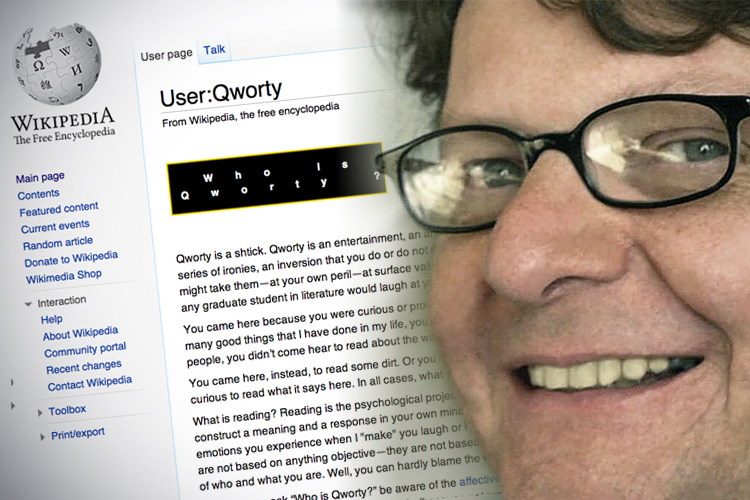
On Thursday morning, about 48 hours after I first contacted Young, Qworty published a dramatic manifesto on his user page at Wikipedia. Titled “Who is Qworty?” the essay declared Qworty to be “a schtick … an entertainment, an annoyance, a distraction, a put-on, a reading experience, a performance, a series of ironies, an inversion that you do or do not get. ”
“Wikipedia is the great postmodern novel,” declared Qworty. “Wikipedia is ‘not truth’ … Wikipedia, like any other text, is not reality.”
Those of us who depend on Wikipedia as a source of neutral, accurate information might find some cause for alarm in the fact that an editor responsible for 13,000 edits believes Wikipedia is a postmodern novel. But ironically, the closer one examines the trail of evidence left behind by Qworty, the stronger his case seems! If truth is messy, then Wikipedia is even messier.
I told Young later that morning that I was more convinced than ever that he was Qworty. A few hours later, he responded to me with a baffling sequence of messages that at first made no sense. Eventually, I realized that he had confused me with someone else, and in doing so, had seriously contradicted some of his earlier assertions. A few hours later, at 4 p.m. Pacific time, Young told me on Facebook that he had posted a statement on his Wikipedia page. The jig was up. Qworty admitted that he was “Bob Young.”
In my experience, mysteries rarely wrap themselves up so neatly. But solving the question of Qworty’s true identity doesn’t end this story. In his confession, Qworty claimed that “All of my edits have been in accordance with Wikipedia policy.” This is hard to square with many of his edits to the pages of other writers and, in particular, his strenuous efforts to hide his own identity when editing his own page. Qworty has also been at the center of scores of disputes over the years. He has even come to the angry attention of Wikipedia founder Jimmy Wales on at least three separate occasions. As far back as 2010, Wales told Qworty that “You have been warned many times in the past about civility violations and so I know you know better.”
Qworty has destructively edited the pages of other writers. He has made numerous edits to his own page while obsessively hiding his true identity. And yet there have never been any significant consequences for his actions. For those of us who love Wikipedia, the ramifications of the Qworty saga are not comforting: If Qworty has been allowed to run free for so long — sabotaging the “truth” however he sees fit, writing his own postmodern novel — how many others are also creating spiteful havoc under the hood, where no one is watching?
++++
Before we get to the nitty gritty of how Qworty was exposed, let’s spend some time in the real world of Robert Clark Young. The first paragraph of Young’s Wikipedia page finishes with the line: “Young has been involved in several high-profile issues through the fiction and journalistic articles he has written.”
For our purposes here, the most noteworthy of these “high-profile issues” was a ferocious assault launched by Young against the Alabama writer Brad Vice, along with nearly everyone else associated with the Sewanee Writers’ Conference, published in the pages of the New York Press in December 2005.
At the time Brad Vice was an up-and-coming writer who had made a very bad mistake. In one of his short stories, “Tuscaloosa Knights,” he included, without attribution, passages from an autobiographical non-fiction work by Carl Carmer, a writer who is an icon of sorts for the Alabama literary community. The discovery of what many saw as a clear case of plagiarism created a huge stink. Vice’s first collection of stories was pulped by his publisher (although it was later reissued in slightly revised form).
An argument can be made that Vice’s “plagiarism” was actually a convoluted, postmodernish homage to Carmer. A fierce and lengthy battle broke out in the Southern literary community over just exactly how big a sin Vice had committed. Vice is teaching at the University of West Bohemia in the Czech Republic and declined to revisit with me what he considers the most painful part of his life. But how one judges Brad Vice isn’t really pertinent to this story. What we do know for sure is that Robert Clark Young devoted a significant amount of intellectual and emotional energy to attacking not just Vice, but the entire community of writers centered around the Sewanee Writers’ Conference that had nurtured Vice.
In his New York Press diatribe, Young described the Sewanee writers as a bunch of back-scratchers who “go about coloring one another’s Easter eggs and then filling one another’s baskets.” He reserved special vehemence for Barry Hannah, “the conference’s Godfather, the ailing patriarch who sits in an overstuffed chair in the conference bookstore, too weak to stand, the youngsters kneeling before him as he signs books.”
“While Hannah’s posterior is arguably the most prominent one available for the ambitious lips that gather at Sewanee,” wrote Young, “Vice was prolific in giving positive strokes to anyone at the conference who could have been of use to him.”
But perhaps the most important passage is one which named no writers at all, but just described the conference.
Over those 12 days, many of the South’s leading writers will congregate here. They will decide which of the conference’s attendees should be considered for future scholarships to the conference, which writers should receive letters of recommendation to graduate programs, which hot new novelists should receive blurbs, which conference attendees should be nominated for inclusion in “New Stories From the South,” and which book-length manuscripts might make good candidates for next year’s Flannery O’Connor Award in Short Fiction. In addition to deciding which writers will be rewarded with career boosts, they will decide which writers will be greeted at the conference with indifference or official silence or, even worse, a coordinated workshop attack.
The emphasis is mine. Because one relevant piece of data that Young probably should have included in his broadside was the fact that in the summer of 2001, Young had been a guest fellow at the Sewanee Writers’ Conference, where he had both given a reading and participated in a workshop co-taught by Barry Hannah.
In the eruption of online commentary that Young’s article provoked, a longtime Sewanee staffer, novelist Leah Stewart, pointed out Young’s omission. Acknowledging that she was “one of the Sewanee insiders Young so despises,” Stewart wrote that “I don’t even begin to recognize the version of Sewanee Young paints, and I can’t help but feel that that description, and his vendetta against Brad Vice, are colored by the fact that his work was poorly received at the conference, both in the workshop and at the reading he gave.”
I contacted Stewart this week, and she confirmed to me via email her account of the Sewanee workshop. Young/Qworty later contended that comments such as Stewart’s were part of a “smear campaign” carried out by Vice’s friends. That possibility cannot be ruled out of hand, but one has to wonder: Did Young consider himself to be a victim of a “coordinated workshop attack” at Sewanee? And did he vow revenge?
++++
So much for the real world, where writers have been getting pissed off at other writers and taking their vengeance via the poison pen since the days when cuneiform was the dominant communications medium. Now let’s move to the online world of Wikipedia, where the same pettiness and spite runs rampant, only cloaked in pseudonyms and hidden in palimpsest-like layers. Let’s put aside Robert Clark Young for the moment, and focus on Qworty.
Qworty’s very first action as a Wikipedia editor, barely five minutes after he created his account on March 10, 2007, was to archive the Talk page devoted to Robert Clark Young’s Wikipedia page.
Talk pages are where Wikipedia editors hash out their differences on what should be included in the text of a Wikipedia article. If you are a savvy Wikipedia user, and you doubt the accuracy or sourcing of some element in a particular article, it is often quite useful to inspect the Talk page to see what people have been fighting about. Talk pages show how the sausage gets made. Talk pages, just like actual Wikipedia articles, can also be edited — conversations about content can be removed, as well as the content itself. It is to Wikipedia’s great credit that not only is every single previous version of every Wikipedia article preserved for all time, but so too are all the versions of all the discussions about those pages.
Archiving a Talk page doesn’t get rid of it entirely; it just makes the page one more click distant from the curious reader. The usual justification for archiving a page is that it has gotten too long and unwieldy and out of date. Years of old discussions make it difficult to find more recent discussions of pertinent matters. But archiving a page is also a way of hiding it, of adding one more level of obscurity to issues that someone might prefer left out of the public eye.
And that’s where it gets interesting. Notable items on the Talk page about Young that was archived by Qworty included 1) a long dispute between two editors about how best to describe Young’s involvement in the Brad Vice plagiarism controversy, 2) an assertion that Young had at one time admitted writing his own Wikipedia page, and 3) an exchange between two editors in which one editor was suspicious that the other was actually Robert Clark Young, acting under yet another hidden identity.
The fact that Qworty’s very first action as an editor was to make it just a little bit more difficult for the casual reader to stumble upon discussions questioning whether Young was involved in editing his own page raised a red flag for the Wikipediocracy editors investigating Qworty. They were further intrigued to discover that two additional edits had then been made to the archived Talk page. These edits removed the reference to Young’s supposed admission that he had written his own page and deleted the conversation in which one editor had questioned the true identity of the other editor.
The Wikipediocracy researchers further discovered that those two edits had been made by two different editors who had created accounts solely to make one edit — the change to the archived Talk page about Young. After making those edits, the accounts never made another edit again. The implication is obvious. Someone was really obsessed about doing everything possible to hide any discussion of whether Robert Clark Young was involved in editing his own page, to the point that they were creating special purpose Wikipedia accounts to cover their tracks.
In my own reporting, the only online reference I could find to Young supposedly admitting that he had written his own Wikipedia page appears in a blog post by the writer Michelle Richmond in December 2005, shortly after Young’s New York Press piece. Richmond, a novelist originally from Alabama but now living in San Francisco, had made the assertion while discussing Leah Stewart’s account of Robert Clark Young’s bad Sewanee experience.
I emailed Richmond and asked her whether she remembered the source of her assertion. She could not recall where she had heard it. As far as I was concerned, as a reporter, her blog post was therefore useless for proving anything about Qworty’s identity. It was unsourced hearsay, and I could understand that a good case could be made that it should have no place in the sourcing for a Wikipedia article. Still, I was intrigued to see that an effort had been made to hide the discussion about the propriety of linking to her post in an archived Talk page. And alarm bells really started to ring when I learned that in April 2013, Qworty made a series of changes to Michelle Richmond’s Wikipedia page, removing links to stories by and about her.
As I came to discover, over the years, Qworty has also made changes to Brad Vice’s Wikipedia page, to Barry Hannah’s Wikipedia page, and to the pages of another Sewanee writer treated very harshly in Young’s New York Press story, Richard Bausch. Qworty, of course, made scores of changes to Robert Clark Young’s page. Now that we know Qworty is Robert Young, the evidence of rampant abuse of Wikipedia’s policies on conflict-of-interest is undeniable.
The most hilarious Qworty-Young conflict-of-interest incident involves the writer Thomas Pynchon. In January 2007, a Wikipedia editor named “Mangawood” — again, an account that only made one edit, ever, to Wikipedia — added the following paragraph to Thomas Pynchon’s page:
In the late 1980s, author Robert Clark Young prevailed upon his father, an employee of the California Department of Motor Vehicles, to look up Pynchon’s driving record, using Pynchon’s full name and known birthdate. The results showed that Pynchon was living at the time in Aptos, California, and was driving a Datsun. Young reported the episode in his essay “One Writer’s Big Innings,” published in the Black Warrior Review and reprinted in the AWP Chronicle.
Two days later, another editor changed the last sentence to, “The improperly-obtained cancelled licence subsequently found its way into the hands of at least two academics publishing scholarly work on Pynchon.”
Three years later, Qworty deleted the words “improperly-obtained” from the sentence. No detail involving Robert Clark Young was too small for Qworty/Young to attend to.
There were moments during the reporting of this story that felt like I had become a character in a Thomas Pynchon novel. Then Pynchon made a cameo appearance. Could the story get any deliciously weirder? Yes, it could. If you consider a rampaging army of sock puppets weird.
A sock puppet is an online persona created to purposefully disguise one’s identity. According to the Wikipediocracy researchers who have gone over every edit on Robert Clark Young’s page with a brace of exceedingly fine-toothed combs, much of the early work creating and editing the page — long before Qworty made the scene — was carried out by a series of disposable sock puppets: Wikipedia accounts that were created, made a few edits and then disappeared forever.
Many of these sock puppets can be traced to IP addresses located in California, where Young was raised and still lives. Three different sock puppets were affirmatively discovered to be operated by the same person behind Qworty — a big no-no for Wikipedia. One short-lived sock puppet was named “Professor Ron Hill” — the name of an English professor who taught at the University of San Diego while Robert Clark Young was attending classes there. Some of the sock puppets were female personas, some male. (One person who knows Young told me that he often liked to assume female personas online.)
When I first reviewed it, the available information about the sock puppets who have been editing Young’s page didn’t add up to anything I would consider a smoking gun proving that they were all operated by Young. Now that we know that Qworty is Robert Young, it seems entirely possible that the majority of these sock puppets, if not all of them, were Young. We’ll probably never know the full truth. What we do know, however, casts a harsh light on Wikipedia. Wikipedia’s commitment to respecting anonymity means anyone can create their own sock puppet and make whatever edits they like. This is supposed to be against Wikipedia’s rules, but the available evidence suggests that enforcement is lax.
And this is what bothers the Wikipediocracy critics the most. This is why they came to me. There’s no accountability.
“The reason I am doing this,” said Andreas Kolbe, one of the Wikipedocracy members who shared his research with me, “is that I want the public to know just what goes on under the surface of Wikipedia and how the site plays dice with people’s reputations by allowing anonymous editing of biographies of living persons. As someone who joined the project with a fair amount of enthusiasm for its mission more than seven years ago, I have found the realities of how Wikipedia is written irresponsible and deeply disturbing, and given the site’s status as a top-10 website, I believe the public needs to understand just what is going on in Wikipedia day after day.”
++++
On Tuesday, I found Robert Clark Young on Facebook, and I asked him straight out if he was Qworty. Here is our first exchange:
Andrew Leonard
Hi, I’m a writer for Salon, researching a story about Wikipedia editing. Your name has come up in the discussion of the activities of a user named Qworty, and I’d like to talk to you about it.
Robert Clark Young
Hello Andrew,
I know nothing of how Wikipedia is edited and have never had an account there. I’m afraid that I am so tech-deficient that I wouldn’t even know how to open one.
I have been aware for some time that there is an article there about me, but like many articles on Wikipedia (as I gather), it contains several factual errors. For instance, I never graduated with a Ph.D. from the University of Houston, and have never claimed to. I left the doctoral creative program there after one year.
A few years ago, my agent wrote to the editors of Wikipedia to have this and a few other errors corrected, but to my knowledge nothing was ever done. If you know someone who could help me with this I would be most grateful.
All the best,
Andrew Leonard
Thanks. So the story gets curiouser and curiouser. Did you know that there are a group of Wikipedia editors who are convinced that _you_ are the Wikipedia editor Qworty? Did you know that just a few days ago, your Wikipedia page was vandalized (and then restored) — as part of the back-and-forth in a very convoluted sequence of “edit wars” that has been raging for the last few weeks?
Robert Clark Young
No, I was not aware of any of that. I am not an editor “Qwerty” and I do not know any editors there. Also, what do you mean by “vandalized”? Do you mean vandalized as in stolen or robbed and then moved to another website or something? Should I be alarmed, and/or should I contact the editor-in-chief of Wikipedia perhaps? Thank you for the information.
Some parts of the exchange struck me as odd, particularly his declaration that he was was “tech-deficient.” Young has over 5,000 friends on Facebook, a Twitter account, a resume that includes a stint teaching at the online-only University of Phoenix and a credit on his eldercare website that says “Designed by Robert Young © 2012 using Homestead website templates.” He sounded right at home in the realm of new technology.
After I discovered Qworty’s pattern of meddling with Wikipedia pages of writers that Young had tangled with, I challenged him again but received no answer. Instead, Qworty published his postmodern Wikipedia manifesto. A few hours after I told Young on Facebook that I was convinced he had written the manifesto, he responded with a series of messages that made no sense. He seemed to be confusing me with someone else.
Robert Clark Young
I don’t get it. And I mean this as objectively as possible, since I have zero knowledge of the background here. But it seems to me that saying “It’s a shit article about a non-notable dump of a store” is a lightyear or two distant from the work of Jesus.
Now, for all I know, it IS a shit article and the store IS a fucking dump. I haven’t looked at the article and I haven’t been in the store.
So if what we are discussing is your beef or complaint or whatever you want to term it, I don’t see it.
If, on the other hand, your issue is full disclosure in journalism, then I suppose in every article you write bashing Wikipedia, you would be required to list your extensive blocking history there, as well as whatever went on.
I don’t know what went on.
None of these are my issues.
Young’s message was baffling. I knew that I had never said, anywhere “It’s a shit article about a non-notable dump of a store.” So I googled that phrase and found it turned up in a Wikipediocracy thread that, oddly, a member of Wikipediocracy had tweeted a link to me the day before. But the phrase that really jumped out at me was the reference to my “extensive blocking history” at Wikipedia. On Wikipedia, editors who break the rules and are caught are blocked from being able to continue editing. I have no “blocking history” at Wikipedia — I’ve never even had an account there. The reference caught Young in a revealing contradiction. He’d pretended initially that he had no knowledge of how Wikipedia works, but the context of this bizarre communication indicated that he had a pretty good understanding of the interior mechanics of Wikipedia.
I suggested he needed to come clean. Two hours later, Young sent me a message saying he had posted a statement on Wikipedia. That turned out to be Qworty’s confession. In his confession, Qworty/Young made the following claims:
I stand behind all of my other edits. If you disagree with some of them, then your disagreement is with Wikipedia policies themselves or the ways in which you perceive that I have applied them. Or perhaps your disagreement is more fundamental: with the “culture” of Wikipedia itself.
In 2005 and 2006, my own Wikipedia article was vandalized by writers with whom I was then engaged in a public literary feud. I came here initially to correct and defend the article about me. I then became interested in Wikipedia editing in general.
Over the years, I have occasionally edited the Wikipedia articles of writers with whom I have feuded. These edits were done in compliance with Wikipedia policies, and I stand by those edits.
The mind boggles. After years of styling himself as someone who specializes in scrubbing Wikipedia pages clean of “conflicts of interest,” Qworty/Young admitted to editing “the Wikipedia articles of writers with whom I have feuded.” How can Wikipedia possibly allow this man to keep his editing privileges? And how are we, the general public, supposed to trust Wikipedia, when Qworty’s record shows how easy it is to work out personal grudges and real-world vendettas in this great online encyclopedia for years without anyone taking action?
Qworty is just one of thousands of Wikipedia editors. He is surely not representative of the mainstream. But just as surely, there are others like him, working out their own agendas under cover of assumed identities. We just don’t know. Nobody knows. Nobody watches everything that happens on Wikipedia; nobody can watch everything that happens. But Qworty’s example tells us that even when people call attention to a rogue editor, even when that editor’s temper tantrums come to the attention of the founder of Wikipedia, it’s quite possible that no action will be taken.
The greatest irony of Qworty’s story is that his own actions as an editor prove his theory that Wikipedia is a postmodern novel in which “truth” and “reality” don’t exist. And yet Wikipedia is also an important, valuable part of our everyday information lives, relied upon by millions of people as a great source of information. What does it say about all of us that we’re living in, and depending on, a postmodern novel constructed, in part, on grudge-settling authors engaged in ancient vendettas? Could Thomas Pynchon have dreamed this up?
UPDATE:
Moments before this article was due to be published, a member of Wikipedia’s Arbitration Committee posted the following message on Qworty’s Talk page.
Your thoughts on your userpage and above present some interesting food for thought. However, some of your comments above are extremely troubling when considered in light of your edits and the “rants” you posted last month, which were deeply unfortunate and reflected negatively on the project. If you do continue or resume editing in the future, you are directed not to edit biographical articles concerning any living person (other than yourself and excluding reversion of obvious vandalism) and not to make disparaging comments about any living person on any page of Wikipedia. I hope you will understand that at this point, these restrictions are in the best interests of all concerned. Newyorkbrad (talk) 16:07, 17 May 2013 (UTC)
SECOND UPDATE: For further reading on this saga, including more details about how Qworty went about his editing, please read this blog post by the folks at Wikipediocracy.
THIRD UPDATE: Wikipedia’s self-correcting mechanisms leaped into action after the publication of this article. Qworty has been officially, and indefinitely, blocked from editing Wikipedia, and various investigations into his past history have begun. You can see the Wikipedia community in action here.
