

Is this the end of unpaid internships?

A judge's ruling in favor of two Fox Searchlight interns could change the way companies big and small do business

Topics: ProPublica, fox searchlight, interns, Black Swan, Jobs, economy, i, ,

Is this the end of unpaid internships? (Credit: Shutterstock)
This originally appeared on ProPublica.

ProPublica
Yesterday, a federal judge issued the first major ruling on the illegality of unpaid internships in recent years, challenging a rise in corporate reliance on uncompensated workers.

Judge William H. Pauley III ruled that Fox Searchlight Pictures violated U.S. and New York minimum wage laws by not paying two production interns for work done on the set of the movie “Black Swan.”

Pauley ruled that the interns had essentially completed the work of paid employees – organizing filing cabinets, making photocopies, taking lunch orders, answering phones – and derived little educational benefit from the program, one of the criteria for unpaid internships under federal law. Pauley also ruled that the plaintiffs were employees and thus protected by minimum wage laws.


“I hope this sends a shockwave through employers who think, ‘If I call someone an intern, I don’t have to pay them,’” Eric Glatt, one of the plaintiffs, told ProPublica. “Secondarily, it should send a signal to colleges and universities who are rubber-stamping this flow of free labor into the marketplace.”

The “Black Swan” case is one of three class-action lawsuits in recent years that have alleged wage violations by companies, and the first to result in a ruling; one othersettled out of court, and the other was denied class-action status. This week’s decision could have broader implications for companies and courts across the country.

As we’ve reported, internships in the for-profit sector must meet six criteria to qualify to be unpaid under federal minimum wage law. One is that the internship must benefit the intern; another is that the company must derive no “immediate advantage” from the intern’s work.

Previously, some courts have ruled that interns — legally considered trainees — can be unpaid if they derive the primary benefit from their work, an argument Fox Searchlight also relied on in this case.

But Pauley called the “primary beneficiary” test too “subjective and unpredictable,” and focused instead on whether the company derived an immediate advantage from the interns’ work.
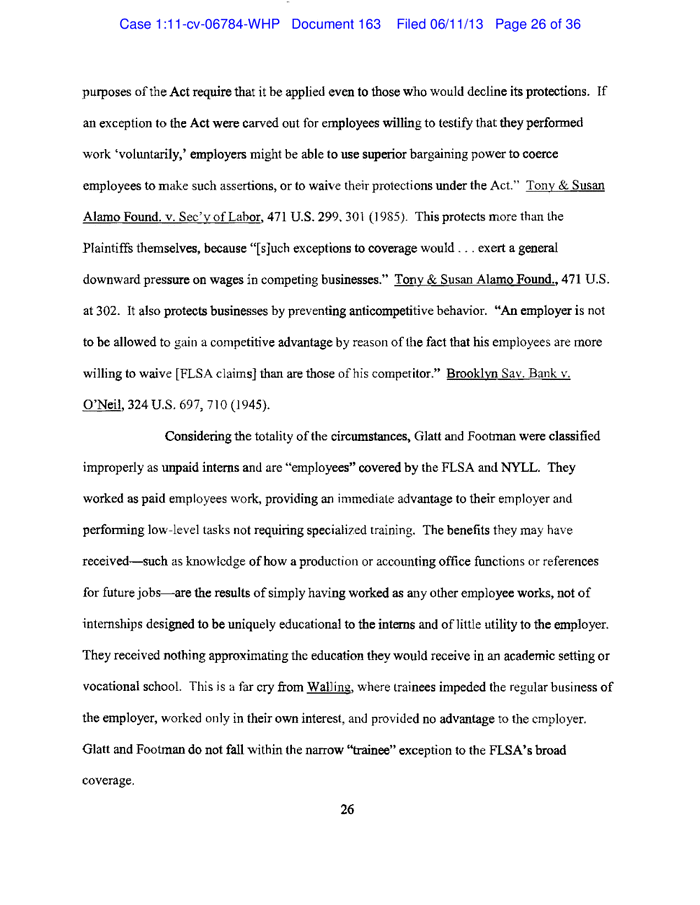
NYLL stands for the New York Labor Law. FLSA is the Fair Labor Standards Act, a federal worker protection law.

Pauley also wrote that the “primary beneficiary” test doesn’t comport with a seminal Supreme Court case that undergirds the law about unpaid interns today. In that 1947 case, Walling v. Portland Terminal Co., the Supreme Court ruled that a training program for prospective railroad workers was exempt from federal minimum wage laws.

“I think [the decision] might reflect a more modern understanding that most interns provide genuine labor to their employers,” said David Yamada, an expert on labor law and Director of the New Workplace Institute at Suffolk University. “The judge is looking at this and saying ‘These guys aren’t doing a high school internship where you pad around after someone all day and go home. These are professional programs, and they’re learning their trade by delivering work.’”

The ruling also raised the issue of college credit, which Yamada said “opens a very interesting door.”

Many employers attempt to use academic credit as a legal justification for unpaid internships. But in his ruling, Pauley explicitly noted that academic credit doesn’t automatically pave the way for no pay.
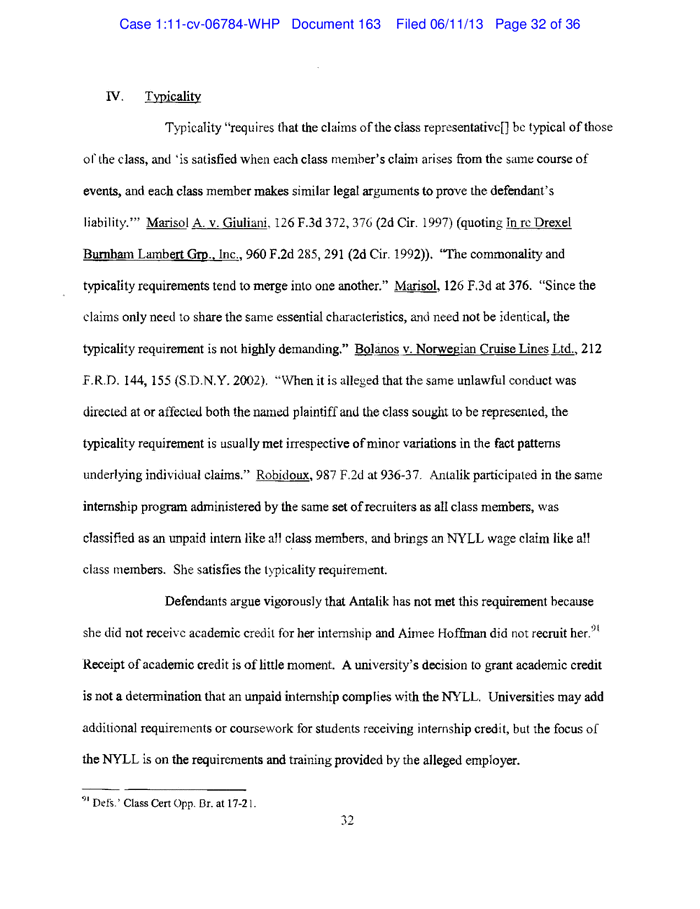
Rachel Bien, an attorney who represented the plaintiffs in the Fox case, said yesterday’s ruling shows that “that justification [of college credit] is not founded on the law.”

“The law focuses on what employers are doing and if they’re offering a bona fide training program,” Bien explained

One last point to note: The judge also certified class-action status for this lawsuit, which means other interns at Fox may be eligible for back wages. Pauley’s ruling is contrary to that in a similar case against the Hearst Corporation. A judge declined to grant the Hearst case class-action status, saying the interns (at various magazines and with various duties) didn’t have enough in common.

Chris Petrikin, a spokesperson for Fox, said the company was “very disappointed” with the ruling and plans to appeal to the Second Circuit Court of Appeals, where the differing legal approaches of the Fox Searchlight and Hearst cases may be reconciled.

ProPublica is currently investigating internships in the United States that violate labor laws, such as the Fox Searchlight case. And we need your help. To contribute, you can:

Featured Slide Shows

7 motorist-friendly camping sites

close X
  • Share on Twitter
  • Share on Facebook
  • Thumbnails
  • Fullscreen
  • 1 of 9

Sponsored Post

  • White River National Forest via Lower Crystal Lake, Colorado
    For those OK with the mainstream, White River Forest welcomes more than 10 million visitors a year, making it the most-visited recreation forest in the nation. But don’t hate it for being beautiful; it’s got substance, too. The forest boasts 8 wilderness areas, 2,500 miles of trail, 1,900 miles of winding service system roads, and 12 ski resorts (should your snow shredders fit the trunk space). If ice isn’t your thing: take the tire-friendly Flat Tops Trail Scenic Byway — 82 miles connecting the towns of Meeker and Yampa, half of which is unpaved for you road rebels.
    fs.usda.gov/whiteriveryou


    Image credit: Getty

  • Chattahoochee-Oconee National Forest via Noontootla Creek, Georgia
    Boasting 10 wildernesses, 430 miles of trail and 1,367 miles of trout-filled stream, this Georgia forest is hailed as a camper’s paradise. Try driving the Ridge and Valley Scenic Byway, which saw Civil War battles fought. If the tall peaks make your engine tremble, opt for the relatively flat Oconee National Forest, which offers smaller hills and an easy trail to the ghost town of Scull Shoals. Scaredy-cats can opt for John’s Mountain Overlook, which leads to twin waterfalls for the sensitive sightseer in you.
    fs.usda.gov/conf


    Image credit: flickr/chattoconeenf

  • Nordhouse Dunes Wilderness Area via Green Road, Michigan
    The only national forest in Lower Michigan, the Huron-Mainstee spans nearly 1 million acres of public land. Outside the requisite lush habitat for fish and wildlife on display, the Nordhouse Dunes Wilderness Area is among the biggest hooks for visitors: offering beach camping with shores pounded by big, cerulean surf. Splash in some rum and you just might think you were in the Caribbean.
    fs.usda.gov/hmnf


    Image credit: umich.edu

  • Canaan Mountain via Backcountry Canaan Loop Road, West Virginia
    A favorite hailed by outdoorsman and author Johnny Molloy as some of the best high-country car camping sites anywhere in the country, you don’t have to go far to get away. Travel 20 miles west of Dolly Sods (among the busiest in the East) to find the Canaan Backcountry (for more quiet and peace). Those willing to leave the car for a bit and foot it would be remiss to neglect day-hiking the White Rim Rocks, Table Rock Overlook, or the rim at Blackwater River Gorge.
    fs.usda.gov/mnf


    Image credit: Getty

  • Mt. Rogers NRA via Hurricane Creek Road, North Carolina
    Most know it as the highest country they’ll see from North Carolina to New Hampshire. What they may not know? Car campers can get the same grand experience for less hassle. Drop the 50-pound backpacks and take the highway to the high country by stopping anywhere on the twisting (hence the name) Hurricane Road for access to a 15-mile loop that boasts the best of the grassy balds. It’s the road less travelled, and the high one, at that.
    fs.usda.gov/gwj


    Image credit: wikipedia.org

  • Long Key State Park via the Overseas Highway, Florida
    Hiking can get old; sometimes you’d rather paddle. For a weekend getaway of the coastal variety and quieter version of the Florida Keys that’s no less luxe, stick your head in the sand (and ocean, if snorkeling’s your thing) at any of Long Key’s 60 sites. Canoes and kayaks are aplenty, as are the hot showers and electric power source amenities. Think of it as the getaway from the typical getaway.
    floridastateparks.org/longkey/default.cfm


    Image credit: floridastateparks.org

  • Grand Canyon National Park via Crazy Jug Point, Arizona
    You didn’t think we’d neglect one of the world’s most famous national parks, did you? Nor would we dare lead you astray with one of the busiest parts of the park. With the Colorado River still within view of this cliff-edge site, Crazy Jug is a carside camper’s refuge from the troops of tourists. Find easy access to the Bill Hall Trail less than a mile from camp, and descend to get a peek at the volcanic Mt. Trumbull. (Fear not: It’s about as active as your typical lazy Sunday in front of the tube, if not more peaceful.)
    fs.usda.gov/kaibab


    Image credit: flickr/Irish Typepad

  • As the go-to (weekend) getaway car for fiscally conscious field trips with friends, the 2013 MINI Convertible is your campground racer of choice, allowing you and up to three of your co-pilots to take in all the beauty of nature high and low. And with a fuel efficiency that won’t leave you in the latter, you won’t have to worry about being left stranded (or awkwardly asking to go halfsies on gas expenses).


    Image credit: miniusa.com

  • Recent Slide Shows

  • Share on Twitter
  • Share on Facebook
  • Thumbnails
  • Fullscreen
  • 1 of 9

Comments

19 Comments

Comment Preview

Your name will appear as username ( settings | log out )

You may use these HTML tags and attributes: <a href=""> <b> <em> <strong> <i> <blockquote>