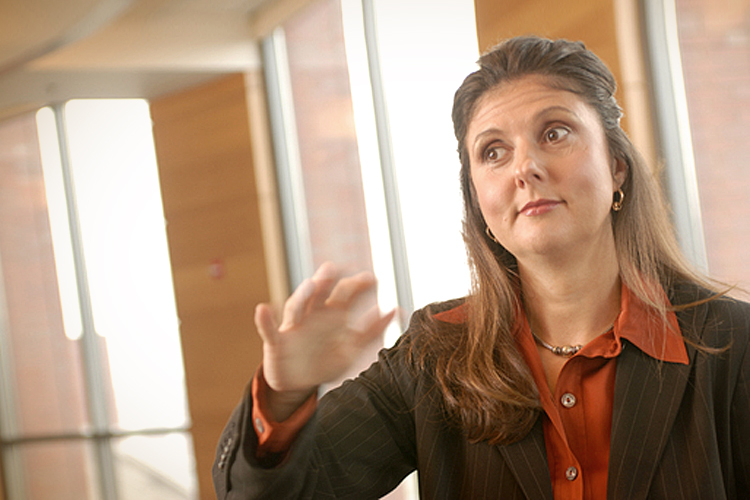

Economist Betsey Stevenson: Working parenthood “not just a woman’s issue”

Stevenson is set to join the Council of Economic Advisers -- and is a working mom and "out breast-feeder" herself

Topics: Betsey Stevenson, Parenting, working parents, ,

Economist Betsey Stevenson: Working parenthood Betsey Stevenson (Credit: Twitter)

“Taking time out of the market comes with a lot of baggage, for women,” said Betsey Stevenson, a public policy professor and economist who’s just been named to Obama’s Council of Economic Advisers. She explained that the costs of even a temporary absence from the workforce are felt decades down the road: “You never get those lost wages back … you lose any gains you’ve made, come back in at a lower wage … there are promotions you don’t get.”

Stevenson spoke in D.C. on Wednesday at a New America Foundation forum devoted to issues affecting contemporary families, including single motherhood, new trends in divorce and if and how marriage equality will transform the institution of marriage. Since the president had announced his intent to appoint Stevenson to the three-person council just two days earlier, her insights about marriage, divorce and women in the labor force were particularly interesting: She’ll now be tasked with giving the president economic advice to inform domestic policy, meaning she’ll have an effect on the home lives of countless Americans.

The intended topic of conversation for Stevenson and her partner, Justin Wolfers (also a professor at Michigan and economist), was “Home Economics: How the Changing Economy Shapes Decisions to Marry—or Not Marry.” But Stevenson spoke most passionately about what happens to women who choose to stay home rather than remaining in the workforce after having children. Thinking about such economic decisions in the short term, rather than the long term, might be tempting for new parents. Still, Stevenson urged the audience to consider  “the effects of stepping out today for the rest of your time in the labor force.”

Since the New America Foundation is a nonpartisan think tank, Stevenson and Wolfers studiously avoided taking the discussion about the costs of leaving the workforce, even temporarily, into the realm of potentially partisan policy prescriptions. Though the United States is one of only three countries in the world not to mandate paid maternity leave, legislation to mitigate the problem remains, for whatever reason, a cause primarily championed by Democratic legislators.


In an earlier panel on single mothers, writer Katie Roiphe came the closest of all the guests to a suggestion of what America could do to make having children easier for women, though she introduced her arguments with, “I don’t feel qualified to make policy proclamations.” She noted that France has near-universal day-care access, though in the United States “our response is moralism,” instead of support. Roiphe has been inflammatory on other subjects, but on Wednesday she introduced an important dimension to an at times myopic discussion of the challenges single mothers face.

When it came to increasing public support for moms who work, Stevenson pointed out that the problem transcends gender: “If we’re going to have women playing an equal role in the labor force, then we have to think of it as a parents’ issue, not just a woman’s issue.”

She and Wolfers also see the modern institution of marriage as one altogether different from marriages decades ago. While couples in generations past were highly specialized (i.e., one breadwinner, one home worker), married people today do more tasks together, or switch off. With the advent of modern technology, Wolfers joked (in seriousness), “Housework has become so simple that even a man can do it.” Anyone can bake a cake from a boxed mix or do a load of laundry, and so gender roles have changed.

Which isn’t to say Wolfers and Stevenson never specialize.

“I do all the bills and taxes, and Justin deals with the technology,” explained Stevenson.

“I have no idea how much money I have,” Justin said drolly. “The benefit of marriage has eroded over time,” they concluded, and so they remain unmarried, though they often cite the gendered unfairness in the tax code when filing joint returns as the primary reason.

Their union is admirably egalitarian — Wolfers is, for the second time, following his partner to D.C. (the first being when Stevenson was chief economist at the Department of Labor). He’ll work at the Brookings Institution as a senior fellow – hardly a chopped liver scenario. Incidentally, the last female on the Council of Economic Advisers, Christina Romer, was also in a relationship with a fellow high-profile economist (David Romer).

What is exciting about Stevenson’s nomination to the Council of Economic Advisers is her decidedly gender-conscious and humanistic approach to economics. “I’m an out breast-feeder,” she confidently said at one point in the discussion. It took the Affordable Care Act, she noted, to amend the Fair Labor Standards Act to require that employers provide a place other than a bathroom and break time for employees to express breast milk.

Though in their partnership it’s Stevenson who tends to put concepts in more opaque economic language — the couple has a routine in which Wolfers will interject, “To put it in understandable terms,” and then reword her train of thought — her research highlights markets and behaviors often ignored by other economists. It’s critical for America to have such a perspective with ready access to President Obama’s ear.

Samantha Lachman

Samantha Lachman is an editorial intern at The Nation. Follow her on Twitter at @SamLachman.

Featured Slide Shows

7 motorist-friendly camping sites

close X
  • Share on Twitter
  • Share on Facebook
  • Thumbnails
  • Fullscreen
  • 1 of 9

Sponsored Post

  • White River National Forest via Lower Crystal Lake, Colorado
    For those OK with the mainstream, White River Forest welcomes more than 10 million visitors a year, making it the most-visited recreation forest in the nation. But don’t hate it for being beautiful; it’s got substance, too. The forest boasts 8 wilderness areas, 2,500 miles of trail, 1,900 miles of winding service system roads, and 12 ski resorts (should your snow shredders fit the trunk space). If ice isn’t your thing: take the tire-friendly Flat Tops Trail Scenic Byway — 82 miles connecting the towns of Meeker and Yampa, half of which is unpaved for you road rebels.
    fs.usda.gov/whiteriveryou


    Image credit: Getty

  • Chattahoochee-Oconee National Forest via Noontootla Creek, Georgia
    Boasting 10 wildernesses, 430 miles of trail and 1,367 miles of trout-filled stream, this Georgia forest is hailed as a camper’s paradise. Try driving the Ridge and Valley Scenic Byway, which saw Civil War battles fought. If the tall peaks make your engine tremble, opt for the relatively flat Oconee National Forest, which offers smaller hills and an easy trail to the ghost town of Scull Shoals. Scaredy-cats can opt for John’s Mountain Overlook, which leads to twin waterfalls for the sensitive sightseer in you.
    fs.usda.gov/conf


    Image credit: flickr/chattoconeenf

  • Nordhouse Dunes Wilderness Area via Green Road, Michigan
    The only national forest in Lower Michigan, the Huron-Mainstee spans nearly 1 million acres of public land. Outside the requisite lush habitat for fish and wildlife on display, the Nordhouse Dunes Wilderness Area is among the biggest hooks for visitors: offering beach camping with shores pounded by big, cerulean surf. Splash in some rum and you just might think you were in the Caribbean.
    fs.usda.gov/hmnf


    Image credit: umich.edu

  • Canaan Mountain via Backcountry Canaan Loop Road, West Virginia
    A favorite hailed by outdoorsman and author Johnny Molloy as some of the best high-country car camping sites anywhere in the country, you don’t have to go far to get away. Travel 20 miles west of Dolly Sods (among the busiest in the East) to find the Canaan Backcountry (for more quiet and peace). Those willing to leave the car for a bit and foot it would be remiss to neglect day-hiking the White Rim Rocks, Table Rock Overlook, or the rim at Blackwater River Gorge.
    fs.usda.gov/mnf


    Image credit: Getty

  • Mt. Rogers NRA via Hurricane Creek Road, North Carolina
    Most know it as the highest country they’ll see from North Carolina to New Hampshire. What they may not know? Car campers can get the same grand experience for less hassle. Drop the 50-pound backpacks and take the highway to the high country by stopping anywhere on the twisting (hence the name) Hurricane Road for access to a 15-mile loop that boasts the best of the grassy balds. It’s the road less travelled, and the high one, at that.
    fs.usda.gov/gwj


    Image credit: wikipedia.org

  • Long Key State Park via the Overseas Highway, Florida
    Hiking can get old; sometimes you’d rather paddle. For a weekend getaway of the coastal variety and quieter version of the Florida Keys that’s no less luxe, stick your head in the sand (and ocean, if snorkeling’s your thing) at any of Long Key’s 60 sites. Canoes and kayaks are aplenty, as are the hot showers and electric power source amenities. Think of it as the getaway from the typical getaway.
    floridastateparks.org/longkey/default.cfm


    Image credit: floridastateparks.org

  • Grand Canyon National Park via Crazy Jug Point, Arizona
    You didn’t think we’d neglect one of the world’s most famous national parks, did you? Nor would we dare lead you astray with one of the busiest parts of the park. With the Colorado River still within view of this cliff-edge site, Crazy Jug is a carside camper’s refuge from the troops of tourists. Find easy access to the Bill Hall Trail less than a mile from camp, and descend to get a peek at the volcanic Mt. Trumbull. (Fear not: It’s about as active as your typical lazy Sunday in front of the tube, if not more peaceful.)
    fs.usda.gov/kaibab


    Image credit: flickr/Irish Typepad

  • As the go-to (weekend) getaway car for fiscally conscious field trips with friends, the 2013 MINI Convertible is your campground racer of choice, allowing you and up to three of your co-pilots to take in all the beauty of nature high and low. And with a fuel efficiency that won’t leave you in the latter, you won’t have to worry about being left stranded (or awkwardly asking to go halfsies on gas expenses).


    Image credit: miniusa.com

  • Recent Slide Shows

  • Share on Twitter
  • Share on Facebook
  • Thumbnails
  • Fullscreen
  • 1 of 9

Comments

1 Comments

Comment Preview

Your name will appear as username ( settings | log out )

You may use these HTML tags and attributes: <a href=""> <b> <em> <strong> <i> <blockquote>