
Dim lighting sparks creativity

New German research finds a darkened room encourages freedom of thought and inspires innovation

Topics: Pacific Standard, Germany, Lighting, Neuroscience,

Dim lighting sparks creativity
This piece originally appeared on Pacific Standard.

Pacific Standard There are certain times when you want the lights turned way down low. One such time, according to recent research, is when you need to think creatively.

“Darkness increases freedom from constraints, which in turn promotes creativity,” report  Anna Steidle of the University of Stuttgart and Lioba Werth of the University of Hohenheim. A dimly lit environment, they explain in the Journal of Environmental Psychology, “elicits a feeling of freedom, self-determination, and reduced inhibition,” all of which encourage innovative thinking.

Steidle and Werth describe six experiments which provide evidence for their thesis. The key one featured 114 German undergraduates, who were seated in groups of two or three in a small room designed to simulate an office.

The room was lit by a fixture hanging from the ceiling directly above the desk. The amount of illumination varied, with some groups receiving only 150 lux (dim light), others 500 lux (the recommended lighting level for an office), and still others 1,500 lux (bright light).

After acclimating themselves for approximately 15 minutes, participants went to work on what the researchers describe as “four creative insight problems typically used in creativity research. These tasks require that individuals change their perceptions of a given problem in order to find the optimal solution.”

After spending two minutes attempting to solve each problem, participants rated how free from constraints they felt. They noted the degree to which they felt externally controlled, and reported their level of self-assurance.

The results: Those in the dimly lit room solved significantly more problems correctly than those in the brightly lit room. They also felt freer and less inhibited than their intensely illuminated counterparts. Participants in the bright and the conventionally lit rooms did not differ significantly from one another on either scale.

“These results indicate that dim illumination heightens perceived freedom from constraints, which in turn improves creative performance,” the researchers conclude.


Don’t have a dimmer switch at your desk? No worries. Other experiments found that merely priming the idea of darkness—such as by taking five minutes to describe an experience of literally being in the dark, and recalling how it felt—was sufficient to boost creativity. Participants who did just that drew more innovative portraits of space aliens than their counterparts who had described being in bright light.

However, the darkness-spurs-innovation equation did not always hold true. In another experiment, the researchers found “the darkness-related increase in creativity disappeared when using a more informal, indirect light instead of direct light.”

In this experiment, the light provided by the luminaire illuminated the ceiling and surrounding walls instead of providing a “top-down” light on the desk. Under those conditions, the dimness did not heighten a sense of freedom from constraints, and thus did not result in more creativity.

What’s more, the researchers note, innovation consists of two distinct phases: generating ideas, and then analyzing and implementing them. The latter requires analytical thinking, and in a final experiment, participants did better on that task when they were in a brightly lit room rather than a dimly lit one.

“Creativity may begin in the dark,” Steidle and Werth write, “but it shouldn’t end there.”

Nevertheless, during that all-important phase when you’re grasping for ideas, dim light appears to be a catalyst for creativity. “Darkness changes a room’s visual message,” the researchers explain, and one such message seems to be it’s safe to explore widely and let your imagination run free.

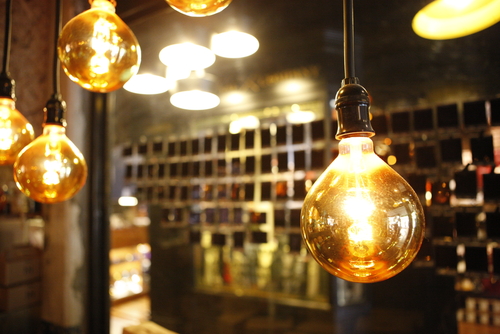
These results would seem to contradict those of an earlier study, which found creativity is boosted by the presence in the room of a bare light bulb. However, a closer reading finds they are compatible: It was the symbolic power of the bulb (which has gone off over many a cartoon character’s head to signify a mental breakthrough) that boosted creativity, not the level of illumination in the room.

So if you’re struggling to finish that screenplay or come up with the next must-have app, you might try illuminating your workspace with one bare bulb of minimal wattage. If you don’t want to be thought of as a dimbulb, perhaps the answer is a dim bulb.

Update: OK, that last suggestion wasn’t as clever as I thought it was. (What can I say? I was writing in a very bright room.) Steidle writes: “I’d rather suggest creating an informal and benign visual atmosphere by dimming direct light and having a light bulb somewhere in your field of vision which is turned on from time to time. As far as I understand it, the turning on of the light bulb is what primes the procedure of gaining insight.”

Featured Slide Shows

7 motorist-friendly camping sites

close X
  • Share on Twitter
  • Share on Facebook
  • Thumbnails
  • Fullscreen
  • 1 of 9

Sponsored Post

  • White River National Forest via Lower Crystal Lake, Colorado
    For those OK with the mainstream, White River Forest welcomes more than 10 million visitors a year, making it the most-visited recreation forest in the nation. But don’t hate it for being beautiful; it’s got substance, too. The forest boasts 8 wilderness areas, 2,500 miles of trail, 1,900 miles of winding service system roads, and 12 ski resorts (should your snow shredders fit the trunk space). If ice isn’t your thing: take the tire-friendly Flat Tops Trail Scenic Byway — 82 miles connecting the towns of Meeker and Yampa, half of which is unpaved for you road rebels.
    fs.usda.gov/whiteriveryou


    Image credit: Getty

  • Chattahoochee-Oconee National Forest via Noontootla Creek, Georgia
    Boasting 10 wildernesses, 430 miles of trail and 1,367 miles of trout-filled stream, this Georgia forest is hailed as a camper’s paradise. Try driving the Ridge and Valley Scenic Byway, which saw Civil War battles fought. If the tall peaks make your engine tremble, opt for the relatively flat Oconee National Forest, which offers smaller hills and an easy trail to the ghost town of Scull Shoals. Scaredy-cats can opt for John’s Mountain Overlook, which leads to twin waterfalls for the sensitive sightseer in you.
    fs.usda.gov/conf


    Image credit: flickr/chattoconeenf

  • Nordhouse Dunes Wilderness Area via Green Road, Michigan
    The only national forest in Lower Michigan, the Huron-Mainstee spans nearly 1 million acres of public land. Outside the requisite lush habitat for fish and wildlife on display, the Nordhouse Dunes Wilderness Area is among the biggest hooks for visitors: offering beach camping with shores pounded by big, cerulean surf. Splash in some rum and you just might think you were in the Caribbean.
    fs.usda.gov/hmnf


    Image credit: umich.edu

  • Canaan Mountain via Backcountry Canaan Loop Road, West Virginia
    A favorite hailed by outdoorsman and author Johnny Molloy as some of the best high-country car camping sites anywhere in the country, you don’t have to go far to get away. Travel 20 miles west of Dolly Sods (among the busiest in the East) to find the Canaan Backcountry (for more quiet and peace). Those willing to leave the car for a bit and foot it would be remiss to neglect day-hiking the White Rim Rocks, Table Rock Overlook, or the rim at Blackwater River Gorge.
    fs.usda.gov/mnf


    Image credit: Getty

  • Mt. Rogers NRA via Hurricane Creek Road, North Carolina
    Most know it as the highest country they’ll see from North Carolina to New Hampshire. What they may not know? Car campers can get the same grand experience for less hassle. Drop the 50-pound backpacks and take the highway to the high country by stopping anywhere on the twisting (hence the name) Hurricane Road for access to a 15-mile loop that boasts the best of the grassy balds. It’s the road less travelled, and the high one, at that.
    fs.usda.gov/gwj


    Image credit: wikipedia.org

  • Long Key State Park via the Overseas Highway, Florida
    Hiking can get old; sometimes you’d rather paddle. For a weekend getaway of the coastal variety and quieter version of the Florida Keys that’s no less luxe, stick your head in the sand (and ocean, if snorkeling’s your thing) at any of Long Key’s 60 sites. Canoes and kayaks are aplenty, as are the hot showers and electric power source amenities. Think of it as the getaway from the typical getaway.
    floridastateparks.org/longkey/default.cfm


    Image credit: floridastateparks.org

  • Grand Canyon National Park via Crazy Jug Point, Arizona
    You didn’t think we’d neglect one of the world’s most famous national parks, did you? Nor would we dare lead you astray with one of the busiest parts of the park. With the Colorado River still within view of this cliff-edge site, Crazy Jug is a carside camper’s refuge from the troops of tourists. Find easy access to the Bill Hall Trail less than a mile from camp, and descend to get a peek at the volcanic Mt. Trumbull. (Fear not: It’s about as active as your typical lazy Sunday in front of the tube, if not more peaceful.)
    fs.usda.gov/kaibab


    Image credit: flickr/Irish Typepad

  • As the go-to (weekend) getaway car for fiscally conscious field trips with friends, the 2013 MINI Convertible is your campground racer of choice, allowing you and up to three of your co-pilots to take in all the beauty of nature high and low. And with a fuel efficiency that won’t leave you in the latter, you won’t have to worry about being left stranded (or awkwardly asking to go halfsies on gas expenses).


    Image credit: miniusa.com

  • Recent Slide Shows

  • Share on Twitter
  • Share on Facebook
  • Thumbnails
  • Fullscreen
  • 1 of 9

Comments

2 Comments

Comment Preview

Your name will appear as username ( settings | log out )

You may use these HTML tags and attributes: <a href=""> <b> <em> <strong> <i> <blockquote>