

Edward Snowden, the former National Security Agency contractor who provided documents to The Guardian and blew the whistle on secret surveillance programs collecting the personal data and information of innocent Americans and others from around the world, has been officially charged.
The complaint, which was filed on June 14 and leaked to the press yesterday, shows he was charged with “unauthorized communication of national defense information” and “willful communication of classified communications intelligence information to an unauthorized person,” which are both felonies under the Espionage Act.
As highlighted previously, Snowden is the eighth person who leaked information to be charged under the Espionage Act under President Barack Obama. The previous seven are: Shamai Leibowitz, Thomas Drake, Stephen Kim, Jeffrey Sterling, Pfc. Bradley Manning, John Kiriakou and James Hitselberger.
Prior to the Obama administration, only three people who leaked information had been charged under the Espionage Act: Daniel Ellsberg, the Pentagon Papers whistleblower, who was charged under President Richard Nixon; Samuel T. Morison, a Navy civilian analyst who was charged under President Ronald Reagan; Lawrence Franklin, a Pentagon analyst charged under President George W. Bush.
Morison leaked photographs of Soviet ships to alert America to what he perceived as a new threat. Franklin leaked information on Iran to the American Israel Public Affairs Committee (AIPAC).
The Morison case is one of the first cases where the Justice Department began to use the Espionage Act to criminalize leaks, even though it was never intended for leakers. [Note: It had been used against dissidents so, perhaps, it wasn’t all that novel to apply it to individuals dissenting against authority by releasing information to the press.]
Ellsberg had been pursued by the Nixon administration. And, as New York Times legal counsel James Goodale highlights in his recent book, Fighting for the Press, the Nixon Administration had a grand jury setup to go after Times reporter Neil Sheehan for his work publishing the Pentagon Papers. But, it was not until Morison’s case that the government began to make arguments around the Espionage Act that have become common under Obama.
New York Times columnist Anthony Lewis wrote in 1985 that the Reagan Administration was using the Morison case “to try to turn the Espionage Act into something the United States has never had: a criminal statute against leaks. And by persuading the trial judge and then the jury, it did create something very much like the British Official Secrets Act.”
He described what Morison had done. He did not spy. He leaked “three photographs taken from a US satellite, of a Soviet aircraft carrier under construction. He sent them to Jane’s Defense Weekly, a British military magazine. He was not paid. He did it, he said, because the carrier was a significant new element in the Soviet fleet—and publication would alert Americans to the threats.” And, for that, he was convicted on October 17, 1985, of two violations of the Espionage Act (as well as two counts of theft of government property).
Lewis understood the significance of the Espionage Act charges and its conviction. He declared in February 1985, “The charge is what makes this case so important for it takes a press leak of the kind that goes on all the time in our government and treats it as ‘espionage.’ If the Reagan prosecutors win on that theory, then ordinary leaking will become a grave crime and the US will have a draconian Official Secrets Act.”
He also wrote:
“The hallmark of a truly effective internal security system,” Justice Potter Stewart of the Supreme Court said in 1971, in the Pentagon Papers case, “would be maximum possible disclosure, recognizing that secrecy can best be preserved only when credibility is truly maintained.” In other words, the government should focus on a limited area of true secrecy instead of using the blunderbuss approach and trying to stamp everything secret.
The Morison case is the blunderbuss approach. No real spy is going to be discouraged by the government’s fitful moves against leaks. That course wastes resources and weakens the credibility of the effort to protect important secrets.
And Lewis appropriately pointed out, “Espionage and leaks are wholly different things in the American tradition. Spying strengthens foreign powers. Leaking, an everyday occurrence in Washington, is part of the process that enables citizens to judge the policy of their government. We think that process strengthens, not weakens America.”
*
The Reagan Administration did not think leaks strengthened America. In April 1986, after successfully prosecuting Morison, Assistant Under Secretary of Defense Michael Pillsbury was fired, according to TIME magazine, “for allegedly giving reporters details of an Administration plan to provide Stinger missiles to anti-Communist rebels in Angola and Afghanistan.”
TIME also reported, “In a meeting with Deputy Attorney General D. Lowell Jensen,” in May 1986, “CIA Director William Casey discussed the possibility of prosecuting five news organizations — the Washington Post, the Washington Times, the New York Times, TIME and Newsweek — for printing details about U.S. intelligence-gathering operations. Casey subsequently that day met with Washington Post Executive Editor Benjamin Bradlee and Managing Editor Leonard Downie. He told them he was considering asking the Justice Department to take the Post to court for, among other things, reporting on messages between Tripoli and the East Berlin ”people’s bureau” (as Libya calls its diplomatic missions) that the U.S. had intercepted.”
The Obama administration even more zealously opposed leaks. It was a result of the fact that President Obama himself considered leaks to be a “pet peeve.”
Jonathan Alter, author of The Promise, described in his book:
Obama had one pet peeve that could make him lose his cool. It was a common source of anger for presidents: leaks. Complaints about loose lips became a constant theme of Obama’s early presidency. At his first Cabinet meeting he made a point of saying that he didn’t want to see his Cabinet “litigating” policy through the New York Times and the Washington Post. At a Blair House retreat for the Cabinet and senior staff at the end of July he devoted about a quarter of his comments to urging his people to keeping their disagreements within the family: “We should be having these debates on the inside, not the outside.” And during his twenty hours of deliberations over Afghanistan in the fall, he returned repeatedly to the theme. Naturally in Washington nearly every time he got upset about leaks it leaked.
For all his claims that he didn’t want yes-men around him, no one on his staff was brave enough to tell the president that obsessing over leaks was a colossal waste of time. (Aides should have recognized that the age-old problem in Washington isn’t managing leaks, but managing the president’s fury over them.) But it wouldn’t have mattered: leaks offended Obama’s sense of discipline and reminded him of everything he disliked about the capital. He was fearsome on the subject, which seemed to bring out his controlling nature to an even greater degree than usual…
The “controlling nature” not only led to a record number of prosecutions of leakers under the Espionage Act but also excluding intelligence and national security agency employees from the Whistleblower Protection Enhancement Act.
The Office of the Inspector General of the US Intelligence Community investigated 375 leaks cases between November 2011 and June 2012, ” a figure that Steven Aftergood of Secrecy New described as exceeding “previously reported levels by a considerable margin.”
After Manning disclosed government information to WikiLeaks, Obama setup an “insider threat” program that encouraged a culture of snitching within intelligence and national security agencies. The program made it punishable if someone did not share information on individuals, who were engaged in suspicious conduct that indicated they might be considering leaking. The program further normalized a policy of treating leaking as an act that amounted to aiding America’s enemies.
Under Obama, the clampdown on leaks engulfed the press, too. In a leak investigation into the source who disclosed details on a CIA underwear bomb plot sting operation in Yemen, the Justice Department seized the Associated Press’ records from 20 phone lines that at least 100 journalists. The FBI also labeled Fox News reporter James Rosen and “aider, abettor and co-conspirator” in former State Department employee Stephen Kim’s leak on North Korea. And the Obama Justice Department has continued to fight in the courts to force New York Times reporter James Risen to testify about what former CIA officer Jeffrey Sterling revealed to him.
Over-classification was rampant under Reagan, as it was under Obama. Lewis noted for the Times when writing about the Morison case:
…The government classifies millions of documents every year, most of them containing no real secrets. The fact that our satellites can photograph the Soviet Union foot by foot, for example, has been well publicized—and the government itself has published satellite pictures of such things as airports in Nicaragua…
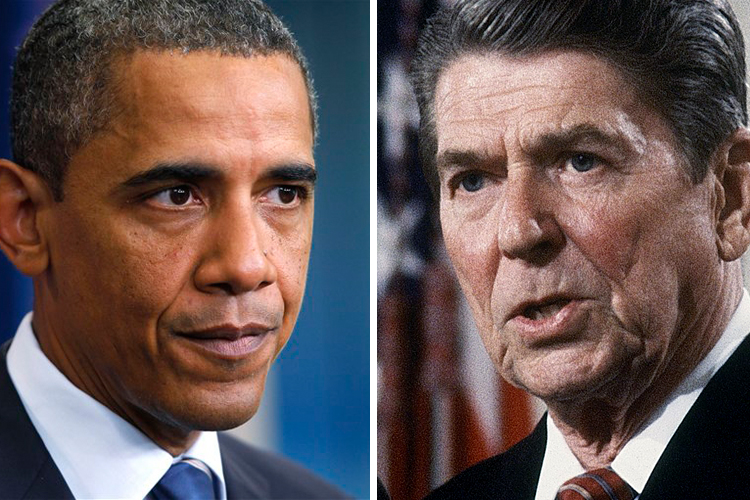
Both presidents, Reagan and Obama, sought to suppress those who would dare to inform citizens of any information that may be in the public interest but which the administration wanted to remain concealed so they could carry out their agenda without being scrutinized or questioned.
Reagan and Obama were fully aware that leaks ignite discussion, which would be difficult for the White House to control. Despite the benefits of widespread debate to a society, prosecutions were pursued. Each case sent a message to all government employees that they were not to go to reporters or media organizations and provide information that might start a conversation on any controversial or possibly illegal national security programs or policies.
