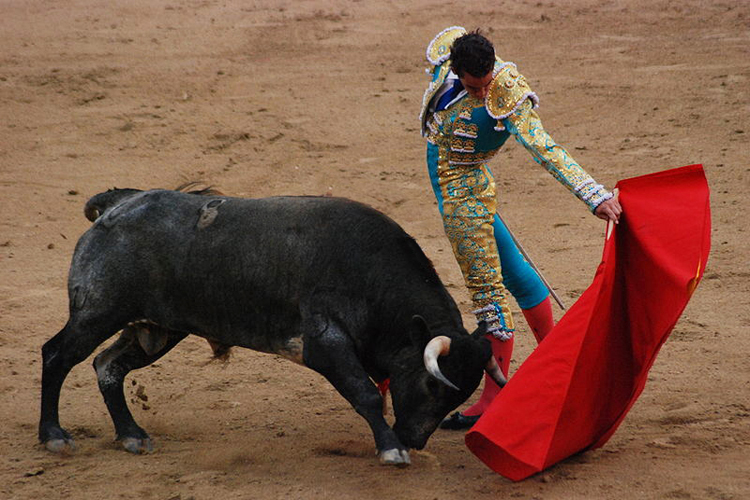

Adiós, Spanish bullfighting?

Economic woes and animal rights activists threaten the country's national pastime

Topics: GlobalPost, Spain, Bullfighting, Europe, Europe Union, ,

Adiós, Spanish bullfighting?
This article originally appeared on GlobalPost.

Global Post MORALZARZAL, Spain — Jesus Mejias is only 14, but he’s already mapped out his future: he wants to become a matador and appear in the great bullrings of Madrid and Seville.

He’s just taken a big step to fulfilling that ambition at a trainee bullfight in this small town 30 miles north of Madrid.

Mejias stands at a little over five feet tall and his voice hasn’t broken, but his skills with the cape against a quarter-ton bullock wowed the local crowd. At the end of the faena, he drove his sword into the animal’s heart, killing it with the cool precision of a veteran.

“I want to be a great bullfighter,” he said afterward. “That’s why I’m here. Otherwise I’d be at home studying.”

Mejias and the other teenagers who took part in the event are part of the next generation of Spanish matadors. But they’re embarking on their careers at a time that bullfighting’s future is more in doubt than perhaps any other time in its three-century history — as Moralzarzal’s three-quarters-empty bullring attests.

The most obvious problem is economic. These days, cash-strapped Spaniards are unwilling to pay for tickets that can cost upwards of $65 for a hard seat under the burning summer sun.

Crippled by a prolonged recession, the country has a jobless rate of 27 percent and a strict government austerity program that’s mandated cuts to civil servants’ salaries, pension freezes and tax rises.

“This is an extreme situation,” says Juan Jose Rueda, owner of La Dehesa, a bull-breeding farm near Madrid. The 700-hectare estate’s calm beauty, of shady meadows where cows and bulls graze, hides what Rueda describes as the industry’s “chaos.”

“We’re selling our bulls at prices that have been dropping for a long time,” he says. “The sector is depressed, it can’t carry on like this.”

Bullfighting has been surviving in a bubble, he explains, much like the one that buoyed the real estate sector before the economic crisis.

Top bullfighters still command high fees — up to $400,000 per bullfight in some cases — and tickets remain expensive. But the demand is no longer there, especially as younger generations show less and less interest in the deeply traditional pastime.


In 2007, when Spain’s economy was at the height of its construction-led boom, around 2,700 official bullfights took place across the country. This year, Rueda reckons, there will be fewer than 500.

Big cities such as Madrid, Seville and Valencia are maintaining their traditional summer festivals, albeit with fewer ticket sales. But for the thousands of smaller towns that also have bullfighting traditions, such as Moralzarzal, it’s getting harder to justify paying for the bulls, bullfighters and all the organization that accompanies a week-long fiesta.

The local authorities happily subsidized the events several years ago, but now fewer and fewer can afford to.

However, there’s more that ails the industry than only the economic slump, says Antonio Lorca, the bullfighting critic for El Pais newspaper. He says the spectacle’s quality has declined because matadors prefer to face more docile and therefore less dangerous bulls.

“We’ve gone from having bulls that were fierce and aggressive to having animals that are weak, soft and good-natured,” he says.

“Bullfighting is based on the ferocity of the animal and the skill of the man facing it. But if the bull isn’t fierce, the whole thing loses its meaning… it’s like playing soccer without a ball.”

Rueda, the bull breeder, plays down the criticism, although he points out that it’s usually the bullfight organizers, rather than the farmers, who select the animals that will feature in bullfights.

Lorca also points to the bullfighters as a problem, saying that only a handful of first-class matadors remain in Spain. And he believes only one has the potential to be “the 21st century’s great savior of bullfighting.”

Jose Tomas, 37, has already retired from the ring once, only to make a spectacular comeback in 2007. Known for his high-risk technique, he has frequently been gored, and often emerges from bullfights with his traditional matador’s suit smeared in blood — his own and the animals’.

He almost died in 2010 from an injury to his groin in Aguascalientes in Mexico. He’s continued to bullfight since recovering, but mainly at lower-profile events.

Given the challenges facing bullfighting, it’s little wonder that half-a-million Spaniards have presented Congress with a proposal for the fiesta to be enshrined in law as a “cultural asset.”

Its supporters are concerned that an animal rights-driven ban on bullfighting implemented in the northern region of Catalonia last year could spread to other parts of Spain.

“Bullfighting will definitely disappear, we’ve already seen this in Catalonia,” says Sharon Nunez, of the animal rights organization Igualdad Animal.

“This has made the bullfighters and the bullfighting industry more aware of how weak they really are and how much they have to fight back.”

Featured Slide Shows

7 motorist-friendly camping sites

close X
  • Share on Twitter
  • Share on Facebook
  • Thumbnails
  • Fullscreen
  • 1 of 9

Sponsored Post

  • White River National Forest via Lower Crystal Lake, Colorado
    For those OK with the mainstream, White River Forest welcomes more than 10 million visitors a year, making it the most-visited recreation forest in the nation. But don’t hate it for being beautiful; it’s got substance, too. The forest boasts 8 wilderness areas, 2,500 miles of trail, 1,900 miles of winding service system roads, and 12 ski resorts (should your snow shredders fit the trunk space). If ice isn’t your thing: take the tire-friendly Flat Tops Trail Scenic Byway — 82 miles connecting the towns of Meeker and Yampa, half of which is unpaved for you road rebels.
    fs.usda.gov/whiteriveryou


    Image credit: Getty

  • Chattahoochee-Oconee National Forest via Noontootla Creek, Georgia
    Boasting 10 wildernesses, 430 miles of trail and 1,367 miles of trout-filled stream, this Georgia forest is hailed as a camper’s paradise. Try driving the Ridge and Valley Scenic Byway, which saw Civil War battles fought. If the tall peaks make your engine tremble, opt for the relatively flat Oconee National Forest, which offers smaller hills and an easy trail to the ghost town of Scull Shoals. Scaredy-cats can opt for John’s Mountain Overlook, which leads to twin waterfalls for the sensitive sightseer in you.
    fs.usda.gov/conf


    Image credit: flickr/chattoconeenf

  • Nordhouse Dunes Wilderness Area via Green Road, Michigan
    The only national forest in Lower Michigan, the Huron-Mainstee spans nearly 1 million acres of public land. Outside the requisite lush habitat for fish and wildlife on display, the Nordhouse Dunes Wilderness Area is among the biggest hooks for visitors: offering beach camping with shores pounded by big, cerulean surf. Splash in some rum and you just might think you were in the Caribbean.
    fs.usda.gov/hmnf


    Image credit: umich.edu

  • Canaan Mountain via Backcountry Canaan Loop Road, West Virginia
    A favorite hailed by outdoorsman and author Johnny Molloy as some of the best high-country car camping sites anywhere in the country, you don’t have to go far to get away. Travel 20 miles west of Dolly Sods (among the busiest in the East) to find the Canaan Backcountry (for more quiet and peace). Those willing to leave the car for a bit and foot it would be remiss to neglect day-hiking the White Rim Rocks, Table Rock Overlook, or the rim at Blackwater River Gorge.
    fs.usda.gov/mnf


    Image credit: Getty

  • Mt. Rogers NRA via Hurricane Creek Road, North Carolina
    Most know it as the highest country they’ll see from North Carolina to New Hampshire. What they may not know? Car campers can get the same grand experience for less hassle. Drop the 50-pound backpacks and take the highway to the high country by stopping anywhere on the twisting (hence the name) Hurricane Road for access to a 15-mile loop that boasts the best of the grassy balds. It’s the road less travelled, and the high one, at that.
    fs.usda.gov/gwj


    Image credit: wikipedia.org

  • Long Key State Park via the Overseas Highway, Florida
    Hiking can get old; sometimes you’d rather paddle. For a weekend getaway of the coastal variety and quieter version of the Florida Keys that’s no less luxe, stick your head in the sand (and ocean, if snorkeling’s your thing) at any of Long Key’s 60 sites. Canoes and kayaks are aplenty, as are the hot showers and electric power source amenities. Think of it as the getaway from the typical getaway.
    floridastateparks.org/longkey/default.cfm


    Image credit: floridastateparks.org

  • Grand Canyon National Park via Crazy Jug Point, Arizona
    You didn’t think we’d neglect one of the world’s most famous national parks, did you? Nor would we dare lead you astray with one of the busiest parts of the park. With the Colorado River still within view of this cliff-edge site, Crazy Jug is a carside camper’s refuge from the troops of tourists. Find easy access to the Bill Hall Trail less than a mile from camp, and descend to get a peek at the volcanic Mt. Trumbull. (Fear not: It’s about as active as your typical lazy Sunday in front of the tube, if not more peaceful.)
    fs.usda.gov/kaibab


    Image credit: flickr/Irish Typepad

  • As the go-to (weekend) getaway car for fiscally conscious field trips with friends, the 2013 MINI Convertible is your campground racer of choice, allowing you and up to three of your co-pilots to take in all the beauty of nature high and low. And with a fuel efficiency that won’t leave you in the latter, you won’t have to worry about being left stranded (or awkwardly asking to go halfsies on gas expenses).


    Image credit: miniusa.com

  • Recent Slide Shows

  • Share on Twitter
  • Share on Facebook
  • Thumbnails
  • Fullscreen
  • 1 of 9

Comments

22 Comments

Comment Preview

Your name will appear as username ( settings | log out )

You may use these HTML tags and attributes: <a href=""> <b> <em> <strong> <i> <blockquote>