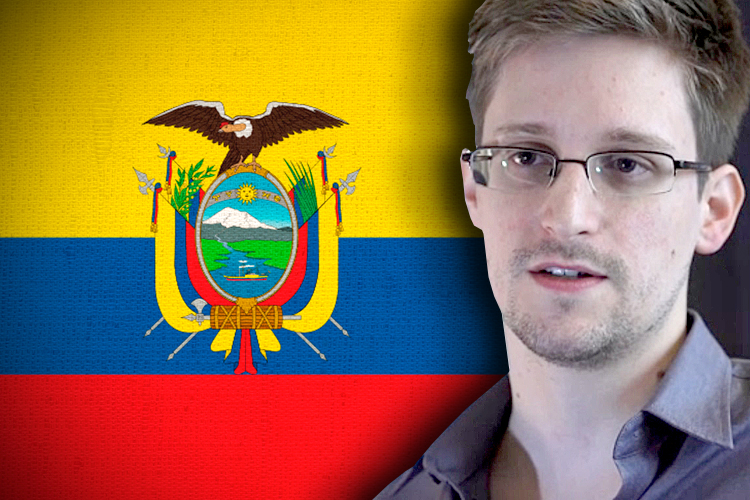

Snowden won’t find a beacon of civil rights in Ecuador
Does he risk losing goodwill by allying with a president known for his "widespread repression" of the media?
By Alex Seitz-WaldTopics: Edward Snowden, Ecuador, Human Rights, Freedom of Speech, Political Freedom, Julian Assange, NSA, Whistleblower, Politics News
Alliances of convenience with unsavory governments are nothing new in international politics, but they would seem to be the kind of moral relativism that recently teamed-up Edward Snowden and Julian Assange might revile — so it’s worth digging a bit deeper into the much-discussed irony about the two idealists taking refuge under the wings of Ecuadorean President Rafael Correa. Assange told reporters today that NSA leaker Snowden is en route to Ecuador, while the WikiLeaks founder himself has been holed up in Ecuador’s embassy in London for months.
The two say they are motivated by a desire to expose human rights and civil liberties violations by the American government, but allying with Correa is like jumping out of the frying pan and into the fire. Many have cursorily noted that Ecuador has a poor record when it comes to freedom of the press, but a closer inspection is even more troubling.
Since not long after taking office in 2007, Correa has led a systematic campaign against critical journalists in his country — human rights activists say — using litigation, legislation and intimidation against against media figures who criticize his administration. Just two weeks ago, the country’s legislature passed a sweeping new law, backed by Correa, that will “seriously affect the freedom of the press and freedom of expression,” according to the U.N.’s Special Rapporteur for the Promotion and Protection of Freedom of Expression
The law lets the government decide what is “truthful” information, and threatens criminal sanctions against journalists for “undermining the prestige” of people or groups. Journalists and human rights activists say the law will give the government new powers to crack down on political enemies. It even allows authorities to order media outlets to issue public apologies for their reporting.
“This law is yet another effort by President Correa to go after the independent media,” said Human Rights Watch Americas director José Miguel Vivanco. “The provisions for censorship and criminal prosecutions of journalists are clear attempts to silence criticism.”
Monica Almeida, an editor of the daily El Universo newspaper, which is often critical of Correa, called the law “completely crazy,” saying it is “designed to regulate everything we do.”
But it’s just the latest in what the Committee to Protect Journalists has called “widespread repression of the media” from the Correa administration.
For instance, in the first six months of 2012 alone, the state broadcasting authority closed 20 private radio and television outlets, some without proper legal process. Or take the case where, in 2011, a newsmagazine anchor criticized the administration’s heavy hand in dealing with a dissident. The very next day, the administration ordered the TV network to preempt the anchor’s broadcast with a 10-minute-long “harsh and personal rebuttal from a government spokesman.”
In January of last year, the president introduced legislation that prohibits the media from disseminating “messages” or “reporting” that would detract from the “political thesis” or candidate for office. The determination of what violates the law would be made by an office controlled by Correa’s party, naturally.
And Correa himself has never refrained from personally shaming and attacking adversarial journalists, especially on his weekly broadcast, which networks are required to transmit. He’s thrown around terms like “treason,” and called the media “ignorant,” “misbehaving” “liars.” The president regularly says that the press is his “biggest enemy,” according to the State Department, which notes that his administration often uses “legal mechanisms such as libel laws and administrative regulations to suppress freedom of the press.”
Beyond press freedom, Correa made big promises on the rights of indigenous people, but has cracked down harshly on their protests, according to Amnesty International, undermining the freedom to assemble. A U.N. Special Rapporteur has also expressed concern about impunity in cases of extralegal killings and abuses by police.
And especially ironically, Correa has recently made it more difficult for refugees to seek asylum. Ecuador has the largest number of refugees in the region (mostly from armed conflict in Colombia), but in late May, Correa issued a presidential directive that imposes new restrictions on the rights of refugees.
Snowden should be judged based on what he did, not which country he ends up in. But whatever political power he has or had came from a notion that he gave up everything in pursuit of higher ideal. At best, allying with Correa makes him look like an opportunist. At worst it suggests that he’s not really motivated by idealism but by a vendetta against the U.S. government and a reflexive desire to embarrass it. The common ground between Correa and Snowden, after all, is an adversarial position to the U.S.
At first, Snowden seemed more thoughtful and principled than Assange, but in allying with Correa, it’s hard not to see a double standard or a tacit endorsement (Assange has spoken pretty favorably of the president) of a regime that presumably stands for everything they oppose.
Alex Seitz-Wald is Salon's political reporter. Email him at aseitz-wald@salon.com, and follow him on Twitter @aseitzwald. More Alex Seitz-Wald.
You Might Also Like
More Related Stories
-
Federal judge approves challenge to Michigan ban on gay marriage
-
Five states see new antiabortion laws go into effect
-
Romney voted against presidential run in family poll
-
David Petraeus paid a lot of money for being David Petraeus
-
DHS will begin reviewing visas for binational same-sex couples
-
Egyptian protestors gather before military deadline
-
Who is the Democrats' Ted Cruz?
-
Will Fox News change with America?
-
Economic inequality was created
-
Justices Antonin Scalia and Elena Kagan hunt together
-
Edward Snowden has nowhere to go
-
Stop comparing Wendy Davis to the Khaleesi!
-
Six amazing signs from the "Stand with Texas Women" rally
-
Edward Snowden releases statement from Moscow
-
Dark money group lies to IRS about being dark money group
-
Report: Computer user believed to be Adam Lanza discovered
-
House GOPer introduces constitutional ban on same-sex marriage
-
Hey, GOP: Mexican immigrants aren't necessarily Democrats
-
Best of the worst: Right-wing tweets on the Texas abortion battle
-
Fox News adopts George Zimmerman
-
Alison Lundergan Grimes will challenge Mitch McConnell
Featured Slide Shows
7 motorist-friendly camping sites
close X- Share on Twitter
- Share on Facebook
- Thumbnails
- Fullscreen
- 1 of 9
- Previous
- Next
Sponsored Post
-
White River National Forest via Lower Crystal Lake, Colorado For those OK with the mainstream, White River Forest welcomes more than 10 million visitors a year, making it the most-visited recreation forest in the nation. But don’t hate it for being beautiful; it’s got substance, too. The forest boasts 8 wilderness areas, 2,500 miles of trail, 1,900 miles of winding service system roads, and 12 ski resorts (should your snow shredders fit the trunk space). If ice isn’t your thing: take the tire-friendly Flat Tops Trail Scenic Byway — 82 miles connecting the towns of Meeker and Yampa, half of which is unpaved for you road rebels. fs.usda.gov/whiteriveryou
Image credit: Getty
-
Chattahoochee-Oconee National Forest via Noontootla Creek, GeorgiaBoasting 10 wildernesses, 430 miles of trail and 1,367 miles of trout-filled stream, this Georgia forest is hailed as a camper’s paradise. Try driving the Ridge and Valley Scenic Byway, which saw Civil War battles fought. If the tall peaks make your engine tremble, opt for the relatively flat Oconee National Forest, which offers smaller hills and an easy trail to the ghost town of Scull Shoals. Scaredy-cats can opt for John’s Mountain Overlook, which leads to twin waterfalls for the sensitive sightseer in you. fs.usda.gov/conf
Image credit: flickr/chattoconeenf
-
Nordhouse Dunes Wilderness Area via Green Road, Michigan The only national forest in Lower Michigan, the Huron-Mainstee spans nearly 1 million acres of public land. Outside the requisite lush habitat for fish and wildlife on display, the Nordhouse Dunes Wilderness Area is among the biggest hooks for visitors: offering beach camping with shores pounded by big, cerulean surf. Splash in some rum and you just might think you were in the Caribbean. fs.usda.gov/hmnf
Image credit: umich.edu
-
Canaan Mountain via Backcountry Canaan Loop Road, West Virginia A favorite hailed by outdoorsman and author Johnny Molloy as some of the best high-country car camping sites anywhere in the country, you don’t have to go far to get away. Travel 20 miles west of Dolly Sods (among the busiest in the East) to find the Canaan Backcountry (for more quiet and peace). Those willing to leave the car for a bit and foot it would be remiss to neglect day-hiking the White Rim Rocks, Table Rock Overlook, or the rim at Blackwater River Gorge. fs.usda.gov/mnf
Image credit: Getty
-
Mt. Rogers NRA via Hurricane Creek Road, North CarolinaMost know it as the highest country they’ll see from North Carolina to New Hampshire. What they may not know? Car campers can get the same grand experience for less hassle. Drop the 50-pound backpacks and take the highway to the high country by stopping anywhere on the twisting (hence the name) Hurricane Road for access to a 15-mile loop that boasts the best of the grassy balds. It’s the road less travelled, and the high one, at that. fs.usda.gov/gwj
Image credit: wikipedia.org
-
Long Key State Park via the Overseas Highway, Florida Hiking can get old; sometimes you’d rather paddle. For a weekend getaway of the coastal variety and quieter version of the Florida Keys that’s no less luxe, stick your head in the sand (and ocean, if snorkeling’s your thing) at any of Long Key’s 60 sites. Canoes and kayaks are aplenty, as are the hot showers and electric power source amenities. Think of it as the getaway from the typical getaway. floridastateparks.org/longkey/default.cfm
Image credit: floridastateparks.org
-
Grand Canyon National Park via Crazy Jug Point, Arizona You didn’t think we’d neglect one of the world’s most famous national parks, did you? Nor would we dare lead you astray with one of the busiest parts of the park. With the Colorado River still within view of this cliff-edge site, Crazy Jug is a carside camper’s refuge from the troops of tourists. Find easy access to the Bill Hall Trail less than a mile from camp, and descend to get a peek at the volcanic Mt. Trumbull. (Fear not: It’s about as active as your typical lazy Sunday in front of the tube, if not more peaceful.) fs.usda.gov/kaibab
Image credit: flickr/Irish Typepad
-
As the go-to (weekend) getaway car for fiscally conscious field trips with friends, the 2013 MINI Convertible is your campground racer of choice, allowing you and up to three of your co-pilots to take in all the beauty of nature high and low. And with a fuel efficiency that won’t leave you in the latter, you won’t have to worry about being left stranded (or awkwardly asking to go halfsies on gas expenses).
Image credit: miniusa.com
-
Recent Slide Shows
-
7 motorist-friendly camping sites
-
Gripping photos: The people of the Turkey protests (slideshow)
-
The week in 10 pics
-
Photos: Turmoil and tear gas in Instanbul's Gezi Park - Slideshow
-
- Share on Twitter
- Share on Facebook
- Thumbnails
- Fullscreen
- 1 of 9
- Previous
- Next
-
The week in 10 pics
-
10 summer food festivals worth the pit stop
-
The week in 10 pics
-
The week in 10 pics
-
9 amazing drive-in movie theaters still standing
-
The week in 10 pics
-
The week in 10 pics
-
The week in 10 pics
-
The week in 10 pics
-
The week in 10 pics
-
The week in 10 pics
-
Netflix's April Fools' Day categories
-
The week in 10 pics
-
The week in 10 pics
-
The week in 10 pics
Related Videos
Comments
Loading Comments...
Most Read
-
NSA reportedly has secret data collection agreement with several European countries Prachi Gupta
-
The best of Tumblr porn Tracy Clark-Flory
-
The smearing of Rachel Jeantel Mary Elizabeth Williams
-
SCOTUS: No right to remain silent unless you speak up Christopher Zara, International Business Times
-
You are how you sneeze Ryan O'Hanlon, Pacific Standard
-
NYT columnist Michael Powell slams NYT columnist Thomas Friedman Jillian Rayfield
-
Thanks for nothing, college! Tim Donovan
-
The Atlantic's latest silly idea is wrong: No, fast food won't cure obesity Deena Shanker
-
"Do it again or I’m gonna call your wife”: Inside the world of financial domination Ej Dickson
-
New Bank of America whistle-blower emerges: More customer abuse secrets David Dayen


