
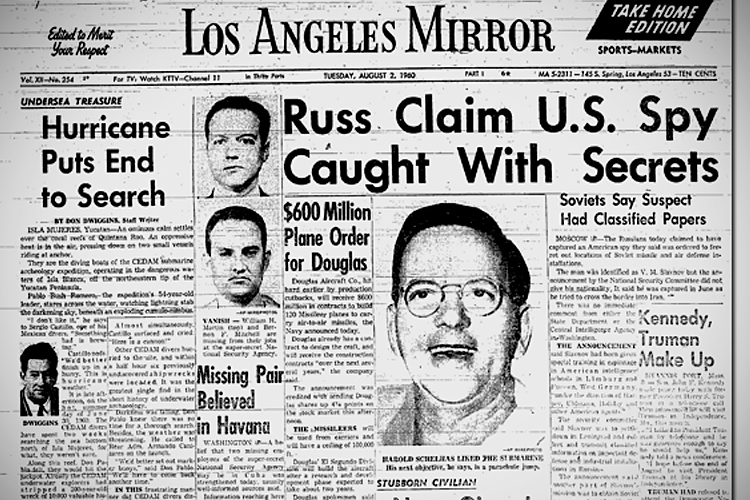

Edward Snowden’s flight from Hong Kong to Moscow last Saturday, reportedly to seek asylum in another country, marked the start of what has become – every 53 years or so – a major National Security Agency defection that involves Russia. I doubt Snowden understood it was anniversary week at Fort Meade. But on June 25, 1960, also a Saturday, two NSA employees named William Hamilton Martin and Bernon F. Mitchell who, like one-time NSA employee and contract worker Snowden, had intimate knowledge of the agency’s sensitive inner operations — quietly boarded a plane in Washington, D.C., with Moscow as their ultimate destination.
The Cold War defection of the two code breakers made global headlines like those Snowden is making, albeit without today’s blow-by-blow tweets and cable coverage. When the two longtime buddies surfaced months later at a press conference in the Soviet Union, they announced they’d been granted asylum and had become Soviet citizens. Standing before 200 reporters at Moscow’s theater-styled House of Journalists, the defectors said they hoped to expose what they called the government’s lies – similar to Snowden’s stated motives in revealing NSA’s megadata collection of the public’s phone calls. The NSA panicked; a secret study from 1963 by the agency declares that “Beyond any doubt, no other event has had, or is likely to have in the future, a greater impact on the Agency’s security program.”
Though a half-century apart, the NSA insider defections have striking parallels. And while Snowden is apparently planning to eventually take up asylum in Ecuador, his predecessors’ historic crossover hints at what kind of life lies ahead for a spy on the lam with his bags, or thumb drive, brimming with pirated documents. There is at least one major difference, however. Snowden is being called everything from hero to traitor, as Mitchell and Martin were (although most Americans back then seemed to agree with President Dwight Eisenhower who labeled the twosome “self-confessed” turncoats, and more than a few sided with former President Harry Truman, who suggested the duo should be shot).
But nobody’s calling Snowden gay, at least. Back in the “Lavender Scare” of the 1950s – detailed in David K. Johnson’s 2006 book and in a movie of the same name due out this summer – the demagogic Sen. Joseph McCarthy was leading the charge against suspected commies and homosexuals supposedly hiding in the government’s closets. Persecuting pinkos took some evidence while charges of just being gay could pass as an indictment – gays and lesbians with sensitive government jobs were conceivably vulnerable to blackmailing. In that atmosphere, and within days of the defectors’ Moscow press conference, Rep. Francis Walter, chair of the subversive-hunting House Un-American Activities Committee (HUAC), labeled Martin and Mitchell “sex deviates,” a commonly used term then for homosexuals. A political legend was therein born.
Even the two defectors seemed to hint at such a lifestyle, telling reporters they felt more suited for Soviet life where they would be “better accepted socially.” Martin, especially, stood out in stereotype, described in news reports as a bookish mathematician and meticulous dresser who, some thought, spoke “slighty effeminately.” The accusation provided an opportune excuse for the NSA. If the defectors were shown to be gay, their credibility and any claims of high-minded motives could be easily dismissed. (Pentagon officials went so far as to announce that after Mitchell was hired, he admitted to having sexually experimented as a teenager with chickens and dogs). Johnson, the author, told me that desertion to Russia back then “was literally unthinkable for most American officials. So to make sense of the defection, they turned to the alleged sexual perversion. That was already associated in the popular imagination with subversion and communism.” Adds NSA expert and author James Bamford, who in “The Puzzle Palace” labeled the defection the worst internal scandal in NSA history: “I think the NSA was looking for any straw to grasp when the defections occurred, and homosexuality was the perfect excuse.”
An excuse it was. But perfect it wasn’t, as I later discovered in a trove of declassified NSA documents.
* * *
Growing up in a conservative Washington state farm community, “Ham” Martin as he was known, seemed an unlikely traitor. His father, John, was then president of the Ellensburg Chamber of Commerce. Ham was a gifted student at Ellensburg High, where he finished school in two years. He later studied at Central Washington College of Education (now Central Washington University). In 1947, he earned a degree in mathematics at the University of Washington in Seattle. He joined the Navy and was assigned to the Naval Security Group in Japan from 1951 to 1954, where he met Mitchell a budding weightlifter, pistol enthusiast and pianist who was born in San Francisco and graduated with a bachelor’s degree from Stanford University. After their Navy service, Martin and Mitchell kept in touch when both returned to college, and met again after they were recruited by the NSA. Both pursued further studies in science and mathematics.
A chess player who collected Japanese sword handles, Martin was seen by some as introverted and troubled. Records show he attended sessions at the University of Washington Counseling Center in the late 1940s where he sought assistance for “certain personality aberrations.” Says one entry: “[Tests] disclosed that Martin was a brilliant but emotionally immature individual who did not respect his father, who pitied his younger brother and who expressed his antipathy toward his mother. Martin’s condition was diagnosed as a beginning character neurosis with schizoid tendencies. It was also believed that Martin was sadistic.”
The duo’s work at the NSA was otherwise uneventful, agency files indicate. With exceptional calculation and pattern-recognition skills, Martin and Mitchell helped decipher and possibly encode secret communiqués at the agency. (Today, much of that work is done by the NSA’s supercomputers, many of them supplied by a company in Martin’s home state. Cray Inc., headquartered in Seattle, furnished the NSA’s first high-speed computer 36 years ago and today provides the petaflop speed supercomputers that crunch America’s phone calls and internet traffic – the megadata described by Snowden in recent leaks to the Guardian and Washington Post).
After four years as trusted employees of America’s largest spy agency, Martin, then 29, and Mitchell, then 31, flew out of Washington, D.C., on that last Saturday in June 1960, with one-way tickets to Mexico City. From there, they flew to Havana and then sailed aboard a Russian freighter to the Soviet Union. It was a plan they worked on for more than a year.
In August, the Pentagon admitted there was a “likelihood” the code breakers — privy to military and diplomatic codes — had slipped behind the Iron Curtain. Then came the September press conference, where Mitchell aired complaints about U.S. foreign policies that echo today. He recounted a 1960 speech by Gen. Thomas Power, then the U.S. Strategic Air Command chief, on the necessity of first-strike capabilities and what Power called the “tremendous advantages that accrue to the man who starts a war.” Said Mitchell: “Gen. Power’s statement involves the dangerous presumption that the United States owns the world.” Mitchell called the first-strike policy suicidal and accused the U.S. of deliberately violating the airspace of other nations before “lying about such violations in a manner intended to mislead public opinion.” He knew the truth, he said, having read the cables.
Martin and Mitchell went on to work and study in Leningrad and, for at least the first year, were intensely debriefed by the Soviet government. Each earned about $500 a month. Martin, who was fluent in Russian, studied at Leningrad University and went by the name Vladimir Sokolodsky. It seemed a triumphal defection.
But as later news reports and NSA files would show, the duo quickly soured on Soviet life, concluding they made a mistake. Over the years, they repeatedly attempted to return to the U.S. if the government wouldn’t charge them with a crime (no deal, said the feds). They introduced themselves to visiting Americans, including touring band leader Benny Goodman, seeking their aid in returning. In a Soviet newspaper interview, Martin called his defection “foolhardy,” but said he wasn’t ashamed. He told another person the Russians actually didn’t trust him, “for he is under constant surveillance by them and given work only of the lowest order of priority,” NSA files state.
Cohort Mitchell, who spoke little Russian, had become morose and a heavy drinker, some sources said, willing to do whatever it took to get out of the country. The NSA and other agencies spied on the ex-spies for decades. By 1975, according to government files, Martin was hitting the bottle, too. “Martin was described by one source as being ‘totally on the skids,’ an incurable alcoholic, and surrounded by degenerates and devoted to the practice of sexual perversions” – though not the homosexual kind of old. Once a fit 5-foot-11 and 175 pounds, Martin had become a “sweaty … seedy” man of over 200 pounds.
They later melded into Soviet life. And then they died. Mitchell lived the longest, spending four decades in Russia. When he died at age 72, he was buried in St. Petersburg in November 2001. Martin, it turned out, returned to American soil in 1987. A diplomatic cable from the U.S. Embassy in Mexico states: “William H. Martin died of cancer at Hospital Del Mar in Tijuana on January 17, 1987.” He was three months short of his 56th birthday, and was able to depart the Soviet Union a few years earlier apparently by using an Australian passport. “Burial,” the cable noted, “took place in the United States.” No location or details were provided.
* * *
The defections would mark a historical turning point in employment protocol at Fort Meade, and the purging and persecution of homosexual government workers. In 1960 the NSA immediately began searching for any other sexual deviants in its ranks, eventually firing 26 employees suspected of being security risks because of their alleged perversions. Looking back, some of the defectors’ neighbors and co-workers told investigators that if they’d been more vigilant about the pair’s sexual proclivities, maybe they’d have been more suspicious of their patriotism. The media happily ran with the story. Among others, the Los Angeles Times reported the two were likely part of a ring of homosexuals who “recruit other sex deviates for federal jobs.” Hearst papers referred to “the two defecting blackmailed homosexual specialists” as a “love team.” The defectors had unwittingly revived a lavender wave set in motion by an infamous 1951 exposé, “Washington Confidential.” That best-seller called D.C. “a garden of pansies” with 6,000 homosexuals on the government payroll, stating that “if you’re wondering where your wandering semi-boy is tonight, he’s probably in Washington.” Adding to the riptide was a HUAC report that concluded Martin was “sexually abnormal; in fact, a masochist,” while Mitchell, who had once posed for nude color slides perched on a velvet-covered stool, had supposedly been outed by his psychiatrist.
In some places, the lavender defector story lives on today. A 1991 Pentagon study of paraphilia (kinky or bizarre sexual behaviors) issued by the Defense Security Service and accessible online named Martin and Mitchell as “publicly known homosexuals” who betrayed their country. Some political and religious websites refer to the two as gay, and a 1997 book, “The Homosexual Revolution,” informs readers that the two “were homosexuals who had been permitted access to classified information.”
But according to NSA investigative files I obtained through the Freedom of Information Act, Martin and Mitchell were straight. The declassified NSA documents, along with others I obtained from the Pentagon, FBI, CIA and State Department, detail the background investigation into the historic spy-agency saga and clear Martin and Mitchell of the “deviancy” charges that rocked the country 53 years ago this summer.
After interviewing more than 450 individuals about the twosome’s character, habits and sex lives — right down to the skin rash on Martin’s stomach — the NSA determined a year after the defections it could find no conclusive evidence the two were lovers or gay. “Martin and Mitchell were known to be close friends and somewhat anti-social, but no one had any knowledge of a homosexual relationship between them,” investigators reported. Both, in fact, had American girlfriends, and “Both married Soviet citizens,” says one government report, “but Martin divorced his wife [Inessa] in about July 1963 after moving to Moscow.” Mitchell married a woman named Galina, dean of the piano faculty at Leningrad Conservatory. Neither apparently fathered any children.
“Personal associates also deny any knowledge of homosexuality on the part of Martin and Mitchell and state that both men engaged in social and sexual activity with women,” NSA investigators found. “One [U.S.] female associate of Mitchell acknowledges frequent and normal sexual activity with him during the entire period of their acquaintance.”
Some American friends and neighbors thought they were “odd young men who kept to themselves.” But they apparently had personal secrets to protect. One of Martin’s companions was a Baltimore stripper known as Lady Zorro. She claimed to have as many as 40 “dates” with Martin, who paid in cash. Another source said Martin was “totally devoted to his all-controlling sadomasochism,” and an Ellensburg man claimed Martin had “perverted sexual relations with Japanese females [while in the Navy] and with women in the State of Washington.” The acts reportedly involved watching, or joining in with, two women having sex.
Still unknown are the secrets Martin and Mitchell evidently provided the Russians. However, their public statements — describing reconnaissance flights both countries likely knew about, and giving general details of NSA communication intercepts — weren’t especially damaging, some observers noted. The NSA argued that neither man handled high-value secrets, describing them as “junior mathematicians” and “clerks.”
“The most plausible explanations for the defection attributed it to personal abnormalities,” the agency’s somewhat self-serving documents state in summation. The probe “revealed that the two were egotistical, arrogant and insecure young men whose place in society was much lower than they believed they deserved. Both had greatly inflated opinions concerning their intellectual attainments and talents, and both reportedly expressed bitter resentment that they had not yet received the recognition they were sure they deserved as up-and-coming young scientists.” The NSA concluded that “the accumulated evidence indicated that the defection was an impulsive, self-generated act, conceived and initiated without outside prompting or assistance.”
Ed Snowden recently said something similar. While he admits to stealing classified secrets, and his extended search for asylum has become a distraction from his revelations, “My sole motive,” he said initially, “is to inform the public as to that which is done in their name and that which is done against them.” He didn’t need prompting, or anyone’s assistance other than the media, to escape, he said, a “world where everything I do and say is recorded. That is not something I am willing to support or live under.” The question now, like the one Martin and Mitchell faced, is whether a world without such recording exists. If so, does it have extradition?
