

Sal Culosi is dead because he bet on a football game — but it wasn’t a bookie or a loan shark who killed him. His local government killed him, ostensibly to protect him from his gambling habit.
Several months earlier at a local bar, Fairfax County, Virginia, detective David Baucum overheard the thirty-eight-year-old optometrist and some friends wagering on a college football game. “To Sal, betting a few bills on the Redskins was a stress reliever, done among friends,” a friend of Culosi’s told me shortly after his death. “None of us single, successful professionals ever thought that betting fifty bucks or so on the Virginia–Virginia Tech football game was a crime worthy of investigation.” Baucum apparently did. After overhearing the men wagering, Baucum befriended Culosi as a cover to begin investigating him. During the next several months, he talked Culosi into raising the stakes of what Culosi thought were just more fun wagers between friends to make watching sports more interesting. Eventually Culosi and Baucum bet more than $2,000 in a single day. Under Virginia law, that was enough for police to charge Culosi with running a gambling operation. And that’s when they brought in the SWAT team.
On the night of January 24, 2006, Baucum called Culosi and arranged a time to drop by to collect his winnings. When Culosi, barefoot and clad in a T-shirt and jeans, stepped out of his house to meet the man he thought was a friend, the SWAT team began to move in. Seconds later, Det. Deval Bullock, who had been on duty since 4:00 AM and hadn’t slept in seventeen hours, fired a bullet that pierced Culosi’s heart.
Sal Culosi’s last words were to Baucum, the cop he thought was a friend: “Dude, what are you doing?”
In March 2006, just two months after its ridiculous gambling investigation resulted in the death of an unarmed man, the Fairfax County Police Department issued a press release warning residents not to participate in office betting pools tied to the NCAA men’s basketball tournament. The title: “Illegal Gambling Not Worth the Risk.” Given the proximity to Culosi’s death, residents could be forgiven for thinking the police department believed wagering on sports was a crime punishable by execution.
In January 2011, the Culosi family accepted a $2 million settlement offer from Fairfax County. That same year, Virginia’s government spent $20 million promoting the state lottery.
The raid on Sal Culosi was merely another red flag indicating yet more SWAT team mission creep in America. It wasn’t even the first time a Virginia SWAT team had killed someone during a gambling raid. In 1998 a SWAT team in Virginia Beach shot and killed security guard Edward C. Reed during a 3:00 AM raid on a private club suspected of facilitating gambling. Police said they approached the tinted car where Reed was working security, knocked, and identified themselves, then shot Reed when he refused to drop his handgun. Reed’s family insisted the police story was unlikely. Reed had no criminal record. Why would he knowingly point his gun at a heavily armed police team? More likely, they said, Reed mistakenly believed the raiding officers were there to do harm, particularly given that the club had been robbed not long before the raid. Statements by the police themselves seem to back that account. According to officers at the scene, Reed’s last words were, “Why did you shoot me? I was reading a book.”
As the Texas Hold ’Em craze picked up momentum in the mid-2000s, fans of the game started hosting tournaments at private clubs, bars, and residences. Police in many parts of the country responded with SWAT raids. In 2011, for example, police in Baltimore County, Maryland, sent a tactical unit to raid a $65 buy-in poker game at the Lynch Point Social Club. From 2006 to 2008, SWAT teams in South Carolina staged a number of raids to break up poker games in the suburbs of Charleston. Some were well organized and high-stakes, but others were friendly games with a $20 buy-in. “The typical police raid of these games . . . is to literally burst into a home in SWAT gear with guns drawn and treat poker players like a bunch of high-level drug dealers,” an attorney representing poker players told a local newspaper. “Using the taxpayers’ resources for such useless Gestapo-like tactics is more of a crime than is playing of the game.”
In 2007 a Dallas SWAT team actually raided a Veterans of Foreign Wars outpost for hosting charity poker games. Players said the tactics were terrifying. One woman urinated on herself. When police raided a San Mateo, California, poker game in 2008, card players described cops storming the place “in full riot gear” and “with guns drawn.” The games had buy-ins ranging from $25 to $55. Under California law, the games were legal so long as no one took a “rake,” or a cut of the stakes. No one had, but police claimed the $5 the hosts charged players to buy refreshments qualified as a rake. In March 2007, a small army of local cops, ATF agents, National Guard troops, and a helicopter raided a poker game in Cary, North Carolina. They issued forty-one citations, all of them misdemeanors. A columnist at the Fayetteville Observer remarked, “They were there to play cards, not to foment rebellion. . . . [I] wonder . . . what other minutiae, personal vices and petty crimes are occupying [the National Guard’s] time, and where they’re occupying it. . . . Until we get this sorted out, better not jaywalk. There could be a military helicopter overhead.”
Police have justified this sort of heavy-handedness by claiming that people who run illegal gambling operations tend to be armed, a blanket characterization that absurdly lumps neighborhood Hold ’Em tournaments with Uncle Junior Soprano’s weekly poker game. And in any case, if police know that people inside an establishment are likely to be armed, it makes even less sense to come in with guns blazing. Police have also defended the paramilitary tactics by noting that poker games are usually flush with cash and thus tend to get robbed. That too is an absurd argument, unless the police are afraid they’re going to raid a game at precisely the same moment it’s getting robbed. Under either scenario, the police are acknowledging that the people playing poker when these raids go down have good reason to think that the men storming the place with guns may be criminals, not cops.
Indeed, that’s exactly what happened to seventy-two-year-old Aaron Awtry in 2010. Awtry was hosting a poker tournament in his Greenville, South Carolina, home when police began breaking down the door with a battering ram. Awtry had begun carrying a gun after being robbed. Thinking he was about to be robbed again, he fired through the door, wounding Deputy Matthew May in both arms. The other officers opened fire into the building. Miraculously, only Awtry was hit. As he fell back into a hallway, other players reporting him asking, “Why didn’t you tell me it was the cops?” The raid team claimed they knocked and announced several times before putting ram to door, but other players said they heard no knock or announcement. When Awtry recovered, he was charged with attempted murder. As part of an agreement, he pleaded guilty and was sentenced to five years in prison. Police had broken up Awtry’s games in the past. But on those occasions, they had knocked and waited, he had let them in peacefully, and he’d been given a $100 fine.
The poker raids have gotten bad enough that the Poker Players Alliance, an interest group that lobbies to make the game legal, has established a network of attorneys around the country to help players who have been raided and arrested.
But the mission creep hasn’t stopped at poker games. By the end of the 2000s, police departments were sending SWAT teams to enforce regulatory law. In August 2010, for example, a team of heavily armed Orange County, Florida, sheriff’s deputies raided several black-and Hispanic-owned barbershops in the Orlando area. More raids followed in September and October. The Orlando Sentinel reported that police held barbers and customers at gunpoint and put some in handcuffs, while they turned the shops inside out. The police raided a total of nine shops and arrested thirty-seven people.
By all appearances, these raids were drug sweeps. Shop owners told the Sentinel that police asked them where they were hiding illegal drugs and weapons. But in the end, thirty-four of the thirty-seven arrests were for “barbering without a license,” a misdemeanor for which only three people have ever served jail time in Florida.
The most disturbing aspect of the Orlando raids was that police didn’t even attempt to obtain a legal search warrant. They didn’t need to, because they conducted the raids in conjunction with the Florida Department of Business and Professional Regulation. Despite the guns and handcuffs, under Florida law these were licensure inspections, not criminal searches, so no warrants were necessary.
That such “administrative searches” have become an increasingly common way for police to get around the Fourth Amendment is bad enough. More disturbing is the amount of force they’re opting to use when they do. In the fall of 2010, police in New Haven, Connecticut, sent a SWAT team to a local bar to investigate reports of underage drinking. Patrons were lined up at gunpoint while cops confiscated cell phones and checked IDs. There have been similar underage drinking SWAT raids on college fraternities. The Atlanta City Council recently agreed to pay a $1 million settlement to the customers and employees of a gay nightclub after a heavy-handed police raid in which police lined up sixty-two people on the floor at gunpoint, searched for drugs, and checked for outstanding warrants and unpaid parking tickets. Police conducted the September 2009 raid after undercover vice cops claimed to have witnessed patrons and employees openly having sex at the club. But the police never obtained a search warrant. Instead, the raid was conducted under the guise of an alcohol inspection. Police made no drug arrests, but arrested eight employees for permit violations.
Federal appeals courts have upheld these “administrative searches” even when it seems obvious that the real intent was to look for criminal activity as long as the government can plausibly claim that the primary purpose of the search was regulatory. In the case of the Orlando raids, simply noting the arrests of thirty-four unlicensed barbers would be enough to meet the test.
But the Fourth Amendment requires that searches be “reasonable.” If using a SWAT team to make sure a bar isn’t serving nineteen-year-olds is a reasonable use of force, it’s hard to imagine what wouldn’t be. At least a couple of federal appeals courts have recognized the absurdity. In 2009 the US Court of Appeals for the Fifth Circuit struck a small blow for common sense, allowing a civil rights suit to go forward against the sheriff’s department of Rapides Parish, Louisiana, after a warrantless SWAT raid on a nightclub thinly veiled as an administrative search. And in 1995 the US Court of Appeals for the Eleventh Circuit made an even broader ruling, finding that having probable cause and a warrant for the arrest of one person in a club did not justify a SWAT raid and subsequent search of the entire club and everyone inside.
But other legal challenges to paramilitary-style administrative searches have been less successful. Consider the bizarre case of David Ruttenberg, owner of the Rack ‘n’ Roll pool hall in Manassas Park, Virginia. In June 2004, local police conducted a massive raid on the pool hall with more than fifty police officers, some of whom were wearing face masks, toting semi-automatic weapons, and pumping shotguns as they entered. Customers were detained, searched, and zip-tied. The police were investigating Ruttenberg for several alleged drug crimes, although he was never charged. The local narcotics task force had tried unsuccessfully to get a warrant to search Ruttenberg’s office but were denied by a judge. Instead, they simply brought along several representatives of the Virginia Department of Alcoholic Beverage Control and claimed that they were conducting an alcohol inspection. Ruttenberg was cited only for three alcohol violations, based on two bottles of beer a distributor had left that weren’t clearly marked as samples, and a bottle of vodka they found in his private office.
In June 2006, Ruttenberg filed a civil rights suit alleging that, among other things, using a SWAT team to conduct an alcohol inspection was an unreasonable use of force. (The town’s vendetta against Ruttenberg stretched on for years and is one of the strangest cases I’ve ever encountered. He eventually sold his bar and moved to New York.) In 2010, the US Court of Appeals for the Fourth Circuit denied his claim. So for now, in the Fourth Circuit, sending a SWAT team to make sure a bar’s beer is labeled correctly is not a violation of the Fourth Amendment.
By the end of the decade, state and local SWAT teams were regularly being used not only for raids on poker games and gambling operations but also for immigration raids (on both businesses and private homes) and raids on massage parlors, cat houses, and unlicensed strip clubs. Today the sorts of offenses that can subject a citizen to the SWAT treatment defy caricature. If the government wants to make an example of you by pounding you with a wholly disproportionate use of force, it can. It’s rare that courts or politicians even object, much less impose consequences.
Another example is the use of these tactics on people suspected of downloading child pornography.
Because people suspected of such crimes are generally considered among the lowest of the low, there’s generally little objection to using maximum force to apprehend them. But when police use force to demonstrate disgust for the crimes the target is suspected of committing, there’s always a risk of letting disgust trump good judgment. In one recent case in West Virginia, police violently stormed a house after a Walmart employee reported seeing an image of a man’s genitals near a child’s cheek in a set of photos a customer had left at the store to be developed. After terrorizing the customer’s family (he was out of town), the police learned that the cheek in the photo wasn’t a child’s but that of a thirty-five-year-old Filipino woman.
Given that most child pornography investigations today involve people who use the Internet to find or distribute the offending images and videos, the investigations can be fraught with problems. There have been several instances in recent years of police waging child porn raids on people after tracing IP addresses, only to learn after the fact that the victims of the raid had an open wireless router that someone else had used to download the pornography. Inevitably, the lesson drawn by police and by the media covering these stories is not that a SWAT raid may be an inappropriate way to arrest someone suspected of looking at child porn on a computer, or that police who insist on using such tactics should probably factor the possibility of an open router into their investigation before breaking down someone’s door, but rather that we should all make sure our wireless routers are password-protected—so we too don’t get wrongly raided by a SWAT team, too.
It can also be difficult to trace an IP address to a physical address, which can lead to yet more mistaken raids. An example of that problem manifested in one of the more bizarre botched raids in recent years. It took place in September 2006, when a SWAT team from the Bedford County sheriff’s department stormed the rural Virginia home of A. J. Nuckols, his wife, and their two children. Police had traced the IP address of someone trading child porn online to the Nuckols’ physical address. They had made a mistake. As if the shock of having his house invaded by a SWAT team wasn’t enough, Nuckols was in for another surprise. In a letter to the editor of the Chatham Star Review, he described the raid: “Men ran at me, dropped into shooting position, double-handed semi-automatic pistols pointed at me, and made me put my hands against my truck. I was held at gunpoint, searched, taunted, and led into the house. I had no idea what this was about. I was scared beyond description.”
He then looked up, and saw . . . former NBA star Shaquille O’Neal.
O’Neal, an aspiring lawman, had been made an “honorary deputy” with the department. Though he had no training as a SWAT officer, Shaq apparently had gone on several such raids with other police departments around the country. The thrill of bringing an untrained celebrity along apparently trumped the requirement that SWAT teams be staffed only with the most elite, most highly qualified and best-trained cops. According to Nuckols, O’Neal reached into Nuckols’s pickup, snatched up his (perfectly legal) rifle, and exclaimed, “We’ve got a gun!” O’Neal told Time that Nuckols’s description of the raid on his home was exaggerated. “It ain’t no story,” he said. “We did everything right, went to the judge, got a warrant. You know, they make it seem like we beat him up, and that never happened. We went in, talked to him, took some stuff, returned it—bada bam, bada bing.”
Incidentally, there have been other strange incidents of SWAT teams with star power. Matt Damon accompanied SWAT officers on several raids while preparing for the movie “The Departed.” And after police mistakenly shot and killed immigrant and father Ismael Mena on a raid in Denver in 1999, they revealed that Colorado Rockies first baseman Mike Lansing had gone along for the ride. Denver police added that it was fairly common to take sports stars on drug raids.
In 2010 a massive Maricopa County SWAT team, including a tank and several armored vehicles, raided the home of Jesus Llovera. The tank in fact drove straight into Llovera’s living room. Driving the tank? Action movie star Steven Seagal, whom Sheriff Joe Arpaio had recently deputized. Seagal had also been putting on the camouflage to help Arpaio with his controversial immigration raids. All of this, by the way, was getting caught on film. Seagal’s adventures in Maricopa County would make up the next season of the A&E TV series Steven Seagal, Lawman.
Llovera’s suspected crime? Cockfighting. Critics said that Arpaio and Seagal brought an army to arrest a man suspected of fighting chickens to play for the cameras. Seagal’s explanation for the show of force: “Animal cruelty is one of my pet peeves.” All of Llovera’s chickens were euthanized. During the raid, the police also killed his dog.
In the end, while the Supreme Court has laid down some avoidable requirements for obtaining a no-knock warrant (or deciding to conduct a no-knock raid at the scene), there are few court decisions, laws, or regulations when it comes to when it is and isn’t appropriate to use a SWAT team and all the bells and whistles of a dynamic entry. The decision is almost always left to the discretion of the police agency—or in the case of the multi-jurisdictional task forces, to the SWAT team itself. The mere fact that there’s actually a split in the federal court system over the appropriateness of using SWAT teams to perform regulatory alcohol inspections at bars shows just how little attention the courts pay to the Fourth Amendment’s reasonableness requirement.
In other words, if the DEA wants to stick it to medical marijuana users because they’re flouting federal law, they can. If Steven Seagal wants to drive a tank into a man’s living room to demonstrate his love of animals, he can. If the Consumer Products Safety Commission (CPSC) wants to send a SWAT team to a physicist’s house to show that it’s cracking down on illegal bottle rockets, it can. At worst, the DEA, the CPSC, and Steven Seagal will be chastised by a judge after the fact, though that seldom happens. Even on the rare occasions when someone actually gets into court and wins an excessive-force lawsuit stemming from a raid, the damages are usually borne by taxpayers, not by the cops who used excessive force. In some cases, community outrage and bad press have persuaded police agencies to change a policy here or there regarding the deployment of their SWAT teams. But if they want to reneg and go back to breaking down the doors of people suspected of stealing decorative fish, there’s very little to stop them.
* * *
Toward the end of the 2000s there were hints that the public was beginning to want a change, though that desire could manifest in unexpected ways. A former colleague at the Cato Institute, Tim Lynch, has told me that when he gives talks about the Waco raid, he finds that people are somewhat sympathetic to the argument that the government overreacted, but that they still can’t get past the weirdness of the Branch Davidians themselves—their stockpile of weapons and the claims of sexual abuse and drug distribution in the community. Even the children who died are sometimes dismissed with guilt by association. But when he mentions that the ATF agents killed the Davidians’ dogs, Lynch tells me, people become visibly angry. I have found the same thing to be true in my reporting on drug raids.
At first, that may seem to indicate that people callously value the lives of pets more than the lives of people. But the fact that killing the dog during these raids has become nearly routine in many police agencies demonstrates just how casually those agencies have come to accept drug war collateral damage. When I started logging cop-shoots-dog incidents on my blog (under the probably sensational term “puppycide”), people began sending me new stories as they happened. Cops are now shooting dogs at the slightest provocation. As of this writing, I’m sent accounts of a few incidents each week.
It’s difficult to say if this is happening more frequently. There are no national figures, and estimates are all over the map. One dog handler recently hired to train a police department in Texas estimates there are up to 250,000 cop-shoots-dog cases each year. That seems high. In 2009 Randal Lockwood of the American Society for the Prevention of Cruelty to Animals (ASPCA) told the Las Vegas Review-Journal that he sees 250 to 300 incidents per year in media reports, and he estimates that another 1,000 aren’t reported. The Indianapolis Star reported that between 2000 and 2002 police in that city shot 44 dogs. A recent lawsuit filed by the Milwaukee owner of a dog killed by cops found that police in that city killed 434 dogs over a nine-year period, or about one every seven and a half days. But those figures aren’t all that helpful. They don’t say how many of those dogs were actually vicious, how many were strays, or how many were injured and perhaps killed as an act of mercy versus how many were unjustified killings of pets.
What is clear is that police are almost always cleared of any wrongdoing in these shootings. An officer’s word that he felt a dog posed a threat to his safety is generally all it takes. Whether or not the officer’s fear was legitimate doesn’t seem to matter. Thanks to smart phones and surveillance cameras, a growing batch of these incidents have been caught on video have shown that officers’ claims that the dog was threatening often aren’t matched by the dog’s body language. In recent years, police officers have shot and killed chihuahuas, golden retrievers, labs, miniature dachshunds, Wheaton terriers, and Jack Russell terriers. In 2012 a California police officer shot and killed a boxer puppy and pregnant chihuahua, claiming the boxer had threatened him. The chihuahua, he said, got caught in the crossfire. Police officers have also recently shot dogs that were chained, tied, or leashed, going so far as to kill pets while merely questioning neighbors about a crime in the area, cutting across private property while in pursuit of a suspect, and after responding to false burglar alarms.
It’s possible that these incidents could just be attributed to rogue cops. But the fact that the police are nearly always excused in these cases—even in the more ridiculous examples—suggests there may be an institutional problem. So does the fact that only a handful of police departments give their cops any training at all when it comes to reading and handling the dogs they may encounter. In a 2012 article for the Huffington Post, my intern J. L. Greene and I looked at twenty-four recent cases of “puppycide” and called the relevant police departments to inquire about training. Only one department could confirm that its officers received training at the time of the incident in question. (Eleven departments did not return our phone calls.) That jibes with an earlier article I wrote for The Daily Beast in which both the ASPCA and the Humane Society told me that they offer such training to any police department that wants it, while few take advantage of the offer. Joseph Pentangelo, the ASPCA’s assistant director for law enforcement, who also served twenty-one years with the NYPD, told me, “New York is the only state I know of that mandates formalized training, and that’s during academy. There are some individual departments in other parts of the country that avail themselves of our training, but not many. Not enough.”
Given how likely it is that police officers will often interact with animals, you would think that such training would be common. It is at the US Postal Service. A spokesman for the USPS told me that while dog bites do happen on occasion, serious dog attacks on mail carriers are almost nonexistent. Postal workers are given regular training in distracting dogs with toys, subduing them with voice commands, or, at worst, incapacitating them with Mace. Mail carriers are shown a two-hour video and then given annual instruction on topics like recognizing and reading a dog’s body language and differentiating between aggressive charging and playful bounding, and between a truly dangerous dog and a merely territorial one.
The fact that the Postal Service offers such training and most police departments don’t lends some credence to the theory that dog shootings are part of the larger problem of a battlefield mentality that lets police use lethal force in response to the slightest threat—usually with few consequences. “It’s an evolving phenomenon,” says Norm Stamper, the former Seattle police chief. “It started when drug dealers began to recruit pit bulls to guard their supply. These dogs weren’t meant to attack cops. They were meant to attack other drug dealers who came to rob them. But of course they did attack cops. And yes, that’s awfully scary if one of those things latches on to your leg.”
But Stamper says that like many aspects of modern policing, dog shootings may have had a legitimate origin, but the practice has since become a symptom of the mind-set behind a militarized police culture. “Among other things, it really shows a lack of imagination. These guys think that the only solution to a dog that’s yapping or charging is shooting and killing it. That’s all they know. It goes with this notion that police officers have to control every situation, to control all the variables. That’s an awesome responsibility, and if you take it on, you’re caving to delusion. You no longer exercise discrimination or discretion. You have to control, and the way you control is with authority, power, and force. With a dog, the easiest way to take control is to simply kill it. I mean, especially if there are no consequences for doing so.”
A handful of police departments do now mandate dog training, including Nashville, Omaha, and Milwaukee. Police departments in Austin, Fort Worth, and Arlington, Texas, do too. All began offering training after public backlash over one or more cop-shoots-dog incidents.
“In my ten years in law enforcement on the street, I can’t remember one case where a police officer shot a dog,” says Russ Jones, the former narcotics cop with the San Jose Police Department and the DEA. “I don’t understand it at all. I guess somewhere along the line a cop shot a dog under questionable circumstances and got away with it. Word got out, and now it seems like some cops are just looking for reasons to take a shot at a dog. Maybe it just comes down to that—we can get away with it, therefore we do it.”
* * *
On the Friday afternoon before the 2009 G-20 summit was to begin in Pittsburgh at the David L. Lawrence Convention Center, a reader in the city sent me a photo he’d snapped moments earlier. The photo was of a police officer standing in the middle of an intersection. He was wearing a military-green top, camouflage pants, and combat boots. He had a gun strapped to his thigh and looked to be carrying another one. The camouflage in particular seemed odd—as it does whenever it’s worn by a police officer in an urban area. It was unclear why this cop would have wanted to hide, and even if he did, how camouflage would help him do so in the city. There seemed to be little purpose for it other than to mimic the military. In any case, it was a sign of what was to come.
This is how the country that gave the world the First Amendment now handles protest. There’s a disquieting ease now with which authorities are willing to crush dissent—and at the very sorts of events where the right to dissent is the entire purpose of protecting free speech—that is, events where influential policymakers meet to make high-level decisions with far-reaching consequences. In fact, the more important the policymakers and the more consequential the decisions they’ll be making, the more likely it is that police will use more force to keep protesters as far away as possible. As Norm Stamper said, this unfortunately was the lesson the country’s law enforcement agencies took from the 1999 WTO protests in Seattle.
A number of police departments from across the country had sent officers to Pittsburgh to help police the 2009 summit. Nearly all were dressed in similar paramilitary garb. In one widely circulated video from the summit, several police officers dressed entirely in camouflage emerged from an unmarked car, apprehended a young backpack-toting protester, stuffed him into the car, then drove off. It evoked the sort of “disappearance” you might envision happening in a Latin American country headed by a junta, or one of the countries of the Soviet bloc. Matt Drudge linked to the video with a headline describing the officers in it as members of the military. They weren’t, though it’s certainly easy to understand how someone might make that mistake.
Another video showed a police unit with a handcuffed protester. Officers surrounded the protester, propped him up, then posed with him while another officer snapped a trophy photo. (YouTube later removed the video, citing a terms of use violation.) It was later revealed that the police unit was from Chicago. They had taken vacation time to come to Pittsburgh to provide “freelance security” for the G-20 summit.
As the summit went on, Twitter feeds and uploaded photos and videos claimed (and sometimes provided some evidence to prove) that police fired tear-gas canisters into dorm rooms, used sound cannons, and fired bean bags and rubber bullets. One man was arrested for posting the locations of riot police to his Twitter feed. The charges were later dropped.
Emily Tanner, a grad student at the University of Pittsburgh who described herself as a “capitalist” who didn’t agree with the general philosophy of the antiglobalization protesters, covered the summit, the protests, and the fallout on her blog. The most egregious police actions seemed to take place on the Friday evening before the summit, around the university, when police began ordering students who were in public spaces to disperse, despite the fact that they had broken no laws. Students who moved too slowly were arrested, as were students who were standing in front of the dormitories where they lived.
A University of Pittsburgh spokesman later said that the tactic was to break up crowds that “had the potential of disrupting normal activities, traffic flow, egress and the like. . . . Much of the arrests last night had to do with failure to disperse when ordered.” Note that no one needed to have broken any actual laws to get arrested. The potential to break a law was more than enough. That standard was essentially a license for the police to arrest anyone, anywhere in the city, at any time, for any reason.
Pennsylvania ACLU legal director Vic Walczak said the problem was that police didn’t bother to attempt to manage the protests. They simply suppressed them. In the process, they rounded up not only innocent protesters but innocent students who had nothing to do with the protests at all. In all, 190 people were arrested. One of the arrestees was a reporter from the left-leaning organization Indy-Media. When they apprehended her, the police took her camera. When they returned her camera, it was broken, and the police had deleted her photos and videos of the protests and police reaction. The police presence “seemed to focus almost exclusively on peaceful demonstrators,” Walczak said. “On [Friday] night they didn’t even have the excuse of property damage going on or any illegal activity. It’s really inexplicable.”
Inexcusable perhaps, but not inexplicable. Since Seattle, this had become the template. At the 2008 Republican National Convention in Minneapolis, police conducted peremptory raids on the homes of protesters before the convention had even started. Police broke into the homes of people known to be activist rabble-rousers before they had any evidence of any actual crime. Journalists who inquired about the legitimacy of the raids and arrests made during the convention were also arrested. In all, 672 people were put in handcuffs. The arrest of Democracy Now journalist Amy Goodman was captured on a widely viewed video. She was charged with “conspiracy to riot.” That charge against Goodman was later dropped. So were the charges against most of the others arrested. The Minneapolis Star-Tribune reported the following February that charges were dropped or dismissed for 442 of the 672 people arrested.
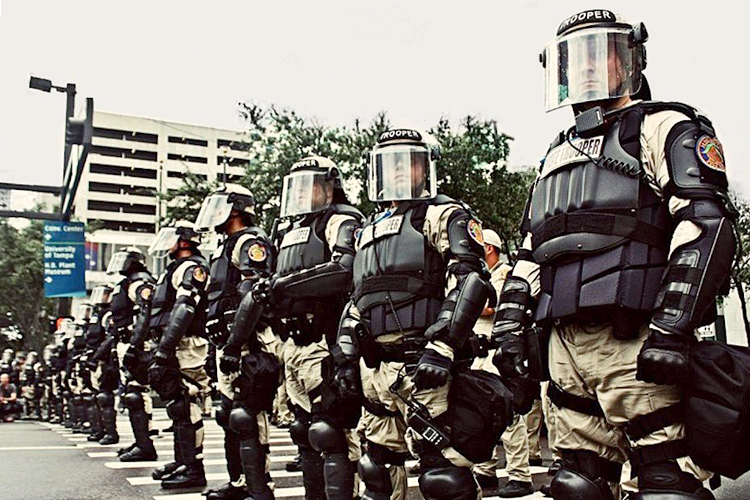
There were similar problems at the 2008 Democratic National Convention. Police in Denver showed up for the protests decked out in full riot gear. One particularly striking photo from Denver showed a sea of cops in shiny black armor, batons in hand, surrounding a small, vastly outnumbered group of protesters. The most volatile night of the convention featured one incident in which Jefferson County, Colorado, deputies unknowingly clashed with and then pepper-sprayed undercover Denver cops posing as violent protesters. The city later paid out $200,000 to settle a lawsuit alleging that a Denver SWAT team was making indiscriminate arrests, rounding up protesters and bystanders alike.
Perhaps the best insight into the mentality the police brought to the DNC protests could be found on the T-shirts the Denver police union had printed up for the event. The shirts showed a menacing cop holding a baton. The caption: DNC 2008: WE GET UP EARLY, TO BEAT THE CROWDS. Police were spotted wearing similar shirts at the 2012 NATO summit in Chicago. At the 1996 DNC convention in Chicago, cops were seen wearing shirts that read: WE KICKED YOUR FATHER’S ASS IN 1968 . . . WAIT ’TIL YOU SEE WHAT WE DO TO YOU!
This default militaristic response to protest of overkill was then given an extended national stage during the Occupy protests of 2011. In the most infamous incident, now forever captured in countless Internet memes and mashups, Lt. John Pike of the University of California–Davis campus police casually hosed down a peaceful group of protesters with a pepper-spray canister. But that was far from the only incident. Police across the country met protesters in riot gear, once again anticipating—and in too many instances seemingly even craving—confrontation. In Oakland, the skull of Iraq War veteran Scott Olsen was fractured by a tear-gas canister that the police had fired into the crowd. In New York, NYPD officer Anthony Bologna pepper-sprayed a group of helpless protesters who had been penned in by police fencing.
One thing the Occupy crackdowns did seem to do was focus renewed attention on police tactics and police militarization. Big-picture stories about the Pentagon buildup, Department of Homeland Security (DHS) funding for antiterror gear, and the proliferation of SWAT teams started streaming out of media outlets, giving the militarization issue the most coverage it had received since Kraska’s studies came out in the late 1990s. Part of that was due to social media. The ubiquity of smart phones and the viral capacity of Twitter, Facebook, Tumblr, and blogs were already bringing unprecedented accountability to police misconduct and government oppression, be it a Baltimore cop screaming obscenities at a kid on a skateboard, a transit cop in Oakland shooting a man who lay handcuffed on his stomach, or government paramilitaries in Iran gunning down a young woman in cold blood during Arab Spring democracy protests. But the Occupiers, who tended to be young, white, and middle-to upper-middle-class, knew social media like few other demographics. They knew how to live-stream video directly to the Internet. They all had smart phones, so police couldn’t suppress incriminating video by confiscating one or two or ten phones—someone was bound to have video of not only the original incident but also of police trying to confiscate phones to cover it up.
The political reaction to the Occupy crackdowns was interesting to watch. In the 1990s, it had been the right wing—particularly the far right—that was up in arms over police militarization. Recall the outrage on the right over Waco, Ruby Ridge, and the raid to seize Elián González. The left had largely either remained silent or even defended the government’s tactics in those cases. But the right-wing diatribes against jackbooted thugs and federal storm-troopers all died down once the Clinton administration left office, and they were virtually nonexistent after September 11, 2001. By the time cops started cracking heads at the Occupy protests, some conservatives were downright gleeful. The militarization of federal law enforcement certainly didn’t stop, but the 9/11 attacks and a friendly administration seemed to quell the conservatives’ concerns. So long as law enforcement was targeting hippie protesters, undocumented immigrants, suspected drug offenders, and alleged terrorist sympathizers, they were back to being heroes.
Steven Greenhut, a conservative-leaning columnist for the Orange County Register and editor of the investigative journalism site CalWatchdog, was dismayed by the right’s reaction. “What’s really disgusting is the natural instinct of so many conservatives to stick up for the police,” Greenhut wrote. “They don’t like the Occupy protesters, so they willingly back brutality against them, without considering the possibility that conservatives at some point might be on the receiving end of this aggression.”
Unfortunately, consistent voices like Greenhut’s have been rare. Partisan reaction to aggressive police actions against opponents tends to fall somewhere between indifference and schadenfreude.
After the December 2012 shooting massacre in Newtown, Connecticut put the issue of gun control back into the political discourse, some progressives again dredged up the right’s criticism of the ATF in the early 1990s. In one lengthy segment, MSNBC host Rachel Maddow aired old footage from Waco and Ruby Ridge while making some tenuous connections between gun rights politicians and activists and Weaver, McVeigh, and Koresh. She referred to a “conspiracy-driven corner of the gun world’s paranoia about federal agents,” without paying much heed to the fact that the ATF was inflicting the same sort of abuse on suspected gun offenders that Maddow herself has decried when used against suspected undocumented immigrants or Occupy protesters. More tellingly, Maddow added that there’s nothing wrong with wanting to give more power to the ATF based only on the politics of the people opposed to doing so. “Sometimes the character of the opposition defines why something ought to be the most politically viable thing in the world,” she said.
But even before Newtown, progressives have been advocating for the use of more government force against political factions they find unsavory. In 2009 the Department of Homeland Security issued a controversial report on what the author—DHS analyst Daryl Johnson—called a resurgence of right-wing extremism and the threat it posed to domestic security. The report was widely criticized on the right and was eventually criticized and revoked by DHS secretary Janet Napolitano. But after a spate of mass killings in the following years by assailants with political views that in some cases could loosely be characterized as right-wing, Johnson became something of a progressive hero. Most of the incidents involved clearly mentally ill attackers whose politics were all over the place. Even Johnson acknowledged that the incident most in line with his thesis—the massacre at a Sikh Temple in Oak Creek, Wisconsin, by a white supremacist named Wade Michael Page—was the work of a “lone wolf” attacker and likely would not have been prevented by the recommendations in his report.
Still, he was celebrated on the left. The progressive advocacy group Media Matters declared him “vindicated.” Similar sentiment popped up on progressive outlets like ThinkProgress, Salon, Rachel Maddow’s MSNBC blog, and Democracy Now.
In truth, attacks by groups on the fringes of the right wing have actually dropped in recent years, despite some claims that they’ve increased in response to the election of a black president. Attacks from groups on the fringes of the left wing are in decline too, as are alleged attempted terrorist attacks by fringe Muslim groups.
In a 2012 interview with the Idaho Spokesman Review, Johnson showed why it may not have been such a great idea for progressives to embrace him simply because he wanted to shut down opinions they found distasteful. Johnson was interviewed for an article on the twentieth anniversary of the Ruby Ridge fiasco, and he took one step further Rachel Maddow’s idea of supporting government force simply because you don’t like the factions opposing it. Johnson in fact suggested that merely having concerns about police militarization is a worry only borne by extremists. In fact, he appeared to have suggested that even recognizing that militarization is happening is an indication of fringe extremism.
“For American extremists, the siege at Ruby Ridge symbolizes the ‘militarized police state,’” said Johnson. The US government, through its Department of Homeland Security in particular, he said, “has unintentionally fostered, and even solidified, Orwellian conspiracies concerning an overzealous, oppressive federal government and its perceived willingness to kill to ensure citizen compliance. . . . In the minds of modern-day extremists, [Homeland Security] has enhanced the lethal capability of many underfunded, small-town police forces through its grant programs.” Using federal grants, state and local law enforcement agencies have been able to buy expensive equipment and training that are “commonly associated with the military,” he said, adding that “extremists view such a security buildup as a continuation of the Ruby Ridge legacy.” That legacy is a continuing drumbeat for extremists and white supremacists who recruit with the message of “big government versus the little guy” and “the government set me up.” These extremist ideas continue as messages and even recruiting themes among various radical groups in the United States, Johnson said.
I attempted to contact Johnson to ask if he’d like to clarify his comments. He didn’t return my calls. As they stand, these quotes are striking, particularly from someone who once worked for the Department of Homeland Security and now runs a consulting firm that works with law enforcement agencies. They certainly appear to dismiss police militarization—a phenomenon documented by a wide range of media outlets and criticized by interests all across the political spectrum—as merely a fantasy cooked up by extremists to boost their recruiting. Incidentally, the publications and advocacy groups who have recently expressed concerns about police militarization include ThinkProgress, Wired, Salon, MSNBC, and Democracy Now— all of them also ran articles praising Johnson.
So long as partisans are only willing to speak out against aggressive, militarized police tactics when they’re used against their own and are dismissive or even supportive of such tactics when used against those whose politics they dislike, it seems unlikely that the country will achieve enough of a political consensus to begin to slow down the trend.
Excerpted from “Rise of the Warrior Cop: The Militarization of America’s Police Forces” by Radley Balko. Reprinted with permission from PublicAffairs Books.
