
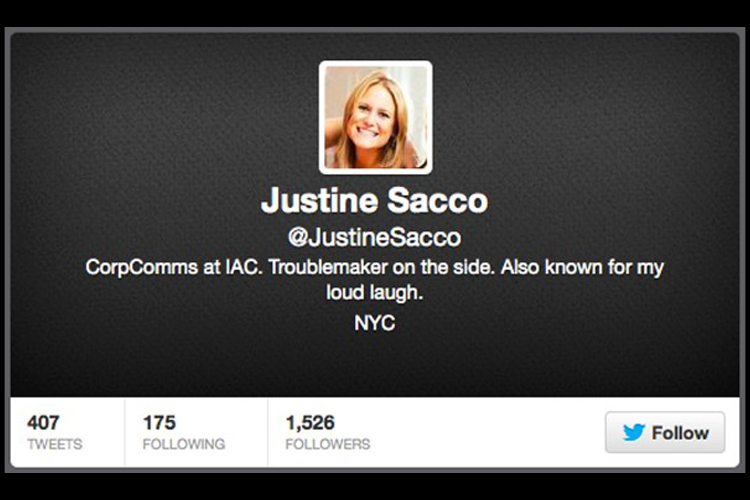

PR executive Justine Sacco wrote an offensive tweet before boarding a flight from London to Cape Town, South Africa. “Going to Africa. Hope I don’t get AIDS. Just kidding. I’m white!” she said. Between the time Sacco tweeted and when she landed in South Africa twelve hours later, the hashtag #HasJustineLandedYet trended worldwide. A great many of the tweets including the hashtag were downright hilarious. Even Donald Trump, a paragon of ignorance, chastised Sacco on Twitter, saying, “Justine, what the hell are you doing, are you crazy? Not nice or fair! I will support @AidforAfrica. Justine is FIRED!”
Internet sleuths figured out which flight Sacco was on and when she would land. Her work and cell phone numbers were uncovered. Her entire online footprint was revealed. She had made inappropriate tweets before. She had Instagram and Facebook accounts. These have all been deleted but nothing on the Internet really disappears. The digital echoes of her mistakes will endure. Sacco’s former employer, InterActiveCorp, immediately distanced themselves, condemned her words and she was fired. During her flight, Sacco gained thousands of Twitter followers, an audience raptly waiting, somewhat gleefully, to see what would happen next. Justine Sacco unwittingly scripted a gripping, real-life soap opera and she wasn’t even there to watch it unfold.
Here was instant comeuppance for someone who said something terrible. Here was comeuppance for a white person generalizing shallowly about Africa, the continent, as if it were one large country with only one story to tell. Here was a woman reveling in her whiteness and assuming that her whiteness was some kind of shield against a disease that does not discriminate. I was amused by the spectacle. I followed along even though something in my stomach twisted as the hours passed. It was a bit surreal, knowing this drama was playing out while Sacco was at 38,000 feet.
At the same time, I was horrified. It all felt a bit frenzied and out of control, as interest in the story mounted and the death threats and gendered insults began. The online outrage and Sacco’s comeuppance seemed disproportionate. The amount of joy some people expressed as they engaged with the #HasJustineLandedYet hashtag gave me pause.
Somewhere along the line, we forgot that this drama concerned an actual human being. Justine Sacco did not express empathy for her fellow human beings with her insensitive tweet. It is something, though, that the Internet responded in kind, with an equal lack of empathy. We expressed some of the very attitude we claimed to condemn.
To be clear, Sacco’s tweet was racist, ignorant and unacceptable. Her cavalier disregard for the global impact of AIDS was offensive. In that regard, it was heartening to see that someone purchased the domain www.justinesacco.com and redirected it to Aid for Africa so that some good might come out of such a crass and careless remark. Justine Sacco’s actions should not have gone without consequences. In her case, though, the consequences were severe and swift. She made a cheap joke and paid a steep price. She has since apologized, though it is hard to take the apology seriously because we have become so accustomed to this cycle of public misstep, castigation, apology. Nothing really changes.
We can excoriate Justine Sacco but we need to interrogate white privilege and the relative comfort Sacco felt in demonstrating such poor judgment. It seemingly did not cross her mind that it would be inappropriate to make that joke in such a public forum. We also need interrogate the corporate culture where an attitude like Sacco’s was clearly not a deterrent to her success. As Anil Dash noted on Twitter, “That @Justine Sacco is offensive is obvious. The bigger problem is that her mindset is no barrier to corporate success.”
At the same time, we are only outraged about Justine Sacco because we happened to hear about her tweet. She was, before this debacle, someone with only two hundred Twitter followers. She made her comments in public, but her public was quite limited. If someone hadn’t tipped off Gawker, if thousands of people hadn’t shared Sacco’s tweet, if Buzzfeed hadn’t latched onto the story, making it go ever more viral, we would have never known about Sacco’s racism and ignorance. This does not excuse her words, but is Justine Sacco different from any of us? We like to think the best of ourselves. We like to believe we always say and do the right things. We like to believe our humor is always politic. We like to believe we harbor no prejudices. At least, that’s the impression we give when we are so quick to condemn those whose weaknesses and failures are subjected to the harsh light of the Internet.
The world is full of unanswered injustice and more often than not we choke on it. When you consider everything we have to fight, it makes sense that so many people rally around something like the hashtag #HasJustineLandedYet. In this one small way, we are, for a moment, less impotent.
In many ways, 2013, particularly online, was a year of reckoning. More than ever, people were held accountable for their words and actions. Outrage was spoken, not swallowed.
After the Boston Marathon bombings, people shared grief and outrage on social media. From all around the world they stood with the people of Boston, often using the hashtag #BostonStrong. Some became amateur detectives, sifting through the images and other information law enforcement officials released to the public, as if they, too, could play a role in bringing the responsible culprits to justice.
In June, Texas senator Wendy Davis rose to national prominence during a 13-hour filibuster protesting SB5, a bill further restricting abortion laws in Texas. People from all around the United States watched the live video feed provided by the Texas Tribune. The hashtag #standwithwendy allowed people to voice their support for Davis’s efforts and their disdain, and to a lesser extent, their support for legislative attempts to curtail reproductive freedom. The legislation ultimately passed but a vigorous protest was heard and will be remembered.
Paula Deen’s racism was revealed in the contents of a deposition. Before long, most of Deen’s business relationships had shattered, including those with Food Network, WalMart, Target, Walgreens, JCPenny, Sears, QVC, Smithfield Foods and others. Black Twitter responded with the #paulasbestdishes hashtag, using humor as a means of coping with the painful reality that Paula Deen is but one of many people who harbor racial prejudices. Deen’s comeuppance seemed more appropriate than Sacco’s because she was a far more prominent and powerful figure.
Hanna Rosin declared the patriarchy dead, which gave rise to the #RIPPatriarchy hashtag, used by feminists to mock the incorrect notion that somehow all was right in the world for women. The GOP made an ill-advised attempt at honoring Rosa Parks, implying that her efforts had ended racism, which led to the #whenracismended hashtag. Russell Simmons’s All Def Digital released the “Harriet Tubman Sex Tape,” and was quickly forced to take down the video and offer an apology. People were not going to stand silently by as the legacy of Harriet Tubman was diminished so recklessly.
Mikki Kendall started the hashtag #solidarityisforwhitewomen to challenge the exclusion of feminists of color from mainstream feminism. Jamilah Lemieux started the hashtag #blackpowerisforblackmen soon after, to challenge sexism within the black community. After Renisha McBride was murdered in Detroit, dream hampton brought much-needed national attention to the tragedy with the #RenishaMcBride hashtag. People began sharing their stories and demanding justice. Theodore Wafer, the homeowner who shot and killed McBride, will now face trial. For once, perhaps, there will be actual justice for the death of a young black woman.
As R. Kelly released his latest album, some people refused to forget that R. Kelly is an unabashed pedophile. During an online Q & A, R. Kelly tried to use the hashtag #AskRKelly and quickly lost control of it as people used the hashtag to mock and rightly shame R. Kelly for his crimes. Mikki Kendall and Jamie Nesbitt Golden created the hashtag #fasttailedgirls to address the sexual violations black girls face and the fact that all too often, the responsibility for these violations is placed on the backs of black girls and not the perpetrators. Writer and activist Suey Park created the hashtag #notyourAsiansidekick to, in her words, create “a space for [Asian-American, Pacific Islander and Native Hawaiian women] to use our voices, build community, and be heard.”
A common thread between the most powerful hashtags this year is that many were created by women and/or people of color, people whose voices are all too often marginalized in the forums where they most need to be heard. These hashtags not only inspired necessary conversations, they were the catalyst for all manner of activism.
Social media is something of a double-edged sword. At its best, social media offers unprecedented opportunities for marginalized people to speak and bring much needed attention to the issues they face. At its worst, social media also offers everyone an unprecedented opportunity to share in collective outrage without reflection. In the heat of the moment, it encourages us to forego empathy.
It is, perhaps, fitting that 2013 has come to an end with the story of Justine Sacco. I confess I do harbor a certain amount of empathy for her and honestly, this empathy makes me uncomfortable. I don’t want to feel sorry for Sacco. I don’t even know if I feel sorry for her, exactly. Instead, I recognize that I’m human and the older I get, the more I realize how fallible I am, how fallible we all are. I recognize that Justine Sacco is human. She should have known better and done better, but most of us can look at poor choices we’ve made, critical moments when we did not do better.
As I watched the online response to Justine Sacco’s tweet, I thought of Shirley Jackson’s short story, “The Lottery,” first published in 1948 but quite prescient. In a village there is a ritual that has gone largely unquestioned for generations. There is a box and in the box are slips of paper. Each year, the heads of each family draw slips of paper. One will be marked and then the members of that person’s family draw slips again. Whoever selects the slip with a black mark is the sacrifice. Everyone takes up stones and sets upon the unlucky victim. Every citizen is complicit in the murder of someone who, just moments before he or she was chosen, was a friend, a neighbor, a loved one.
Justine Sacco was not sacrificed. Her life will go on. We will likely never know if she learned anything from this unfortunate affair. In truth, I don’t worry so much about her. Instead, I worry for those of us who were complicit in her spectacularly rapid fall from grace. I worry about how comfortable we were holding the stones of outrage in the palms of our hands and the price we paid for that comfort.
