
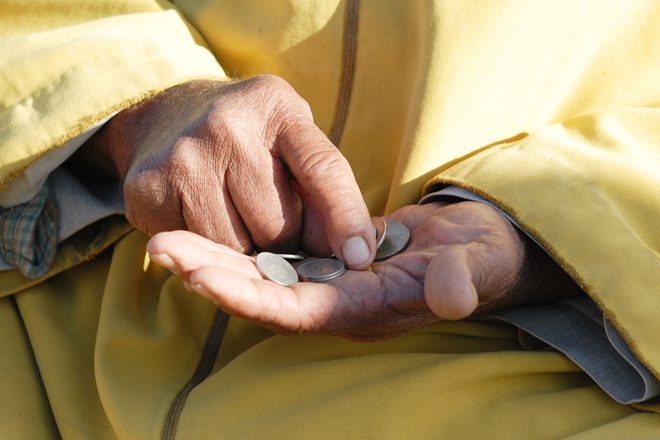


 It takes money to make money, they say, but if you don’t have money you lose money. Those with the money have been cutting themselves so much of the money pie that half of us are poor or almost poor now. According to the US Census Bureau, half of Americans are poor, or just on the edge. Fifteen percent (46.5 million) are in poverty, while “half of Americans are in or near poverty.” On top of that 76% of Americans are living paycheck-to-paycheck.
Republicans constantly talk about how good the poor have it. In 2002 the Wall Street Journal called the poor “Lucky Duckies” because they are “the beneficiaries” of the progressive tax system and pay little or no taxes. But the reality is that it just plain sucks to be poor. It’s actually more expensive not having enough money to get by.
Here are nine examples of why it is expensive to be poor.
1. Getting around. When you don’t have the money to get a nice, reliable car you are stuck with time-consuming and not-inexpensive public transportation—if it is available at all. Investment in public infrastructure has declined dramatically since the Reagan tax cuts, and that was a long time ago. The American Society of Civil Engineers (ASCE) “Infrastructure Report Card” gives our country’s transit systems a D, saying, “45% of American households lack any access to transit, and millions more have inadequate service levels.” Additionally, “deficient and deteriorating transit systems cost the U.S. economy $90 billion in 2010, as many transit agencies are struggling to maintain aging and obsolete fleets and facilities amid an economic downturn that has reduced their funding, forcing service cuts and fare increases.”
The alternative to relying on our crumbling and increasingly expensive-to-ride public transportation systems is finding an old beater to drive. Old cars break down and this costs money. It costs time. It can cost you a job. Lower-priced older cars will often be the ones that use a lot of gas, sometimes getting less than 20mpg. At today’s gas prices and today’s wages you’re eating up an hour or more’s pay every day just to get back and forth.
2. A place to live. When you rent a typical apartment you have to pay the first month’s rent, a security deposit and sometimes the last month’s rent. You have to have a reference and usually a credit report. If you are poor you may not have any of these things, and you have to live somewhere else. That can be expensive. You might be in a week-to-week situation in a budget motel, requiring you to pay with a money order. Money orders cost money so you’re even paying a fee to pay for your place to sleep.
A 2012 McClatchy news story, Motel families live in limbo, explained,
They are not technically homeless. Yet they have no home beyond a week-to-week existence. Though comprehensive statistics are hard to come by, it’s clear that this lifestyle is becoming more common.… Typically, these families can’t afford the upfront costs of an apartment, so it’s either a motel or a shelter or the street.… Some families move from motel to motel, often for years, trying to be closer to jobs or to escape the harsh culture that sometimes develops.
3. Eating. Eating when you are poor is a problem. Of course, first is having money to get food at all. Then when you can get food you are faced with food choices that can lead to health problems. If you don’t have fridge or a stove you might depend on cheap fast food. If you don’t have a car (or gas for the broken-down car you have) you depend on what is nearby and local stores in bad neighborhoods are expensive compared to gleaming suburban supermarkets. Never mind buying in bulk at Costco, the membership fee alone is more than you can probably afford.
Meanwhile Congress is cutting food assistance, forcing even more people to rely on local food banks. The problem is so bad that the food banks are overwhelmed, often running out of food completely. But food banks can’t help people who don’t have places to store or cook food—they are out of luck.
4. Banking. If you are poor you either don’t have a bank account (8 percent of American households) or have one that costs so much your money drains away. 28.3% of Americans conduct at least some of their financial transactions “outside of the mainstream banking system,” meaning they have to rely on expensive alternatives like non-bank money orders, check-cashing services, prepaid debit cards and payday loans.
For the poor, even being lucky enough to have a bank account means high fees. You don’t have enough to meet the minimum balance requirements so you pay a monthly fee that eats away at any money you have. You will pay a fee averaging $6 to cash your paycheck. You will be hit by terrible fees if the money runs out before the month does. Overdraft fees are incredible. A Pew graphic illustrates how the median overdraft for a $36 transaction racks up a median $35 in fees. “If an overdraft was treated like a short-term loan with a repayment period of seven days, then the annual percentage rate for a typical incidence would be over 5,000 percent.”
If you are not able to get a bank account (or don’t want to risk paying 5000% for writing a check), things are even worse. You turn to payday lenders. Payday loans cost an average of more than 138 percent in interest and fees. According to Think Progress,
“Most take out nine repeat loans per year with an interest rate as high as 400 percent. Forty-four percent of borrowers ultimately default, even after paying back their loans several times over, and thus are pushed ever closer to poverty. Critics have called the practice ‘legalized loan sharking’ and describe the industry as ‘bottom feeders.’ In recent years, major banks have also joined in the practice.”
5. Low pay. Low wages are expensive. When you are paid so little you have to try to get a second job just to have a place to live you don’t have any time left—and time really is money. When you are always working (and getting to and from work) you can’t look for better work. Even if you can look, the time involved and the transportation costs are so high you are eating into the little time and money you might have. The kinds of jobs you end up with if you find one are expensive because you don’t get any paid time off, so any day you get sick or have a child problem you lose money. That’s expensive.
6. Getting paid and not getting paid. Some low-wage employers like Walmart pay you with a debit card. CNBC reported,
Christon works at Walmart. Her paychecks are deposited onto a prepaid debit card—an improvement over old-fashioned paper paychecks, which led to high check-cashing fees. It’s hardly a good substitute for direct deposit, however. One cash withdrawal per period is free, but others cost $2. She can avoid the fee by shopping at Walmart and getting cash back at checkout.
Wage theft is much more common than people realize. Wage theft is restaurants stealing tips, employers demanding free time or not even paying the minimum wage, refusing to pay overtime pay when it is due, calling an employee a contractor or a temp, making various deductions from wages, and other ways that workers end up not getting paid for their work. Poor people are vulnerable, and have to take what they can get. Sometimes employers take advantage of that.
In one case, 600 workers won a lawsuit against a company that ran a warehouse for Walmart for making them sign forms saying they were voluntarily giving up their lunch time. According to the Huffington Post, “More than 60 percent of low-wage workers have some pay illegally withheld by their employer each week, according to a 2009 survey cited in the report. Low-paid workers lose a stunning $2,634 per year, on average, in unpaid wages, or 15 percent of their income, according to the report.”
7. Getting scammed. The poor are vulnerable to, and frequent targets of financial scams. This includes high-interest credit cards. Anything you buy on credit involves paying back with interest. That interest goes somewhere, which means there are people with a very big incentive to get you to borrow. But it’s not just credit cards. We have all read about the mortgage-fraud scams financial institutions were running on poor people who were unable to understand that an initial low-interest rate would balloon to a huge monthly payment. There are also insurance scams, supposed-savings scams, etc.
8. Even the little things. When you are poor you can’t afford various things that save money. Cheap clothing doesn’t last very long. Washing clothes requires going to a laundromat, which costs more than using a washer and dryer. You might have to purchase bottled water because of conditions at your low-rent residence.
High-Wire Act
Being poor is a trap. It becomes one thing after another that keeps you poor. In the Atlantic this month, Barbara Ehrenreich calls being poor “a perpetual high-wire act.”
In today’s America one more way it’s expensive to be poor is that you are the brunt of blame. Our society blames the poor for their predicament. You pay a high price of guilt and blame as the billionaires behind the bank fees, payday loan rates, wage theft and the rest of the above send out the propaganda that the poor are to blame for their own circumstances.
Inequality is costing all of us. Today the 3,000 richest Americans make more than the poorest 23 million. The average McDonald’s employee takes seven months to earn what McDonald’s CEO makes in an hour. Ninety percent of Americans are continuing to go further into debt. Those at the top are blaming the poor, calling them “takers” or “moochers” and calling themselves “producers” and “job creators.”
This is why it is time to raise the minimum wage, and index it to inflation. A $10.10 minimum wage will help lift working people above the poverty line and help end the perpetual high-wire act of falling further and further behind.
