
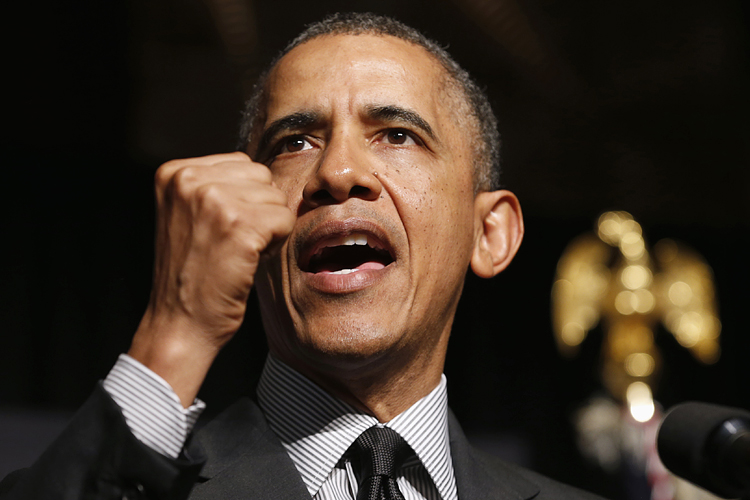

 During the Bush years, people all over the world were horrified by America’s aggression, human rights abuses and militarism. By 2008, only one in three people around the world approved of the job performance of U.S. leaders. The election of President Obama broadcast his message of hope and change far beyond U.S. shores, and Gallup’s 2009 U.S.-Global Leadership Project (USGLP) recorded a sharp rise in global public approval of U.S. leadership to 49 percent.
As in the U.S., the reality of Obama’s policies has gradually eroded global approval of his leadership, which dropped to 41 percent in 2012 before rebounding to 46 percent in 2013. The 2013 USGLP report includes a caveat that Europe and other areas were surveyed in early 2013, soon after Obama’s reelection and before revelations of NSA wire-tapping, so the improved 2013 figures may reflect a fleeting revival of hope rather than a favorable response to U.S. policy.
A closer look at the U.S.-Global Leadership Project report reveals an erosion of approval for U.S. leadership in countries all over the world since 2009. The specific question Gallup asks is, “Do you approve or disapprove of the job performance of the leadership of the United States?” Large numbers in some countries refuse to answer or express no opinion, masking unvoiced disapproval behind fear, deference or politeness. I don’t believe that 71 percent of Vietnamese really have no opinion of U.S. global leadership. But the approval figures are probably not as flawed as the disapproval ones.
In 2008, a majority of respondents approved of the job performance of U.S. leaders in only 30 out of 109 countries. After Obama’s election, this jumped to 54 out of 112 or almost half the countries surveyed. But, in the 2013 report, only 37 percent, 48 out of 130, still had majorities who approved of U.S. leadership. Overall, the number of people who approve of U.S. leadership has declined in 93 countries since 2009, as the impact of Obama’s policies has gradually displaced his iconic image in people’s minds.* In 31 countries, Obama’s leadership approval figures have sunk below Bush’s.**
The most striking drops in approval of U.S. leadership have come in Africa, where U.S. leadership has always enjoyed its highest approval ratings. The continent’s high hopes for Obama may partly account for lower approval in 28 out of 34 countries compared to his “honeymoon” in 2009. But that doesn’t explain why people in 15 out of 27 countries, or most of the continent, now rate U.S. leadership under Obama worse than under Bush. That even includes Kenya, the home of the Obama family. The enthusiasm Obama’s election generated in Kenya and the rest of Africa led Africans to pay greater attention to U.S. policy, but what they discovered has left them severely disillusioned.
Europe was the continent that most unequivocally rejected Bush’s leadership. Only 18 percent of Europeans approved of U.S. leadership in 2008, with approval falling as low as 8 percent in Austria and Belgium and 6 percent in Spain. Obama’s charm offensive was also more effective in Europe than anywhere else, boosting approval to 47 percent in 2009. This fell back to 34 percent by 2012, but recovered to 41 percent in early 2013. But Gallup surveyed Europe in 2013 before Edward Snowden’s revelations of NSA spying, and before Assistant Secretary Nuland organized a coup in Ukraine, turning it into the latest battlefield in the global American war that so alienated Europeans during the Bush administration. So we’ll have to wait for the 2014 report for a read-out on Europe’s reaction to mass wiretapping and “Fuck the E.U.” regime change.
The approval rating of U.S. leadership in Asia varies a lot but has grown along with the region’s economic growth, to 45 percent in 2013, also sweetening the global approval ratings. Latin America looks more like Europe, with a 34 percent rating in the Americas at the end of the Bush administration spiking to 53 percent in 2009, declining to 40 percent in 2013. Argentina rose from 11 percent in 2008 to 42 percent in 2009 but fell back to 19 percent in 2012 and 23 percent in 2013.
Barack Obama’s 2008 campaign promises of hope and change have faded from the headlines around the world as they have in America. His foreign and military policy has conspicuously failed to make a clean break with the Bush policies that alienated so much of the human race. He has failed to close Guantanamo or to hold senior U.S. officials accountable for war crimes. He escalated the war in Afghanistan, where he has conducted 22,000 air strikes, along with hundreds of illegal drone strikes in Pakistan, Yemen and Somalia. He has expanded special forces operations to an incredible 134 countriesand launched bloody proxy wars in Libya andSyria, reducing them to chaos and warlordism to rival Iraq and Afghanistan.
Obama has overseen an evolution in U.S. war policy from mass military occupations to a greater reliance on covert operations, proxy wars and a naval buildup in the Pacific. But this evolution was dictated by the failed occupations of Iraq and Afghanistan and the rise of China rather than by any new vision Obama brought to U.S. policy. A President McCain would have followed roughly the same policy and likely committed many of the same crimes.
Obama’s global charm offensive was always more about style than substance, and the substance behind the mask of “change” was “continuity.” Neither the American nor the global public would have submitted quietly to another George W. Bush. So the challenge for the power brokers of America’s capitalist political system in 2008 was to find and promote a face and a voice that a jaded public would welcome but who would ensure continuity for Wall Street’s control of the economy and America’s relentless but ever more elusive quest for global military dominance. The pretense of change was essential to sidetrack and silence growing demands for actual changes in U.S. policy.
This was the challenge that defined Obama’s inherently deceptive role as the new CEO of America Incorporated. How to change public perceptions without changing the underlying policies that they were based on? The U.S.-Global Leadership Project explicitly defines itself as a tool in such efforts. Its introduction reads, “The (USGLP) gives public- and private-sector leaders a better understanding of what is driving global views of U.S. leadership, creates a context for collaboration on how to improve those views, and enhances U.S. public and private global engagement efforts.”
But the report does not suggest fundamental changes in U.S. policy. The authors implicitly accept that the views of the people they are polling have no voice in such matters. But U.S. leaders must “engage” with them to manufacture consent and minimize resistance to U.S. policy. This was precisely what American power brokers hired Barack Obama to do, and the USGLP is a useful report card on his performance.
The parameters of post-Cold War U.S. foreign policy were first defined in 1992, to provide a stable and predictable framework for “public- and private-sector leaders” to exploit the power dividend gained by the collapse of the Soviet Union. They were spelled out in a “Defense Planning Guidance” document drafted by Under-Secretary of Defense for Policy Paul Wolfowitz and his assistant Scooter Libby, which was leaked to the New York Times in March 1992. The document was substantially revised to obscure its globally offensive implications before it was officially released a month later. But the policy framework outlined by Wolfowitz in 1992 was later codified in the Clinton administration’s 1997 Quadrennial Defense Review and the 2002National Security Strategy, which Senator Edward Kennedy described as “a call for 21st-century American imperialism that no other nation can or should accept.”
The policy Wolfowitz outlined in 1992 was to establish a world order in which the U.S. military would be so dominant and so ready to use overwhelming force that “potential competitors” would be discouraged “from even aspiring to a larger regional or global role.” Even NATO allies would be discouraged from acting independently of the U.S. or forming European security arrangements outside NATO. Once this policy was established, the U.S. would “sufficiently account for the interests of the advanced industrial nations to discourage them from challenging our leadership or seeking to overturn the established political and economic order.”
The 1992 “Defense Planning Guidance” implicitly violated the U.N. Charter’s prohibition on the threat or use of force by threatening unilateral U.S. military force against “potential competitors.” As the New York Times noted at the time, “the Pentagon document articulates the clearest rejection to date of collective internationalism, the strategy that emerged from World War II when the five victorious powers sought to form a United Nations that could mediate disputes and police outbreaks of violence.”
During the Bush administration, the “neoconservative” political philosophy of Wolfowitz, Libby and their cabal came out of the shadows and became a target of widespread public criticism. The roots of U.S. aggression against Iraq were traced to the neoconservative “Project for the New American Century,” founded in 1997 by Robert Kagan and William Kristol, the editor of the Murdoch-funded Weekly Standard. Cheney, Rumsfeld, Wolfowitz and Libby were all PNAC members.
But the role of Kagan’s wife, Victoria Nuland, as the leader of the State Department/CIA team that organized the U.S. coup in Ukraine has drawn new attention to the fact that the neocons still hold positions of power and influence in Washington under Obama. The neocons today are not just influencing policy as an outside pressure group as they did with their “Team B” in the 1970s and PNAC in the 1990s. They remain comfortably ensconced in Obama’s State Department, the CIA, the National Endowment for Democracy (NED) and corporate-funded Washington think-tanks.
Victoria Nuland was Deputy National Security Adviser to Vice President Dick Cheney and then U.S. Ambassador to NATO. Hilary Clinton installed her as State Department spokesperson, and then John Kerry appointed her as Assistant Secretary of State for European and Eurasian Affairs. Her husband, PNAC co-founder Robert Kagan, works at the Brookings Institution, and he and Kristol have now co-founded the Foreign Policy Initiative, widely seen as the successor to PNAC and lampooned as, “The Project for the Rehabilitation of Neoconservatism.”
But Robert Kagan doesn’t seem to need rehabilitating. President Obama prepared for his State of the Union speech in January 2012 by studying Kagan’s essay, “The Myth of American Decline” and discussing it paragraph by paragraph with network news anchors at a White House meeting. In contrast to the USGLP report, Kagan’s essay completely fails to consider the point of view of anybody outside America, but of course that’s not necessary in a propaganda piece for an American audience. Obama drew heavily on the essay in his speech, climaxing with a cheap applause line based on Kagan’s wishful thinking, “Anyone who tells you that America is in decline, or that our influence has waned, doesn’t know what they’re talking about.”
Anther neocon with influence in the Obama administration is Kagan’s brother Frederick.Frederick Kagan is a resident scholar at the American Enterprise Institute and his wifeKimberly is president of the Institute for the Study of War. They were among the principal advocates of escalation in Afghanistan in 2009 and their close relationships with Secretary Gates and Generals Petraeus and McChrystal gave them critical influence in Obama’s decision to escalate and prolong the war.
Former PNAC director Bruce Jackson is the president of the Project on Transitional Democracies, dedicated to integrating Eastern Europe into the EU and NATO. Reuell Marc Gerecht, of the Foundation for the Defense of Democracies and a former CIA officer in Iran, is one of the most strident voices in Washington urging U.S. aggression against Syria and Iran and working to torpedo diplomatic solutions to either crisis.
Carl Gershman and Vin Weber are president and chairman respectively of the National Endowment for Democracy, which laid the groundwork for the coup in Ukraine, spending more than $3.4 billion of our tax dollars on 85 projects there. Ron Paul has called NED, “an organization that uses U.S. tax money to actually subvert democracy, by showering funding on favored political parties or movements overseas.”
But the influence of neoconservatism extends well beyond the cabal of neocons who rode in with the Bush administration. Despite failing every test in their application to the real world for 22 years, the policy framework and goals developed by Paul Wolfowitz in 1992 have become set in stone throughout Democratic and Republican administrations alike. The goal of U.S. military supremacy has become such an article of faith that rational alternatives are viewed as sacrilege or treason.
As Gabriel Kolko noted in “Century of War” in 1994, “options and decisions that are intrinsically dangerous and irrational become not only plausible but the only form of reasoning about war and diplomacy that is possible in official circles.” There are no limits to the crimes that American exceptionalism can justify, and genuine compliance with the rule of law is viewed as an unthinkable existential threat to the new premises of American power.
The only way a government can maintain such an illegitimate position is by the most elaborate use of propaganda, deception and secrecy, both against its own people and the rest of the world. The Obama model has evolved beyond traditional propaganda with techniques of branding and image-making developed in the corporate public relations sector, not least to build a deep sense of trust into the iconic image of a hip, sophisticated president with strong roots in African-American and modern urban culture. The contrast between image and reality, which is such an essential element in Obama’s role, represents a new achievement in “managed democracy,” enabling him to continue and expand policies that are the polar opposite of the change his supporters thought they were voting for.
But this regime of secrecy, deception and propaganda is an essential feature of the neoconservative political philosophy that now drives the leadership of both major political parties. Leo Strauss, the intellectual godfather of the neocons, was a refugee from 1930s Germany who believed that any genuine effort to achieve “government of the people, by the people, for the people” was doomed to end as the Weimar Republic did in Germany with the rise of Hitler and the Nazis. Strauss had a very dark Hobbesian view of human nature, which he justified with “secret” meanings he claimed were hidden in the works of Plato, Nietzsche and all philosophers. Strauss did not believe that the general public could handle the truth as he saw it, so that any system in which the public held real power would surely end in barbarism.
The Straussian solution to this imaginary problem is a system of “managed democracy,” in which a privileged high priesthood or oligarchy monopolizes real power as it oversees a superficial structure of democracy and promotes patriotic and religious myths to ensure the loyalty of the public and the cohesion of society. Political scientist Sheldon Wolin has dubbed this “inverted totalitarianism.” Because it is less openly offensive than “classical totalitarianism,” the inverted form may be more sustainable and therefore more successful in achieving a total concentration of wealth and power, paradoxically making it more insidious and dangerous than the classical totalitarianism the Straussians claim to be saving us from.
In her 1997 book, Leo Strauss and the American Right, Shadia Drury wrote,
Strauss believes that every culture and its morality are human fabrications designed by philosophers and other creative geniuses for the preservation of the herd. Because the truth is dark and sordid, Strauss maintains that the philosophic love of truth must remain the hidden preserve of the very few. But in their public posture, philosophers must pay lip service to the myths and illusions they have fabricated for the many. They must champion the immutability of truth, the universality of justice, and the selfless nature of goodness, while secretly teaching their acolytes that all truth is fabrication, that justice is doing good to friends and evil to enemies, and that the only good is one’s own pleasure. The truth must be deliciously savored by the few, but it is surely dangerous for the consumption of the many.
If this sounds uncannily like the cynical attitude of the people who run America today, it is because we are now living under a neoconservative, Straussian political system, and President Obama, far from representing some sort of alternative, is a neoconservative, Straussian president. In fact, by drawing on the sensibility and tools of Hollywood and the advertising industry to carefully balance traditional appeals to patriotism and religiosity with urban identity politics and inclusive and populist rhetoric, Obama and the Clintons are more sophisticated and masterful practitioners of Straussian politics than Bush or Cheney ever were.
The 2013 U.S.-Global Leadership Project report is the latest evidence that you can fool all the people some of the time and some people all the time, but you can’t fool all the people all the time. And yet fooling all the people all the time is precisely the Straussian model for American politics and government. Behind a smokescreen of democracy and American values, a capitalist political system recycles wealth into political power and vice versa. Behind a consumerist American Dream, a corporate command economy drives a concentration of wealth and power such as 20th-century totalitarians never imagined, supported by a corresponding explosion of poverty, debt and mass criminalization. And behind an endlessly waving flag, a militarized foreign policy wrecks country after country in the name of democracy.
If Leo Strauss was right, the American people will passively accept a diet of endless propaganda and deception fed to us by a wealthy, powerful high priesthood as they gorge themselves on the fruits of our labor. If he was wrong, we will reject Straussian politics, organize effectively to elect a very different political class, and ensure that they democratically represent us to build the better world we all know is possible. But the problems facing the world today will not wait very long for us to make up our minds whether Leo Strauss was right or wrong in his dark, disdainful view of who we are.
___________________
* Afghanistan, Albania, Algeria, Angola, Argentina, Armenia, Australia, Austria, Azerbaijan, Belarus, Bolivia, Brazil, Burkina Faso, Cameroon, Chad, Chile, Colombia, Congo Brazzaville, Congo Kinshasa, Costa Rica, Croatia, Czech Republic, Denmark, Djibouti, Dominican Republic, Ecuador, Egypt, El Salvador, Finland, France, Germany, Ghana, Greece, Guatemala, Haiti, Honduras, Hong Kong, India, Indonesia, Iraq, Ireland, Israel, Ivory Coast, Japan, Kenya, Kosovo, Kyrgyzstan, Lebanon, Liberia, Luxembourg, Macedonia, Madagascar, Malawi, Malaysia, Mali, Mexico, Moldova, Mongolia, Montenegro, Morocco, Netherlands, New Zealand, Nicaragua, Niger, Nigeria, Palestine, Panama, Peru, Russia, Rwanda, Sierra Leone, Slovenia, Somaliland, South Africa, Spain, Sri Lanka, Sweden, Switzerland, Taiwan, Tanzania, Thailand, Trinidad and Tobago, Tunisia, Turkmenistan, Uganda, United Kingdom, Uruguay, Uzbekistan, Venezuela, Vietnam, Yemen, Zambia, Zimbabwe.
** Afghanistan, Armenia, Chad, Colombia, Congo Brazzaville, Djibouti, Ghana, Guatemala, Honduras, India, Indonesia, Iran, Iraq, Israel, Kenya, Laos, Lebanon, Liberia, Madagascar, Malawi, Mali, Nicaragua, Nigeria, the Philippines, Sierra Leone, South Africa, Sri Lanka, Tanzania, Uganda, Vietnam, Zimbabwe.
