
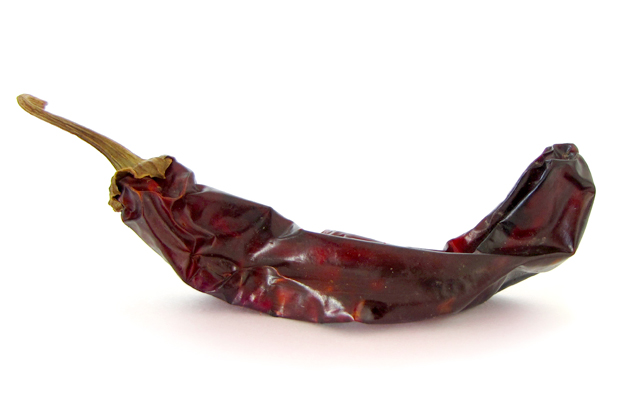

Chili heat is painful, yet enjoyable; fiery, with no rise in temperature. In 1953, T. S. Lee, a biologist at the National University of Singapore, tried to unravel the physiology behind this reaction. He asked a group of forty-six young men to eat chilies, and monitored their sweating. Perspiration is a physiological reaction to heat. Rising body temperature, whether from the surroundings or from muscles warming during exercise, triggers a reaction in the hypothalamus. Via a series of feedbacks between the brain and the body, sweat glands go to work. Sweat evaporating off the skin cools the body; when its temperature drops back to normal, it stops.
Lee had the volunteers dress in cotton trousers only, then painted their faces, ears, necks, and upper bodies with a solution of iodine and dusted them with dry cornstarch—a combination that makes sweat turn blue. Lee used peppers common in Asian cuisine, from the species Capsicum annuum. Their tapered red fruits are about ten to twenty times hotter than jalapenos. For the sake of comparison, at a different time Lee’s subjects also taste-tested solutions of cane sugar, bitter quinine, acetic acid, potassium alum (an astringent that makes the lips pucker), ground black pepper, mustard paste, and hot oatmeal. Some also gargled with hot water, chewed rubber, or swallowed feeding tubes.
In one experimental run, after eating chilies for five minutes straight, the subjects flushed red in the face, then all but one began to sweat. The areas around their noses and mouths turned blue, followed by their cheeks. Lee did another trial with seven participants, feeding them one pepper, then another: five continued to sweat, two profusely. Among the controls, only the acid and ground pepper made the volunteers sweat.
Eating chilies doesn’t raise body temperature, so there is no physical need for cooling. Yet in Lee’s experiment, the subjects sweated as if they had run a mile on a hot afternoon. To verify that the reactions to chili heat and genuine heat were equivalent, Lee had some volunteers put their legs in hot water. As their temperatures rose, the patterns of sweating on their faces were identical to those produced by eating peppers. Lee had already deduced that chili heat could not be a taste, because people felt its burn on their lips, where there are no taste receptors. His experimental results indicated another body system was at work: the one that registers discomfort from burning. The chili burn was a form of pain. But it differs in one important respect: touch boiling water, and the pain intensifies until the hand is withdrawn. Start eating a Carolina Reaper, and the heat builds for several minutes, becoming overwhelming. But continue, and the heat recedes, leaving the mouth numb to chili’s effects. Capsaicin causes pain, then blocks it.
Chili extracts have been used as painkillers for centuries or longer, stretching back into the pre-Columbian era. In 1552, a pair of Mexican natives, Martín de la Cruz, a healer, and Juan Badiano, a teacher, collaborated on a guide to Aztec herbal remedies now known as the Badiano Codex. It makes extensive use of the analgesic properties of chilies. One remedy for inflamed gums was to make a compress: boil the roots of several kinds of pepper plants along with a chili paste, wrap the resulting stew in cotton, and press it against the afflicted
area. Elsewhere, native Americans rubbed hot peppers on their genitals to dull sensation and prolong their sexual pleasure—something early Spanish settlers also tried, to the dismay of prudish priests accompanying them. In nineteenth-century China, chili extracts were used as a local anesthetic for men about to be castrated to serve the emperor’s court as eunuchs. It was capsaicin’s painkilling potential that the chemist Wilbur Scoville was trying to exploit when he developed his eponymous heat scale a century ago. He worked at the laboratory of one of the world’s leading drug manufacturers, the Parke-Davis Company, outside Detroit. Parke-Davis and other pharmaceutical makers of the era were finding new ways to use plant alkaloids, including capsaicin and cocaine. (Parke-Davis once paid Sigmund Freud twenty-four dollars to rate its cocaine products, including a powder and an elixir, against those of its more established German rival, Merck. He noted only a small difference in taste, writing: “This is a beautiful white powder (available at a low price).”
Capsaicin was the active ingredient in Heet Liniment, Parke-Davis’s topical painkiller cream. Scoville was assigned to measure the relative hotness of various pepper plants and concentrations of capsaicin, so that the correct dose could be more accurately gauged. Too much capsaicin burned unpleasantly; too little didn’t work. Capsaicin had been isolated in 1846 by John Clough Thresh, who named it, and also noted that it was chemically related to vanilla. Capsaicin and its relatives, the most pungent compounds in the world, are molecular cousins to one of the gentlest, smoothest flavors. In 1912, there was no simple chemical test to detect capsaicin—only the sense of taste. Scoville ground up dried peppers and prepared extracts of different strengths. He assembled a panel of five lab colleagues. If a sample tasted hot, he diluted it repeatedly until no heat could be detected. The more dilution required to eliminate the last trace of burn, the hotter the pepper was.
Scoville had found a way to quantify a subjective sensation, an important achievement. He called it the Scoville Organoleptic Test, with heat measured in Scoville units. A rating of one million Scoville units meant that the extract had to be diluted to a concentration of one part per million before its heat disappeared. This approach was somewhat imprecise, because people have varying sensitivities to heat just as they do to other flavors, which is why today, the absolute concentration of capsaicin in a pepper is measured with a chromatograph and then converted to Scoville units.
Parke-Davis never succeeded in making capsaicin into an effective, profitable product. Heet is still sold today and still contains capsaicin, but the primary active ingredient is now methyl salicylate, derived from wintergreen. Today, five centuries after the Badiano Codex and one century after Scoville, drug companies are still trying to exploit capsaicin’s numbing effect with dermal patches, injections, and other approaches, but success has largely eluded them. Manipulating the body’s heat-sensing system is a dangerous business; in tests of one of these pain blockers, animals developed persistent high fevers: their bodies literally overheated. Drug companies and biologists of Scoville’s era who studied capsaicin’s peculiar effects encountered the same obstacles that hampered the understanding of taste. They knew some kind of biological alchemy was occurring among capsaicin, body, and brain, but couldn’t pinpoint how it worked. Decades later, the key to this mystery was found in the milky sap of the resin spurge, a cactus-like plant that grows in the Atlas Mountains of Morocco. Moroccans slash open the plant, let the sap run out and dry, and harvest and sell the resulting resin, which contains the most powerful chemical irritant known: resiniferatoxin, or RTX for short, a form of supercapsaicin. Pure capsaicin rates at 16 million Scoville units; RTX rates at 16 billion, a thousand times hotter. Touching resin spurge sap causes severe chemical burns; swallowing more than an eyedropper full is fatal. Yet when greatly diluted, it has powerful medicinal qualities. In the first century AD, Juba, a North African king who was married to a daughter of Marc Antony and Cleopatra, had a terrible case of constipation, and his Greek physician Euphorbus prescribed some sap that had been dried, ground up, and cut with water. (The word “spurge” derives from the French word for “purge.”) This ancient laxative worked so well that Juba named the plant “Euphorbia,” after his doctor. Centuries later, Carl Linnaeus followed suit and named this genus of plants Euphorbia, and this particular one Euphorbia resinifera. Today, the resin is used to treat nasal blockages, snakebites, and poisons.
In the 1980s, RTX caught the attention of scientists studying the chili burn. Since it was so much more powerful than capsaicin, even the tiniest amounts made tissues flare in response. Research accelerated. When applied to the skin or injected, scientists found that RTX tricked the brain and body into thinking that room temperature was hotter than brimstone; then it abruptly shut down the body’s ability to sense heat, or respond to any temperature changes. Rats treated with RTX developed hypothermia. But unlike a topical anesthetic, which numbs all feeling, RTX did not impair other kinds of touch; the rats could still feel a pinch or an electric shock. Only nerves that sensed heat were affected. In one experiment, scientists irradiated a bit of RTX to make it traceable by scanner, injected it into a cell, and observed as its molecules attached themselves to a previously unknown kind of receptor: a heat receptor.
Lee’s sweat-while-you-eat experiment from forty years earlier had been vindicated. Both RTX and capsaicin molecules attached themselves to the body’s receptors for registering heat and pain. These are part of a larger family of sensors that detect grave threats: heat, cold, burns, blows, cuts, pinches, electrical shocks. Without them, humans would die rather quickly.
Capsaicin receptors are embedded in the surface of nerve cells in the mouth, skin, eyes, ears, and nose. When these cells come in contact with anything hotter than 108 degrees Fahrenheit—the signal that the line between “toasty” and “too hot” has been crossed—the receptors’ shape changes in response. This opens a pore to the cell’s interior. The water in the human body is a salty soup of positively and negatively charged particles, diffusing in and out of cells. The pore is only one or two atoms wide, and allows only positively charged calcium ions through. The electrical charge makes the neuron fire, sending a signal to the brain. This process takes only milliseconds, a much faster reaction time than that of taste receptors. Thus the hand jerks away from a hot pan before awareness catches up.
Chilies trick this system. Begin eating a hot pepper, and capsaicin molecules inundate these receptors. This lowers the mouth’s heat threshold, much as salt lowers the melting point of ice; suddenly 98.6 degrees feels like 150. This is why chili peppers taste hot. The heat alarm reaches the brain via the trigeminal nerve, one of the major neural pathways in the head, relaying signals from the face, the nose and mouth, and the eye. The chili burn is the strongest of a number of “tastes” sensed by receptors for heat or touch and carried by the trigeminal nerve that include the sharp pungency of horseradish and wasabi, the gentler tang of lemongrass, and the hot tingle produced by the Szechuan pepper (which is not related to chili or black pepper). Szechuan peppers are also used as an ingredient in lipsticks to inflame the skin and simulate the sensation of pouty lips.
So, pain is a distinct part of flavor, with its own unusual properties. Heat receptors are present all over the body, which makes superhot chilies dangerous. An unpleasant taste can only be sensed by the tongue, but capsaicin envelops you, as my son and I found while watching Ed Currie prepare hot sauce. He poured a bottle of white Bhut Jolokia pepper mash—a beige-colored, six-to-one mix of pureed pepper and vinegar—into a pan, blended in additional spice, then put the mix on the stove. Capsaicin in the steam stung our eyes, then reached our noses, and we coughed and sneezed for ten minutes. Currie appeared immune.
Pepper spray, usually made from cayenne chilies, works the same way. Police-grade pepper spray rates above 5 million Scoville units, more than enough to cause temporary blindness, constricted breathing, near-total incapacitation, and in rare cases, death. India has led the world in finding ways to exploit these properties. The Indian army has experimented with ghost-pepper grenades, and with a food supplement to help warm the bodies of soldiers in the Himalayas. Adopting a local practice of farmers, the environmental agency in Assam set up fences made with ropes dipped in ghost-pepper oil to keep roving elephants out of agricultural areas. Elephant hides are too tough for electric fences, but they yield to ghost peppers.
Capsaicin affects the inside of the body, too. Like taste and smell receptors, heat receptors have been found in nerve cells nearly everywhere, including the brain, bladder, urethra, nasal membranes, and colon. Exactly what they all do isn’t clear, but it goes beyond regulating the temperature; some help keep metabolic systems running within certain limits. But they may also be a source of serious health problems. In 2014, researchers led by Andrew Dillin of the University of California, Berkeley, ran an experiment with mice that had been genetically engineered to lack capsaicin receptors. Predictably, the mice had impaired reactions to heat. But they also lived four months, or 14 percent, longer than did normal mice, and had more youthful metabolisms. As normal mice aged, Dillin found the capsaicin receptors in their bodies started to malfunction. In some mice, they stimulated the pancreas to release a protein that made blood sugar chronically higher—a common malady of old age, and a precursor to diabetes.
Of course, people hoping to live longer can’t get rid of their capsaicin receptors. But eating chilies does the next best thing: it paralyzes them. The numbing from eating superhot peppers occurs as receptors become overwhelmed and nerve cells shut down. The neurons usually recover, but sometimes they die. Julia Child once claimed that eating too much spicy food destroyed the taste buds; this is not true, but she was onto something. Inside the body, this blocking action may shut down the malfunctioning receptors, mimicking the effects that helped those mice live so long. Many studies have shown that eating a chili-rich diet has small but measurable health benefits. Capsaicin raises metabolic rates, burning more calories. Mice without capsaicin receptors, with their active metabolisms, were also less likely to get fat. (Currie lost 180 pounds on a diet heavily spiced with superhot peppers, and says they helped him give up alcohol.)
No health benefit explains the other great mystery of chili heat: why people enjoy the pain and irritation. Like the affection for a hint of bitterness in cuisine, it’s the result of conditioning. But there are no contests to brew the world’s bitterest coffee. The chili sensation mimics that of physical heat, which has been a constant element of flavor since the invention of the cooking fire a million or more years ago; we evolved liking hot food. The chili sensation also resembles that of cold, which is also unpleasant to the skin, but pleasurable in drinks and ice cream, probably because we’ve developed an association between cooling off and the slaking of thirst. But none of these examples explains why, when nature devised capsaicin to repel, humans embraced it in spite of itself.
Paul Rozin became interested in this question in the 1970s, when his then wife Elisabeth Rozin wrote “The Flavor-Principle Cookbook.” Its theme was that ethnic cuisines had certain common flavor signatures that home chefs could appropriate to enliven meals. He began to wonder why some cultures favored highly spicy foods, and others bland. He traveled to a village in the highlands of Oaxaca, in southern Mexico, to investigate, focusing on the differences between humans and animals. The Zapotec residents there ate a diet heavy in chili-spiced food; Rozin wondered if their pigs and dogs had also picked up a taste for it. “I asked people in the village if they knew of any animals that liked hot pepper,” Rozin said. “They thought that was hilariously funny. They said: no animals like hot pepper!” He tested that observation, giving pigs and dogs there a choice between an unspicy cheese cracker and one laced with hot sauce. They’d eat both snacks, but always chose the mild cracker first. Next, Rozin tried to condition rats to like chilies. If he could get them to choose spicy snacks over bland, it would show that the presence of heat in cuisine was probably a straightforward matter of adaptation; animals—and humans—liked heat because chilies were nutritious and the imperatives of survival had overcome its bad taste. Humans might have gradually grown less sensitive to it, just as the Aymara of Bolivia became accustomed to high levels of bitterness in their potatoes.
He fed one group of rats a peppery diet from birth; another had chili gradually added to their meals. Both groups continued to prefer nonspicy food. In another attempt, he spiked pepper-free food with a compound to make the rats sick, so that they would later find it disgusting. They still chose it over the chili-laced food. He induced a vitamin B deficiency in some rats, causing various heart, lung, and muscular problems, then nursed them back to health with chili-flavored food: this reduced but didn’t eliminate their aversion to heat. In all, Rozin thinks he may have made only a single one of these rats into a chili convert. Only rats whose capsaicin-sensing ability had been destroyed truly lost their aversion to it. Rozin’s only real success training animals as chili lovers came later, when he coaxed a pair of chimpanzees to develop a taste for chili-spiced crackers.
Rozin came to believe that something unique to humanity, some hidden dynamic in culture or psychology, was responsible for our love of chili’s burn. For some reason apparently unrelated to survival, humans condition themselves to make an aversion gratifying. The Zapotec weren’t born liking chilies, but picked up a taste for them around the age of four to six years old.
Not long after, Rozin compared the tolerances of a group of people in the United States with limited heat in their diets to the Mexican villagers’ tastes. He fed each group corn snacks flavored with differing amounts of chili pepper, asking them to rank when the taste became optimal and when it became unbearable. Predictably, the Mexicans tolerated heat better than the Americans. But one thing was consistent for both groups: the difference between “just right” and “ouch” was razor-thin. “The hotness level they liked the most was just below the level of unbearable pain,” Rozin said. “So that led me to think that the pain itself was involved: they were pushing the limits, and that was part of the phenomenon.”
The chili culture is all about pushing limits. Ed Currie believed embracing it had helped him overcome his own weaknesses. He had organized his life around a single, powerful sensation, and it had worked: Guinness named Smokin’ Ed’s Carolina Reaper the world’s hottest pepper in 2013. But success depended on staying ahead of the competition; the race would eventually take chili heat higher and higher, past two million Scoville units, into realms of pungency never tasted before. How far could he go, and who would follow?
Pleasure is never very far from aversion; this is a feature of our anatomy and behavior. In the brain, the two closely overlap. They both rely on nerves in the brainstem, indicating their ancient origins as reflexes. They both tap into the brain’s system of dopamine neurons, which shapes motivation. They activate similar higher-level cortical areas that influence perceptions and consciousness. Anatomy suggests these two systems interact closely: in several brain structures, neurons responding to pain and pleasure lie close together, forming gradients from positive to negative. A lot of this cross talk takes place in the vicinity of the hedonic hotspots—areas that bridge basic reflexes and consciousness.
In behavior, pleasure and aversion also work in parallel. Each is a form of motivation forged by natural selection; each triggers actions to safeguard immediate survival and guide learning for the future. Pain alerts people to stop, to pull away, to avoid. Pleasure is a green light to continue, and to return. A little pleasure can reduce pain, and pain can temper pleasure; chronic pain can lead to depression and an inability to experience pleasure. Humans routinely endure pain to achieve a greater reward and the pleasures that accompany it; childbirth, for example. The opposite happens as well, when pleasure leads to pain, such as a hangover, or years of indulgence in drugs makes life seem meaningless and depressing. The love of heat was nothing more than these two systems working together, Rozin concluded. Superhot tasters court danger and pain without risk, then feel relief when it ends. “People also come to like the fear and arousal produced by rides on roller coasters, parachute jumping, or horror movies,” he wrote. “They enjoy crying at sad movies, and some come to enjoy the initial pain of stepping into a very hot bath or the shock of jumping into cold water. These ‘benignly masochistic’ activities, along with chili preference, seem to be uniquely human.” Eating hot peppers may literally be a form of masochism, a soliciting of dangers that civilization cocoons us against.
Rozin’s theory suggests that flavor has an unexpected emotional component: relief. A study led by Siri Leknes, at Oxford University, looked at the relationship of pleasure and relief to see if they were, in essence, the same. Leknes gave eighteen volunteers two tasks while their brains were scanned: one pleasant, one unpleasant. In the first, they were asked to imagine a series of pleasurable experiences, including consuming their favorite meal, drink, or cup of coffee or tea; the smell of a fresh sea breeze or freshly baked bread; a warm bath or smiling faces. In the other, they were given a visual signal that pain was coming, followed by a five-second burst of 120-degree heat from a device attached to their left arms: enough to be quite painful, but not enough to cause a burn.
The scans showed that relief and pleasure were intertwined, overlapping in one area of the frontal cortex where perceptions and judgments form, and in another near the hedonic hotspots. As emotions, their intensity depended on many factors, including one’s attitude toward life. Volunteers who scored higher on a pessimism scale got a stronger surge of relief than did optimists—perhaps because they weren’t expecting the pain to end. Ed Currie’s website features videos of people eating Carolina Reapers. They are studies in torture. As one man tries a bite, his eyes open with surprise, then his chair tips back and he falls on the floor. Another sweats up a storm and appears to be suffering terribly, but presses on until he has eaten the whole thing. Watching these, it suddenly seemed clear to my son and me that whatever enjoyment might be derived from savoring chili flavors, true satisfaction comes only in the aftermath: the relief at having endured, and survived.
Excerpted from “Tasty: The Art and Science of What We Eat” by John McQuaid. Published by Scribner. Copyright 2015 by John McQuaid. Reprinted with permission of the publisher. All rights reserved.
