
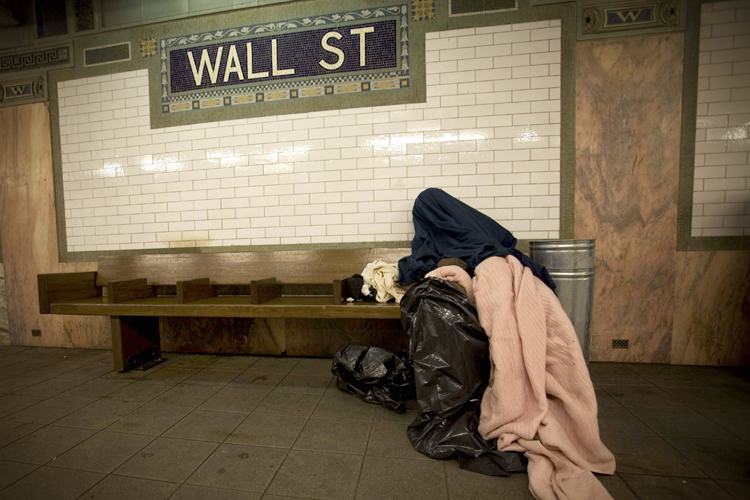

If the stories that went viral last summer about “anti-homeless” sidewalk spikes did not convince you that Western society has a serious problem when it comes to the dehumanization of homeless people, here’s a little anecdote you should keep in mind.
Earlier this month, after news about (and video of) the Los Angeles Police Department’s killing of Charly “Africa” Leundeu Keunang went viral, Salon reached out to Eric Tars, the senior attorney for the National Law Center on Homelessness and Poverty, hoping to get his take on what the high-profile incident might say about the way homeless people are treated in America today. For various reasons, we had to reschedule and push back our conversation by a few days. But during that relatively brief period of time a Republican congressman recommended solving the “homeless problem” through the tactical deployment of wild carnivores — wolves, to be precise — and an editor for Vogue kicked off a social media freakout by joking about a homeless person she saw reading the magazine during a recent trip to Paris.
As gross as this all is, though, only someone with their head in the sand could reasonably describe it as shocking. Because, as Tars eventually told Salon when we spoke recently over the phone, dehumanizing people without homes — both socially and through government policy — is all too common. And the fact that what ails homeless people in America is much like what ails the middle class on the whole (unaffordable housing, a porous safety net, and a lack of stable, decent-paying jobs, etc.) doesn’t seem to matter. Our conversation, which touches on these themes as well as how and why some local communities are changing their approach, can be found below and has been edited for clarity and length.
Now that we know more about the killing in Los Angeles, are there any broader issues afflicting the homeless — or people without homes, rather — that you saw reflected in that story?
Absolutely. I think the way you just framed that question is very telling: you started off saying “the homeless” and then you switched it to “people without homes” and the broader trend that’s the most troubling here is that we don’t see that reflected in the way communities are treating people. We don’t see them dealing with people without homes — our fellow citizens who don’t have homes — but we see them dealing with “the homeless” as some problem, a nuisance, a pest to be gotten rid of, to be managed or exterminated.
Rep. Don Young of Alaska recently recommended letting loose wolves on the streets of cities to deal with the homeless problem. That’s an extreme example, of course, but it represents the broader dehumanization of homeless people. If we thought of homeless people as people, as our fellow citizens, then we wouldn’t see the kinds of laws criminalizing their behavior that we see. That all lends itself to this environment that makes the kinds of violent interactions we saw in L.A. possible.
Homeless people come into contact with law enforcement more often than others, yes?
Because homeless people are on the streets, in public view all the time, they are more exposed to surveillance by the police, to surveillance by other community members who might call the police. Behavior that’s completely innocent, that you or I take for granted — eating, going to the bathroom, all these things that are perfectly legal when done in a private setting — become criminal acts in public. Every time that kind of act is criminalized, it invites an interaction with the police that wouldn’t otherwise happen.
When you combine that with the numbers of people who are mentally ill on the streets … and there’s new research coming out showing that of the police killings over the past few years, I think 50 percent or more have been with people who have had some sort of mental illness. Because that population is overrepresented amongst the homeless population, you see those interactions with the police that wouldn’t otherwise happen provoking a homeless person with mental illness into acts that police then find threatening, and then it turns into a violent interaction.
We see the overall trend of dehumanization, of criminalization of homeless people as being at the root of the kinds of situations that end up resulting in the death of people like Africa [in Los Angeles].
What are some other attributes about the homeless population that people either might not know or might misunderstand?
There are statistics showing that 40 percent of homeless people work in any given month. For a significant population of homeless people, they are working; it’s not that they can’t or won’t or don’t want to work, but that they are simply working but aren’t able to save up enough to make their first and last month’s rent, security deposit or those sorts of things, especially in cities where the cost of living has gone up,
When you combine that with criminalization practices … we’ve seen a number of situations where people are on the cusp of getting housing and then all of a sudden they’re arrested for no good reason, they spend a night in jail, they aren’t able to go to their job the next day, they lose their job, and then they’re back at square one. Plus, they now have a criminal record, which makes it more difficult for them to get employment and access to housing or other services, so it’s actually putting further barriers between the people who are actively trying to get out of homelessness and their ability to do so.
The idea that homeless people are working and struggling to hold down a steady source of income, that doesn’t really jibe with the stereotypical way we think of the homeless population, does it?
While the most visible homeless people are often these chronically homeless individuals who may have mental disabilities, the largest and most quickly increasing population of homeless people are homeless families with children. Even though the number of people sleeping on the streets is going down, the number of homeless children identified by the Department of Education — which uses a different definition of homelessness that includes families who are doubled up with family or friends or sleeping in low-cost motels but still very unstable — that number has gone up and up and up, almost doubling since 2007 at the beginning of the housing crisis.
There is some good news in terms of communities beginning to address chronic homelessness, but they aren’t dealing with the lack of affordable housing in their communities, and that is what continues to drive the growth of family homelessness across the country.
Over all, how do cities tend to deal with their homeless populations? Is there a most-common approach or does it vary?
We’re certainly sympathetic with many communities that are facing cutbacks in federal, state, county and local resources. All of these things have led to the growth of homelessness over the past few years and the growth of visible homelessness. When there’s homeless people visible on the streets, city councillors and mayors will get calls from their constituents, from businesses, saying, do something about this.
We would argue that the problem isn’t the existence of homeless people, it’s the fact that people have no homes, but they get that pressure, and then rather than doing just the slightest bit of research and learning about the great Housing First program and other housing programs that are succeeding in actually solving the sources of homelessness — often at a lower cost than criminalizing — they don’t do that research. So it appears that the easiest way to “do something” about homelessness is to criminalize it and try to force it out of your city and go somewhere else, wherever that elsewhere might be.
Are there more of these types of laws than there used to be?
Over the past few years, we’ve documented the increase in all sorts of ordinances banning sleeping, sitting, lying on the sidewalk, panhandling, sharing food in public places, which is punishing not just people who are homeless but the good samaritans who are trying to actually help them. That’s particularly ironic in many communities, where you hear more conservative members of the political establishment saying that providing these kinds of services isn’t something that government should do but something charity should do, but then you criminalize the charities, so it’s a Catch-22.
We’ve seen incredible growth in all of these kinds of ordinances; 119 percent growth in the number of communities banning sleeping in cars, when often that’s the last resort before somebody becomes street homeless. Of course, if somebody is arrested under one of those kinds of ordinances their car gets impounded and they have no way of getting to work. That’s their last resource; they have no resources to get it out of the impound so they have most likely lost it as well as their source of income and their place to stay. These are completely backwards, counterproductive policies.
What about the communities who have tried a different approach?
There’s been a lot of attention given to Utah’s success in reducing the number of chronically homeless people there by three quarters over the past few years, simply by providing housing. That actually cost the state $8,000 less a year per person than either criminalizing homelessness or just letting people stay on the streets.
The problem is that it’s easy for a community to pass a criminalization ordinance and pretend it doesn’t cost anything versus affirmatively allocating resources to providing houses. If they actually looked at the cost of imposing a new criminal ordinance, they would realize that when you add up the police time in enforcing the law, the cost of housing people in jail or in prison, the court costs for processing them, the emergency room costs for people who don’t have housing who have to seek out emergency care or shelter from the elements … study after study shows that all those costs, when added up, are two to three times more expensive than simply providing housing.
Why is housing so important?
Once a person does have housing, that allows them stability. If it’s a person with disabilities, maybe that’s stability that keeps them from costing the rest of the system more down the road, but if it’s a person who has just had a series of misfortunes and is able to get active employment again, providing them with a stable place to be is a very necessary first step for them to being able to do those things. Again, study after study has shown that once people are in those stably housed situations, they are able to move permanently out of homelessness.
When you engage with the political establishment, do you find a lot of allies who are sympathetic to your message? Or do you find that you have to move outside of traditional channels, where the interests of homeless people aren’t as easily or frequently taken into consideration?
It’s a little bit of both. There is a lot of organizing in the streets of homeless people by homeless people for homeless people that’s going on, trying to get attention to the needs of the communities. There are many religious groups who are engaged in providing services; veterans’ organizations that recognize the disparate impact of homelessness among veterans; advocates for disabled people. There are a lot of allies out there, and in cities where they have taken the time to actually look at the problem and the cost-effectiveness and the morality of different solutions, we do find even business improvement districts and chambers of commerce coming on in support of these kinds of programs.
Utah is obviously a relatively conservative state, but the combination of the religious community there, the strong Mormon influence, and the cost-benefit analysis has brought on non-traditional allies of even more conservative politicians who are saying that this is actually a way of solving the problem of homelessness rather than simply trying to push it out of public view. Police and law enforcement in many communities are actually supportive of these kinds of efforts; they would rather be out fighting real crime than arresting somebody for sleeping on the sidewalk.
So sometimes it takes a little time to find those allies, but they are definitely out there. They may need some more information, some more education in order to be brought on fully, but frequently they do become our strongest allies.
What are some concrete goals or issues that people who might not know that much about homelessness should get behind or get educated about?
I think the key things are learning about the impact of these criminalization policies in communities — the costs to the individuals who are subjected to them, but also the costs to the greater community — so that people understand that it really is so much better in so many ways to simply be able to provide housing to homeless people than it is to try to criminalize them.
Beyond that, it’s the need for real solutions to problems of housing affordability in this country. That’s what’s driving the growth of homelessness, the fact that only one in four people who are eligible for federally subsidized housing is
able to receive it because there isn’t enough funding. That means also that one in four renters right now is paying more than 50 percent of their income on rent, which means that any loss of employment, health incidents, or one missed paycheck can tip that person from being regularly housed into homelessness. There are just so many people who are in very precarious situations, and that is caused, in part, by a lack of attention to the development of affordable housing.
I saw a statistic that in Los Angeles in 2011, 90 percent of the housing that was built was affordable to only 10 percent of the population, meaning that the other 90 percent had to compete for only 10 percent of the housing. Again, that puts so many people on the brink of homelessness. Maybe they’re not homeless today, but they’re right there on the edge. Until we solve those greater housing affordability problems, until we ensure that everybody has access to adequate, affordable housing, we’re going to continue to see homeless people on the streets.
Why do you think so many communities are getting it wrong, so to speak?
The crisis of homelessness provokes crisis responses, responses where people aren’t thinking things thoroughly through, and that ends up in the poor policy decisions that many communities are coming up with.
It really is about who we are as Americans. On the Statue of Liberty, the plaque reads, give me your tired, your poor, your huddled masses. Send the homeless to me, I lift my lamp beside the golden door, but now we’re saying don’t send me your homeless. Even the homeless that are already here, we’re not lifting our lamp beside the golden door, we’re lifting our police baton beside the gilded gates of a gated community. It’s a different concept of who we should be, as Americans. I think we need to return to our best ideals, rather than the worst nightmares that we are becoming.
