
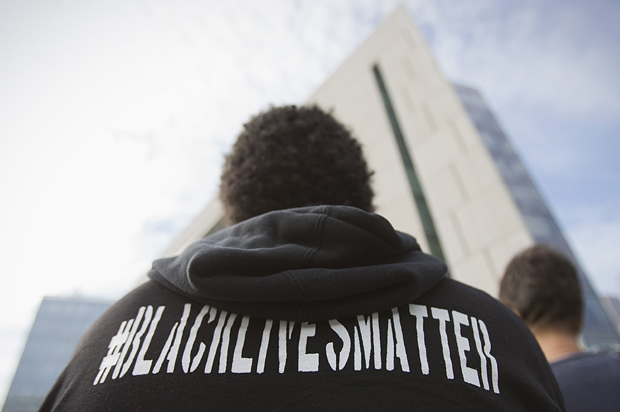

There’s this man in the Book of John who storms into a church, and flies into a rage when he sees the salesmen and moneychangers in this house of worship. He begins violently breaking down the tables where these people are seated. In the book, he is so angry he literally takes the time to make a whip out of cords, so that he can chase these people out with it. This man lashes out because he sees hypocrisy being done in a place he thought was safe and sacred—he sees people who claim to be good doing bad things, in public for everyone to see. It infuriates him. And so he loses all sense of respectability and lets that rage out.
This same guy, at another really difficult moment in his life, has the audacity to shout out at God himself, “Father, father, why have you forsaken me?” He had been beaten, spat upon and tortured. He was being treated like a criminal, though his crime was unclear. It was clear, however, that to the people in control of his earthly fate, his life didn’t matter. So you can imagine at that particular moment, he was a little bit upset with the God he thought was supposed to protect him.
One moral of these New Testament retellings is that everyone has a breaking point. And there’s something incredibly judgmental and inhumane about looking at a person—or a group of people—at his or her breaking point, and chastising him for not pulling up his pants and behaving nicely.
There are times when turning the other cheek or praying or dressing up in a suit and tie for a sit-in just isn’t enough. If it were, all problems and all progress in the world would have been achieved in such a manner. This doesn’t seem like a difficult concept to grasp, but in 2015 people—black, white and otherwise—are still telling black Americans to behave better and dress in a particular manner so that we might earn the respect and empathy of white Americans (because our lives, apparently, depend on it). Yesterday, the Washington Post published a devastating essay by veteran civil rights activist Barbara Reynolds — the very piece of literature many whites and blacks who lean on deadly respectability politics were hoping for:
“The baby boomers who drove the success of the civil rights movement want to get behind Black Lives Matter, but the group’s confrontational and divisive tactics make it difficult. In the 1960s, activists confronted white mobs and police with dignity and decorum, sometimes dressing in church clothes and kneeling in prayer during protests to make a clear distinction between who was evil and who was good.
But at protests today, it is difficult to distinguish legitimate activists from the mob actors who burn and loot. The demonstrations are peppered with hate speech, profanity, and guys with sagging pants that show their underwear. Even if the BLM activists aren’t the ones participating in the boorish language and dress, neither are they condemning it.
The 1960s movement also had an innate respectability because our leaders often were heads of the black church, as well. Unfortunately, church and spirituality are not high priorities for Black Lives Matter, and the ethics of love, forgiveness and reconciliation that empowered black leaders such as King and Nelson Mandela in their successful quests to win over their oppressors are missing from this movement.”
With all due respect to an activist who has surely seen more and done more in her life than I have in my time, I disagree, Barbara Reynolds. And I believe you have done great harm to a worthy cause.
Allow this to be one more voice crying out into the wilderness: Respectability will not save us. And even if it could—even if we had proof that dressing up in our Sunday best and never using profanity and always wearing belts to keep our pants up and never throwing a rock at a police officer guaranteed us safety or equality—it would not be intelligent for us to accept or embrace the notion of respectability. Although Evelyn Brooks Higginbotham coined the term in her seminal text “Righteous Discontent: The Women’s Movement in the Black Baptist Church,” the concept of respectability is rooted in a binary set up not by our ancestors, not by those Church women of the late 1800s, but by the very people who enslaved blacks.
Those enslaved were told an encouraging, deadly lie that there were ways to evade the hatred and the violence of whites. One of the ways to do so was to become a house slave. One of the paths to becoming a house slave was to be of mixed race and therefore the likely product of rape. This was the true beginning of respectability politics, when blacks were shown that a certain type of black person can receive better treatment by whites than another. House slaves were considered by whites to be less dangerous and less animalistic than field slaves. They were clothed better, fed better and sometimes even educated. They had better lives than the average field slave. But they were all, always and still, enslaved.
Perhaps the most lasting effect of this binary created by white supremacy is the idea that there is such a thing as a type of black person who can appeal to the humanity within every white person, and that above all, we must use that appeal to try to appease those suffering from the so-called “affliction” of white supremacy. Reynolds quotes the respectable Rev. Andrew Young, a former aide to Martin Luther King, Jr.: “White supremacy is a sickness … You don’t get angry with sick people; you work to heal the system.”
Reynolds suggests that one way we might heal them—because, again, the burden is on the black community to heal others of the “sickness” that oppresses us—is to practice kindness and pacifism in the face of hatred and violence. She states this as a truth, as though such practices have always been proven to exact complete change, as though once white Americans saw all of those well-dressed, non-violent blacks on television getting murdered in the streets in the 1960s, empathy flooded into all of their hearts and racism finally subsided. She says this as though Dr. Martin Luther King Jr., the number one proponent of non-violence Civil Rights activism himself, made this appeal to white supremacy work through his profound respectability, when the truth is he was shot down just like so many others, for many reasons — because respectability is not enough, and, to quote Hari Ziyad in a profound analysis of this movement, because “empathy won’t save us.”
Reynolds goes on to cite as examples of the respectability and Christ-like behavior to which we young proponents of Black Lives Matter should aspire the families of the Charleston nine, who told the world they’d forgiven Dylann Roof before the bodies of their beloved were even in the ground. But Reynolds neglects to consider the fact that those dead victims were living, breathing images of respectability—praying in a Church and welcoming in a strange white man—when they were slaughtered. Their respectability did not save them. The most offensive remark of Reynolds’ Charleston nine invocation is this blatant lie: “As a result [of their pronouncement of forgiveness], in the wake of that horrific tragedy, not a single building was burned down. There was no riot or looting.” In the Post itself alone were published reports of five black churches burned within a week of the attack. Not a single building was burned down, indeed — five were. It’s clear that Reynolds meant no buildings were burned by black protestors, which might suggest that the families were able to speak to those rightfully angry blacks, but not those responsible for the churches that went down in flames.
Those churches were burned for many reasons. One reason is that respectability politics cannot save us.
There is one part of the op-ed where Reynolds admits that BLM has many positive attributes that the Civil Right Movement did not have. She’s willing to admit that “BLM has improved on the previous generation” by rejecting the traditional straight male hierarchical leadership, by demanding that women be seen and heard as integral to the movement and that LBTQ rights be a part of the intersectional narrative. She has no problem admitting that King’s movement was “sexist to the core, imitating the tone of the country at that time,” as if that didn’t signify a greater problem. It’s true that respectability politics is not entirely about the imitation of white, hetero-normative, Christian behavior—what the Church women activists were doing in the 1800s was more complex than that. But the fact that a black movement adopted misogynistic approaches (just as enslaved blacks did the same, in imitating the white nuclear families that owned them) is not a mere aside—it’s one of the very reasons BLM must be so, very different from the generations of activism that came before.
So yes, respectability is rejected. Yes, the vow of non-violence and non-retaliation is often rejected, though mostly on principle—all of the more public BLM activists have yet to exact violence during any protest, though, like Malcolm X, many don’t appreciate being told that they do not have the right to do so in their own defense. And yes, the hetero-normative, male-dominated movement with one central, deified figurehead is rejected as well. Such rejection does not signify disorganization, as Reynolds and so many believe. Such rejection does not signify a disdain for all who gave their lives, time, and literal blood, sweat and tears—quite the contrary.
This rejection suggests that we are not living in 1965. It suggests that, like most generations, we want to do things our way—to embrace the past where it seems right and to construct a new path that is specific to our time. I wasn’t there, but from what I understand the young people of the Civil Rights Movement were often chastised and criticized by their own parents and by those of the generations before them for going about things in a new way—for pushing too hard up against injustice. Like so many other movements, it was the young people who fought, and they did not always have the support of those who came before them.
Black Lives Matter, like the Civil Rights Movement, does not need the support of every black person in America. It does not need their approval or their permission to operate, or be successful, productive and organized. But even as I write this piece against the words of a person who I believe is ultimately on the same side as me, I can’t help but wish for the putting aside of these differences that were not created by those of us in the fight. It’s like debating the difference between a so-called thug like Michael Brown and a so-called respectable intellectual like, say, Henry Louis Gates Jr. These distinctions are very much a fabrication—both men were victims of racial profiling in their own neighborhoods, though one with obviously more tragic results. It’s the perceived difference between an educated Sandra Bland and, say, the model Sumaya Ysl—both were victims of a very similar system where black women’s lives do not matter. As much as I’ve argued that BLM rightfully and intelligently rejects certain tenants of the Civil Rights Movement, I’d also argue that the differences between the two are more unnecessary constructions meant to divide a group of people that, like any group, is better off as a single unit—a mighty fist that (forgive the “Soul Food” reference) can strike a mighty blow.
Years ago, I left the Church. I was raised Baptist, by a woman whose parents were both missionaries. My mother was one of those kids who went to church five to seven days a week. I no longer consider myself a Christian, but I am a product of that upbringing and of my mother’s upbringing. Even as I have chosen to go in a different direction, I benefit from that upbringing, and the remnants of vacation Bible school and choir practice and springtime revivals show up in almost everything I write. You can appreciate a legacy, and you can respect a legacy. And you can still decide for yourself that you will pass on a new legacy to your children, inspired by your childhood and your parents, but uniquely reflecting your education, your peers and your experiences. No, this ain’t our grandparents civil rights movement — and as Ta-Nehisi Coates put it, neither was our grandparents’. It’s our movement, inspired by their legacies and still determined to be what it must be on its own.
