

 HUDEIDAH, Yemen — The second floor of the dialysis clinic here looks more like a refugee camp than a kidney treatment center.
A few dozen patients have been living here for days, sleeping on either plastic chairs or the grime-covered floor. They are waiting for treatment but the clinic’s machines are not working. With each passing day the toxins in their blood increase. They get sicker. They can do nothing but wait.
Like all of Yemen, they are slowly dying.
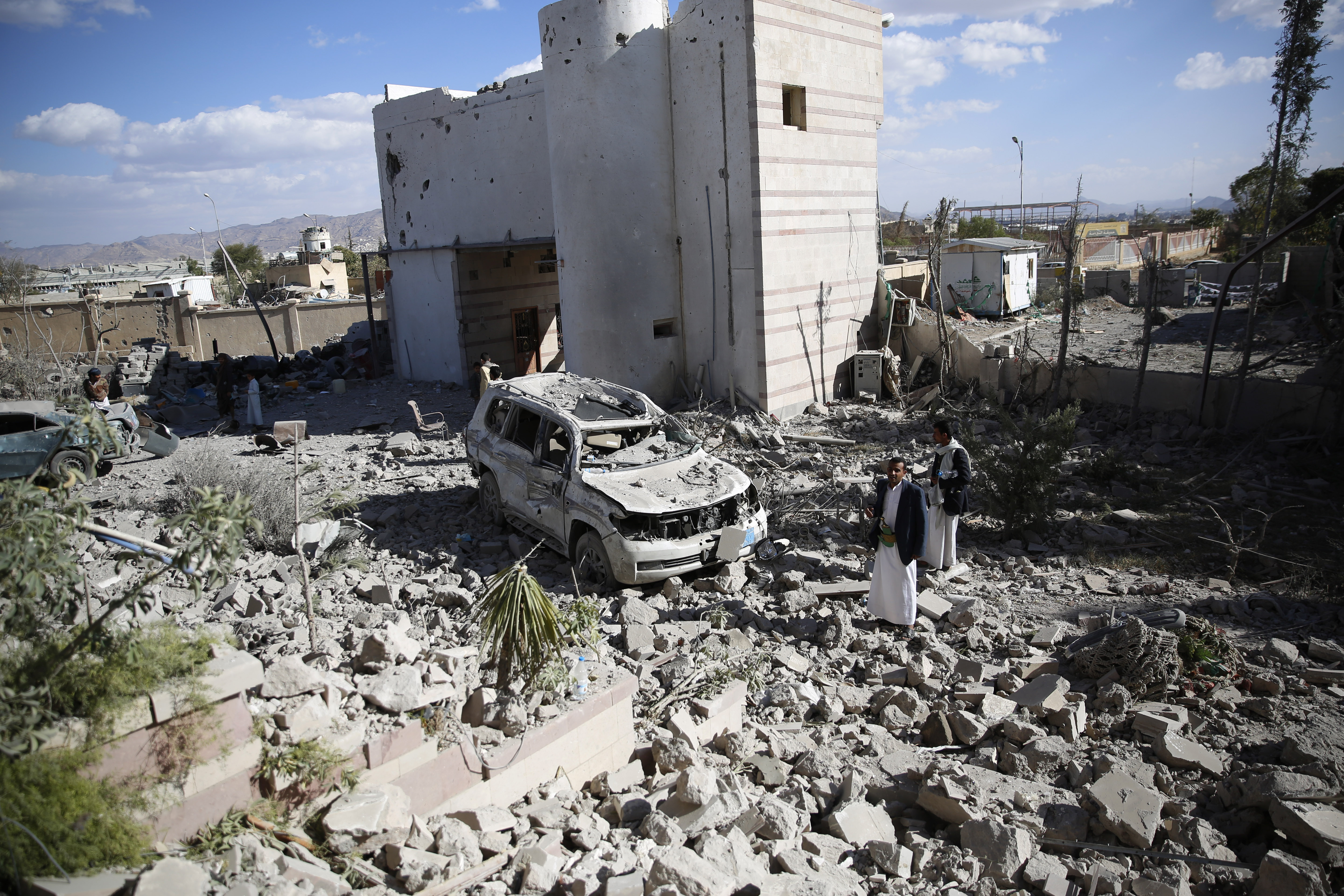
The dialysis center represents all that is wrong with the country right now. Yemen is the site of a civil war, with one side backed by a Saudi-led coalition, the other led by the Houthi rebel movement. For nine months Saudi Arabia has been both bombing the country, at times indiscriminately. It has also imposed a crippling blockade.
The results have been dire for what was already the poorest country in the region. Food is scarce and Yemenis everywhere are going hungry. Officials say the country is on the brink of famine. The blockade has also prevented deliveries of fuel, which inhibits the ability of Yemenis to travel — for treatment at a dialysis center, for example. It has also led to an energy crisis. Electricity is intermittent at best. Meanwhile, violence has displaced millions. For all these reasons, the economy has essentially collapsed.
Saudi Arabia put together a coalition of Arab countries that is directly supported by the United States. The stated goal is to drive back the Houthi rebels and reinstall the country’s ousted president, Abdu Rabbu Mansour. Mansour is friendly to Saudi Arabia and the United States, allowing the latter to conduct its counterterrorism campaigns inside the country. For Saudi Arabia, the war is about countering perceived Iranian influence on a neighboring country.
The airstrikes alone have devastated Yemen, hitting civilian targets like weddings and hospitalswith disturbing regularity. The blockade, meanwhile, is having a quieter, slower, but ultimately more deadly impact.
Saudi Arabia says the blockade is preventing weapons from reaching the Houthis. But it is also preventing humanitarian aid from reaching Yemenis. The Houthis and their allies have set up their own blockades in areas they control, making the problem even worse.
Effectively, Yemenis are being strangled to death. Every day that passes they lose more and more of the essentials: food, water, shelter, fuel and health care.
All of these shortages meet at Hudeidah’s sole dialysis center.
Darweesh Abdullah, an elderly woman who lives more than 40 miles away from the center, has waited for a week, sleeping on the floor. She typically needs dialysis every four days. Now her chest has tightened, making it difficult to breathe. Her legs and feet have swollen. She can no longer walk. “After the war it got a lot harder to get help,” she said.
In a room down the hall, 29 dialysis machines sit eerily idle. Mohamed Abdo, a young hospital supervisor, tries to explain the situation to a knot of forlorn patients gathered around him. There is a problem with the facility that treats the water used in the machines, he tells them, and the hospital must wait for engineers from the distant capital to fix it.
“This has happened a lot and it will happen again,” Abdo said. It is stiflingly hot and humid and there is sweat dripping from his forehead. “We have a very, very big problem.”
Because of a lack of fuel for generators, extended power cuts in the clinic are frequent. If they occur during dialysis, the machines stop and the blood inside can clot. “Many patients have died because of a lack of treatment,” said Hanan Ahmed, a specialist at the center. Some patients can’t reach the center for treatment at all. With high fuel prices, transport costs have skyrocketed, making long journeys an arduous and expensive ordeal.
Aisha Abdo and her husband, Yahiya Hussein, have been living in the clinic for a month and a half because they cannot afford to make the trip from Haradh twice a week for Aisha’s dialysis. “We don’t have money to go home,” Yahiya said. “We are living here for now. We don’t know what the future holds.”
Mohamed Taher, a father of five, was unable to raise the 2,000 riyals (about $9) to make the trip from his village about 40 miles away. His nephew, Saeed Ibrahim, watched helplessly as his uncle grew frail. On Oct. 22, Saeed came to see Mohamed and found him dead. “There’s no hospital in our area and we just couldn’t afford it,” Saeed said, softly.
THE BLOCKADE
The deadly coalition airstrikes receive most of the international press coverage on Yemen, which is already limited. The United Nations says the conflict has so far killed nearly 6,000 people, including more than 2,500 civilians. More than 630 of them have been children. Airstrikes have killed the majority of Yemenis.
But it is the Saudi blockade that might have the most lasting and devastating effects. And that blockade was brought to Yemen by the UN Security Council.
The five permanent members of the Security Council are the United States, Russia, the UK, China and France. In mid-April, less than three weeks after the Saudi-led coalition launched its military campaign, the council passed a resolution drafted largely by the Persian Gulf countries taking part in the war. The resolution imposed a strict arms embargo on the Houthi leadership and their allies. The council approved the resolution, with everyone voting in favor except Russia, which abstained.
The move came after weeks of closed-door negotiations between diplomats from Gulf states and Russia. Russia had lobbied for the language to include text mandating “humanitarian pauses” in the coalition airstrikes. But Gulf countries vigorously opposed that, saying it would allow the Houthis to regroup, according to The New York Times. The final text leaves it to UN Secretary General Ban Ki-moon “to facilitate the delivery of humanitarian assistance and evacuation, including the establishment of humanitarian pauses, as appropriate, in coordination with the Government of Yemen.”
The United States strongly supported the resolution.
Critics say the measure amounts to an endorsement of the siege that is choking supply lines and killing Yemenis who have little or nothing to do with the war.
“The UN resolution certainly allowed for an extremely strict embargo on Yemen that — regardless of intentions — has created blockages that made it very difficult to get basic goods in and out of Yemen,” says Adam Baron, a visiting fellow at the European Council on Foreign Relations and a founding member of the Sanaa Center for Strategic Studies.
Yemen relied heavily on imports for basic goods before the crisis, including more than 90 percent of its staple foods. The impoverished country also imported other essential commodities, like fuel and medicine.
In September, the UN Office for Coordination of Humanitarian Affairs (OCHA) estimated that commercial fuel imports fell to just 1 percent of monthly requirements. Food imports hit their second-lowest level since the war began. Over 21 million people — or more than 80 percent of the population — now require some kind of humanitarian assistance to meet their basic needs.
“People’s lives are at risk and we are seeing an enormous impact on civilian populations,” said Trond Jensen, the head of OCHA in Yemen, which oversees all humanitarian planning in the country. “Part of it is generated by the conflict and part of it is generated by what we see as the de facto blockade — the implementation of the Security Council mandated arms embargo — which has effectively blocked many critical inputs from coming into the country.”
Back in Hudeidah, which is a port city on the Red Sea, the siege is on display. While the southern port of Aden is larger, it is mostly a transit stop for ships. Hudeidah is Yemen’s main conduit for goods. About 80 percent of the country’s imports should move through here.
All the typical elements of a port city are evident: lines of heavy trucks, loading docks, silos and cranes. But absent are the energy and the noise. There is little movement. These days there is almost no industrial activity at all. No boats are allowed into the port without the approval of the Saudi coalition, a process that can take weeks. As deliveries wait, desperately needed cargoes of food begin to spoil.
The deputy chief of Yemen’s Red Sea Port, Yahiya Abbas Sharaf, said the blockade tightened in July, severely restricting access to the port. Since then, he said, not a single large container ship has been allowed into Hudeidah. Before the war, the port would receive a container ship every two to three days.
As if the blockade weren’t enough, late at night on Aug. 17 nine airstrikes hit the port within a span of 15 minutes. All five loading cranes were damaged. A hangar with loading and transport vehicles was destroyed. Sharaf said on the same day they bombed the port in Hudeidah, the coalition announced the port in Aden, now under Saudi control, was operational.
“The coalition has no red lines,” Sharaf said.
The spokesman for the coalition, Saudi Brig. Gen. Ahmed al-Asiri, flatly denies that humanitarian aid is being prevented from entering. “Hudeidah is controlled by the Houthis and we allow ships to go to the port to give them food, medicine and fuel,” al-Asiri told GlobalPost. “Since the start of the military operation more than 800 ships have arrived in different ports.”
The UN High Commissioner for Human Rights sees it differently. “Severe import restrictions, caused mainly by the naval blockade imposed by the coalition forces during the conflict, have also aggravated the humanitarian situation,” the commissioner wrote in a statement released in September.
The blockade has turned average Yemenis into experts in wattage. They know details about battery capacity and the power requirements of anything imaginable. At night, the headlights of passing cars and motorbikes slice through the dark. Some shops on the main thoroughfares light up the sidewalks but, for the most part, to walk the streets of Yemen after sunset is to wade through blackness.
The fuel required to create electricity is now mostly sold on the black market. The prices are exceedingly high. Across Yemen, young men and boys line city streets selling jerrycans and plastic water bottles filled with fuel, colored bright red or deep yellow. According to the United Nations, average fuel prices are 273 percent higher than normal. In some places, the cost of fuel is 400 percent higher.
As a result, electricity is now a precious resource. It must be rationed. In Sanaa, the capital, the electric grid has been dead since September. After sunset, people use candles indoors and light small fires outside. They walk with small headlamps and flashlights. The hum of generators is everywhere. For those who can afford the heavy expense, solar panels are a popular solution. It’s enough for some lights, but not enough for a fridge.
THE HUNGRY
Nothing in Yemen is as bad as the hunger.
Ten of Yemen’s 22 provinces are now classified as facing an emergency food situation, according to the World Food Program. “Half of the country is now just one step away from famine,” the aid agency’s Deputy Regional Director Matthew Hollingworth said during a news conference in Sanaa in December.
Yemenis, especially those uprooted from their homes, are engaged in a daily struggle to find something to eat.
The Dahadh camp sits on the sunwashed rocky hills of Khamer, a town in Amran governorate just north of the capital. Some 3,000 displaced Yemenis, most of them from war-torn Saada, have been living here for months — many of them since the beginning of the conflict nine months ago. They have no comforts. Inside dust-covered tents emblazoned with large UN logos, a single sheet provides little respite from the hard ground. Some families have blankets. Many don’t. They bathe standing in small plastic tubs. To relieve themselves, they walk over the hill, out of sight, and defecate on the ground.
But compared to the lack of food, none of that matters. “My life is all hunger and fatigue,” says Mariam Ahmed, a gnarled and frail grandmother who says she hasn’t eaten for two days. She speaks haltingly, wheezing out short sentences. “There is nothing here. I’ve cried until I couldn’t cry anymore.”
Gnawing pangs of hunger are a daily reality for people like Mariam. Her appetite is never sated. She is weak from the lack of food and there is an almost constant ache in her empty stomach. More than 3 million people in Yemen were added to the ranks of the severely hungry in less than a year. According to recent estimates, 7.6 million people are severely food insecure, a level of need requiring urgent external assistance, the United Nations says.
Camp residents say they have only received two deliveries of food since they arrived, the last one in July. They survive mostly on bread, tea and sometimes rice. When they do receive donations of blankets or mattresses they sell them in order to buy flour.
The bread is baked in metal barrels. With no cooking oil or even wood to make fire, they have taken to burning plastic bottles that children scavenge from the town streets. They pile the bottles in the middle of the camp and light them on fire. The poisonous fumes seep into the dough and a toxic sludge oozes from the bottom of the barrel.
“We know this is not good for us, but what can we do,” said Abdo al-Obadi, a local leader in the camp. “It’s either this or we die of hunger.”
Al-Obadi arrived here in March in the first days of the war when his neighborhood in Saada came under heavy bombardment. He piled 16 families into his truck and drove south. He has been living in the camp ever since. “It’s very bad here,” he said. “There is no work, we have nothing to do.”
Now winter is approaching, and there’s no protection from the cold. “I’m not sure what we’re going to do,” Al-Obadi said. “I think I will be here for four to five years,” he added matter-of-factly. “When the war ends and they rebuild our houses and Yemen is stable.”
THE DISPLACED
That stability seems a long way off.
This month, members of Yemen’s warring sides met in Switzerland for UN-sponsored peace talks in the hope of negotiating an end to the conflict. A seven-day truce was declared to help the chances of success. However, each side has accused the other of repeated ceasefire violations, which threatened to derail an already fragile process.
Yemeni troops loyal to the ousted president captured two towns in northern Yemen from the Houthis as the talks were underway. Meanwhile, Saudi Arabia said two ballistic missiles were fired at the kingdom from Yemen. Areas in the north have seen some of the heaviest aerial bombardment and fiercest ground fighting, causing hundreds of thousands of Yemenis to flee their homes.
The displaced are everywhere in Yemen. More than 2.5 million people, or almost one-tenth of the population, have been forced from their homes since the conflict began, according to the United Nations. The majority of the displaced are women and children. Most have fled the relentless coalition bombardment as well as indiscriminate shelling by rebel groups.
Thousands of Yemenis are sheltering in 260 schools across the country, preventing access to education for some 13,000 children. In a government-run school in Sanaa, more than 280 people are living in cramped conditions. Families live 10 to a classroom but there is still not enough space, forcing others to live under tarpaulin draped over the school’s stairways.
Zubeida Nasser Ahmed has been living here for seven months. Her house was on Jabal Nuqum, a mountain overlooking the capital that is thought to have a munitions depot buried within it. That prompted the Saudi-led coalition to bomb it repeatedly. She was forced to flee with six of her relatives, including her son, daughter-in-law and granddaughter. She has aged far beyond her 43 years. She has no teeth and her face is wizened by hardship. When she reveals her relatively young age she does so apologetically, aware of the disbelief it arouses.
She says the families living in the school receive little food and there is practically no support from local NGOs, which are overwhelmed by the crisis.
“It is wearying to live here. But I don’t know where else to go,” she said. There are no medical services. She takes turns with other residents of the school to go outside and beg for food. Winter is arriving and she has no warm clothes. “No one brings us anything.”
She is suffering from chest aches and indigestion. “All I ask for is peace. How can someone be outside of their house for this long?” She points to Jabal Nuqum in the distance, her former home. “We are going to die here from the cold and the hunger.” One child living in the school passed away from malnutrition several weeks earlier.
Those living in the school, however, are the lucky ones. Some displaced Yemenis are living in conditions so squalid they make the schools an appealing refuge by comparison.
The drive east from Yemen’s highlands to the coastal plain is a journey through steadily increasing temperature and humidity. By the time you get to Beni Hassan, a northern area in Hajjah governorate, some 40 miles from the Saudi border, the heat is all-enveloping. Stepping outside is like walking through warm wet cotton.
On the side of the road, by a small cornfield, is a camp of about 150 displaced families. Though, calling it a camp is indulgent. Residents have built makeshift tents using scavenged pieces of wood that are loosely draped with sheets and torn pieces of tarp. They provide only shade, not shelter.
Nearly all of the people in the camp have been displaced from Haradh, a town near the Saudi border that came under some of the heaviest bombardment of the war. They fled in the first few days of the conflict, not from their homes, but from another refugee camp called al-Mazraq. They had arrived there in 2009, during the last of former president Ali Abdullah Saleh’s six wars with the Houthis. Saleh, the always-politically-flexible former autocrat, is now aligned with the Houthis in the hopes of returning to power.
The al-Mazraq camp was hit by an airstrike four days after the Saudi-led military campaign began. At least 45 people were killed and dozens more wounded. So the survivors fled, displaced twice over. This time they arrived to far worse conditions.
Like many of the camp’s residents, Saeeda Abu Kheir walked from al-Mazraq to Beni Hassan carrying what few belongings he could. She came with her husband and 10 children — one of whom is mentally disabled — and has been living here in squalid conditions for the past eight months. They are surviving, not living. They sleep on the dirt floor. Their only blankets are used for the roof of their tent. Whenever it rains, the camp floods and the ground turns to mud.
Every day the family scrounges for leftovers in local restaurants or begs for flour and sugar from local residents to make bread and tea. Saeda’s husband tries to find work hauling produce in the local market. She says she has only received food from the United Nations or an NGO once in eight months.
“It’s so, so tough here,” she said, holding a baby in her arms in the sweltering heat. Winter is approaching and she says she will have to remove the blankets off her tent to use them to stay warm. “We need blankets and food. That’s all we ask for.”
They have not fully escaped the bombs, either. Airstrikes hit the area of Beni Hassan frequently. Several days before GlobalPost’s visit in November a power plant nearby was struck, sending everyone running into the corn fields.
Several miles north is a larger makeshift camp that hosts some 4,000 families. Most of them also fled the heavy coalition airstrikes in Haradh. Ali Abdullah, a 60-year-old grandfather, has been living here with his family for the past eight months. He is silver-haired and gaunt, and his story is one of continuous suffering.
He too fled the al-Mazraq refugee camp with his family after the coalition bombing in March. One of his sons returned to their home village only to be killed by artillery fire a few days later. Abdullah sought refuge in a nearby village. He says they were forced to flee again when the area was hit by cluster bombs — which are banned by most countries, though not Saudi Arabia or the United States. Dropped by the coalition, the explosives wounded his nephew. The family eventually arrived at Beni Hassan where they built makeshift tents. “This is the worst place we have lived,” he said. “There is nothing here. But where can we go?”
Abdullah says he almost died when he contracted malaria two weeks earlier. Before that he had a severe case of diarrhea that left him dangerously dehydrated. “I just sat and prayed,” he said. “There is no medical care. Anyone who gets sick just waits to see if he will recover. More people are dying from disease and illness in this place than from airstrikes.”
THE HOSPITALS
Like the dialysis center, hospitals in Yemen are ground zero for the humanitarian crisis.
The health system is in “a state of collapse,” according to the World Health Organization. More than 600 health facilities have stopped functioning due to a lack of fuel, supplies and personnel. More than 15 million Yemenis — well over half of Yemen’s population — now lack access to health care.
Visit any medical center — from Sanaa to Saada, Hajjah to Hudeidah — and the hardships are similar: medical shortages, frequent power outages, not enough staff and a ballooning number of patients.
Al-Thawra hospital is the largest medical facility in Yemen. The massive complex sits in the heart of the capital. Despite its stature, al-Thawra is also suffering from an acute shortage of medical supplies. Even basic items like rubbing alcohol are scant. The hospital has not been able to perform heart surgery for two months due to the dearth of proper anesthetics and medicine. The dialysis center has been closed for two months without the replacement tubes and dialysis solution necessary to run the machines. Even the plastic booties for visitors to cover their shoes have run out; the cardboard boxes at the ICU entrances hang empty.
Near the end of October the hospital began to run out of sutures, forcing them to use makeshift stitches that threaten to tear open.
“We are calling for help as soon as possible. From everywhere, from everyone to be able to run facilities or patients, otherwise we will simply have to stop,” said Dr. Abdul Latif Abotaleb, a surgeon at the hospital for 20 years and its deputy director for the past three months. He adds that many people have died because of a lack of available medicine, mainly kidney and heart patients.
As supplies and staff run short, hospitals in Yemen are overwhelmed. Nearly 27,000 people were reported wounded in the conflict as of mid-October, according to the United Nations. Disease outbreaks, including malaria and dengue fever, have made matters worse. Meanwhile, with the limited care available, people are dying from chronic ailments that are easily treatable. Cancer, diabetes and high blood pressure account for 39 percent of all deaths right now in Yemen.
Like health facilities across the country, one of al-Thawra’s main problems is limited fuel. The hospital has barely had any for the last month and a half. They use the minimum amount possible to power the generators. Electricity is rationed for the ICU and surgery, while other sections of the hospital get power for two hours at a time.
“If the situation continues like this we will all die. The sick and the healthy,” Abotaleb said, adding that he has pled his case with the United Nations and international NGOs. But all he can do is wait. “We don’t know what else to do.”
Farther north, in Saada City, the Gomhouri hospital is one of the only ones left in the entire province. Doctors are forced to ration treatment. Patients who are no longer in critical condition are sent home to make room for others. Rooms that were once clinics have been filled with cots and converted into recovery wards.
The pediatrics ward is filled with malnourished children. Some are crying; most are too weak even for that.
Radwan Saleh is just 16 months old. Emaciated, he lies supine and stares blankly into space. His mother sits beside him. Her village of Sagein near the border came under repeated bombing, so she took her children to live in caves in the mountains before finally returning. They had little food. Radwan developed diarrhea and began vomiting, forcing his mother to leave her other children and take him to Saada for treatment.
The hospital receives as many as 20 malnourished children a day, according to Adel Habes, the head of the pediatrics center. “There was always malnutrition in Yemen. But it has increased 300 to 400 percent because of the war. There are no markets, no milk, no food. Roads are blocked and there is nothing reaching certain areas,” he said. Mothers bring their babies in only when they are critical; they have other children to take care of and the trip is usually fraught with danger and prohibitively expensive.
The Gomhouri hospital is the only medical facility in all of Saada with a malnutrition center. Yet it is in desperate need of antibiotics, milk and other supplies. Since March, more than 190 health facilities providing nutritional services have closed due to insecurity or fuel shortages.
“We are lacking in medicines. All of Yemen has this problem but Saada is particularly bad,” Salah al-Shami, the deputy manager of the al-Gomhouri hospital, said. “We want the world to see what is going on. There are real crimes happening here.”
About 2 million are now acutely malnourished, including 1.3 million children — 320,000 of whom are suffering from severe acute malnutrition, the United Nations says. Chronic malnutrition in early childhood harms physical and mental development, putting children at a disadvantage for the rest of their lives.
Hudeidah is the poorest governorate in the Arab world’s poorest country. It had the highest levels of malnutrition in Yemen before the war. The conflict has sent the levels of malnutrition among children soaring.
The number of cases in Hudeidah has at least tripled, according to Awsan Qaied, the head of the severe acute malnutrition center in Hudeidah’s Thawra hospital. That means more children are dying. Infants with severe acute malnutrition have a 75 percent chance of dying from related complications. “Stop the war, stop the siege and they will get better,” Qaied said.
Adnan Abdulfattah, the head of UNICEF’s office in Hudeidah, said the aid agency’s efforts to reduce malnutrition over the past three years were erased within 4 to 5 months.
“Yemen is probably the worst humanitarian situation in the world,” Abdulfattah said. “People think Somalia is the worst, but Yemen I think is the worst, especially in this part of the country.”
There was a time when Somalis fled to Yemen to escape famine and war. Now they are fleeing the other way.
THE ECONOMY
Yemen’s northern province of Saada, the birthplace and homeland of the Houthi movement, is one of the worst-hit areas in the country. In May, the Saudi-led coalition declared Saada City, home to 50,000 people, a “military zone” and gave civilians a few hours to leave.
The ineffable destruction in Saada is difficult to absorb. Airstrikes have reduced whole neighborhoods to rubble. And they have destroyed almost all civilian infrastructure. Anywhere people once gathered — all the places of communal interaction that breathe life into a city — have been bombed.
The Saudi coalition has targeted nearly every single market, or “souq,” and commercial life has come to a standstill. The Old City is a ghost town. All that remains of its thriving main souq, where residents of other towns once traveled to shop, are empty streets and alleys bordered by rubble. Shops and stalls that sold everything from spices and vegetables to electrical appliances and gold have been razed. The airstrikes came in successive waves, destroying hundreds of stores, and with them hundreds of livelihoods. People who were poor before the war are now barely surviving.
Like his father before him, Saleh al-Tumeri, a wiry 50-year-old with brown teeth and wispy white stubble, sold seeds and “tamr” from his shop in the souq for decades. It was his only source of income. After it was bombed in May he lost everything. “All my goods were destroyed and burnt,” he said. He now hawks his wares on the street but earns a fraction of what he used to. On bad days all he can afford is some rice and a quarter of a chicken to feed his family of 12.
Mahmoud Ali Malek, a guard at the souq, points to where various shops once stood. “It is painful to walk through here. These shops were owned by poor people,” he said. “This was their one source of income.”
Mohsin al-Khatib, a government employee who worked in the electricity sector, says that 95 percent of the city’s electrical facilities have been bombed. What little fuel arrives to Saada is too expensive for most residents to run generators. “We are living like widows in mourning,” he said. “Life here is all misery and struggle.”
On the city’s main thoroughfare, rubble lines the streets where shops once stood. Restaurants, homes, banks, pharmacies, and barber shops have all been hit. Before it was bombed, Ibrahim al-Aqwa used to rent the ground floor of his family home to several retail stores. Like many Yemenis, when asked where he will get money now that his main source of income is gone, he points to the sky. “Life has gone down the drain for us,” he said.
The conflict has crippled economic life on a national scale.
Gross Domestic Product is expected to go from $13.3 billion in 2014 to $8.7 billion in 2015, a decline of 35 percent, according to Yemen’s Ministry of Planning and Cooperation. That leaves real GDP per capita at an alarming $326. More than 2.5 million people have lost their jobs. Meanwhile, soaring prices have depleted household savings.
All across the country, Yemenis are struggling to survive.
Amina Saleh Abdullah al-Najar lives with her eight children in Dahr Hamiyet, a warren of narrow alleys on the west side of the capital.
The small three-room house is dark and sparse, almost cavelike. A small window lets in the daylight. There is no electricity, of course. The only source of light in the evening is a small flashlight with a battery that she charges from a neighbor’s motorcycle.
Amina has been living here for the past seven years. Her husband died 11 years ago. The burden of poverty and a life of manual labor and housework have left deep wrinkles around the eyes of the 55-year-old widow, the only feature visible behind her niqab. Her hands are thick and coarse.
After dawn prayers she heads outside, scavenging for four to five hours to collect plastic bottles from the rubbish-strewn streets, which she then sells to middlemen who sell them to factories. Before the war she would be paid about 1,000 riyals for 10 kilos worth of plastic. With factories producing little, she now only gets 200 riyals. With that she has to pay her rent and feed her eight children. It is never enough.
“The war has affected us in every way,” she said.
Often she goes to restaurants and neighbors to beg for food. Her children frequently have no lunch and no dinner, going to bed with growling stomachs. Water deliveries from a local charity all but stopped two months ago and she now has to pay for water to cook, clean and drink. It costs 20 riyals for 20 liters. Gas is scarce and prohibitively expensive because of the siege. She goes to a local market to buy wood and makes small fires in the alley outside her door to cook her family’s meals.
When asked what she will do if prices continue to climb, she throws her hands in the air. “We will try to live, what can we do?” she said. “Otherwise we will just slowly die here.”
THE WORST-OFF
One of the most dire humanitarian situations is in Taiz, Yemen’s third-largest city some 120 miles south of the capital. In addition to suffering the effects of the coalition blockade, the city is also under a vicious internal siege by the Houthis. “The situation in Taiz is very much a microcosm of the entire situation in the country,” Jensen, the head of OCHA, said.
Battle for control of the city among an array of militias and Houthi forces and their allies heated up in September. The Houthis retreated to the outskirts of the city and have blocked nearly all routes in and out. Aid agencies and residents say the Houthis are preventing nearly any commercial goods or humanitarian aid from entering the city.
“Despite repeated attempts by UN agencies and our humanitarian partners to negotiate access and reach people, our trucks have remained stuck at checkpoints and only very limited assistance has been allowed in,” the UN Under-Secretary for Humanitarian Affairs and Emergency Relief Coordinator Stephen O’Brien said in a statement in November.
Two-thirds of the population has fled Taiz. The 200,000 men, women and children who still remain are in desperate need of food, water and medical supplies.
Osamah al-Fakih, a researcher with the Sanaa-based Mwatana Organization for Human Rights, spent a week in Taiz in October doing research. He said Houthi forces have set up checkpoints on the main roads leading to the city and are conducting rigorous searches of anyone trying to enter. Trucks carrying food, fuel and medicine were parked on the side of the road and prevented from going in, al-Fakih said. The blockade is so extensive that Houthi forces are even confiscating bags of groceries, like potatoes or flour, or small fuel containers carried by individual citizens. “I left Taiz very depressed by what I saw,” al-Fakih said.
Residents try to describe the nightmare. Civilians are caught between coalition airstrikes and shelling by Houthi forces. The rubble-lined streets are empty after dark. Most medical facilities have shut down; restaurants and grocers are closed. Much of the population is displaced within the city. There is no electricity and little cell phone reception.
“These people have already suffered extreme hunger, and if this situation continues the damage from hunger will be irreversible,” World Food Program Regional Director Muhannad Hadi said in October. The aid agency said the last UN food aid to reach Taiz had arrived more than five weeks earlier.
Om Farid fled Taiz in October after her 6-year-old son, Farid Shawky, was fatally wounded in a mortar attack as he was playing hide and seek in their residential neighborhood. A video of the boy in the hospital shows him bleeding as doctors tend to his injuries. Through tears he pleads twice in a soft voice to his father, “Don’t bury me.” He died four days later. Relatives buried him; his parents could not bring themselves to do it. The video quickly went viral and became a symbol of Yemen’s suffering.
She says the situation in Taiz had become intolerable. “We were hungry all the time and there was little water,” Farid said. “Food has become so expensive. We ate very little. People were praying for rain just to get some water.”
Taiz once had 20 hospitals but now only six are functioning, according to Doctors Without Borders.
Doctors are desperate for oxygen tanks in order to be able to perform surgery. “We have withstood shortages of medicine, food and water, but oxygen we can’t,” said Dr. Nishawi al-Hami, the head of the emergency room at al-Thawra hospital in Taiz, in a phone interview. “Any patient needing an operation will die if we don’t get more oxygen. People will die every day.”
Al-Hami says staff are working to smuggle supplies on horseback through mountain paths that bypass the main Houthi-controlled roads. “It’s a disastrous, terrible situation, we are lacking everything,” he said. “We are living a humanitarian disaster in Taiz.”
Maher al-Absi, a local activist who works with UNICEF, says he tried to bring desperately needed dialysis solution into the city but was promptly arrested by Houthi forces, who confiscated his supplies. “The Houthis are trying to put pressure on the resistance but they are punishing civilians,” he said.
In October, Doctors Without Borders said that despite weeks of negotiations with Houthi officials, stocks of essential medical supplies were stopped at Houthi checkpoints.
“It is very frustrating that, after weeks of negotiations, we have made no progress in convincing officials of the need to provide impartial medical assistance to the victims of the ongoing fighting within this enclave, despite the continued support we are providing to health facilities in Houthi-controlled areas,” Karline Kleijer, the group’s emergency manager for Yemen, said in a statement.
Saudi officials often point to the siege of Taiz as evidence of rights violations committed by the Houthis. Yet instead of trying to send in humanitarian aid, coalition warplanes have repeatedly dropped weapons to the local militias fighting the Houthis.
“Both sides are using aid as a weapon and they’re using the suffering of the Yemeni people as a political tool,” said Baron, the analyst from the European Council on Foreign Relations. “Until now no side in the conflict has showed any willingness to take firm action to alleviate the suffering of the Yemeni people.”
As the conflict grinds on into its nine month, the level of suffering in Yemen has garnered relatively little attention in the international press.
“It’s important that Yemen is being reported widely in the media so people are conscious of what is happening here,” Jensen, the head of OCHA, said. “The situation is very, very dire and the only solution to end the suffering is peace. We are trying to press all parties to the conflict to go to the negotiating tables in good faith and find a solution for the sake of the people of Yemen.”
