
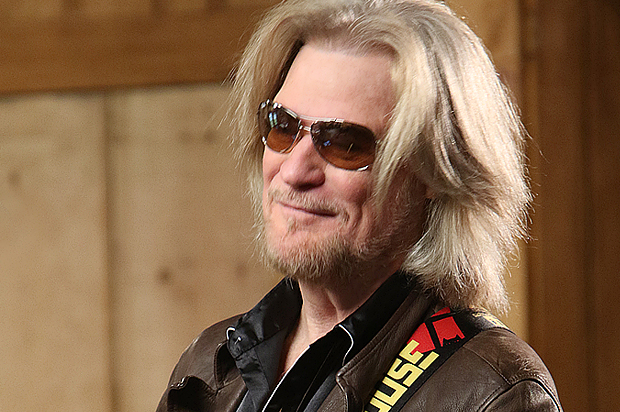

Daryl Hall is possibly the most interesting man in music. He and John Oates form the most successful musical duo of all time, and even though, their setlists during sold out shows around the world are full of instantly recognizable hits from the 1970s and ‘80s, they are not a nostalgia act. More than other performers in their age bracket, including The Rolling Stones and Bruce Springsteen, Daryl Hall and John Oates have constructed a coalition of baby boomers who remember where they were when “Rich Girl” or “Sara Smile” first hit the radio, and thirty and twenty-something fans who enjoy the smooth, soulful, and pop-infused style of “I Can’t Go For That” and “Out of Touch” as if those songs came out yesterday.
Hall owes much of his multigenerational admiration to his songwriting – clandestinely innovative and wildly varied – his voice – one of the best in the business – but also his early adaptation of the internet as an enhancement of art and entertainment, rather as a murderer of creativity, as many often call it. In 2007, Hall launched “Live From Daryl’s House” – an internet show depicting Hall and an invited guest jamming to a variety of songs within the confines of his home. The show still broadcasts from the internet, but also plays on the MTV Live network, and it is now filmed in Hall’s live music club, aptly named “Daryl’s House.”
Guests range from legends like Smokey Robinson, Cheap Trick, and The O’Jays (Cheap Trick was the guest for the debut episode of the current season) to rising stars such as Aloe Blaac, Amos Lee, and another guest of the current season, Wyclef Jean.
The show has a natural excitement. Hall’s band is in peak form – playing grooves so tight it is a wonder there is any oxygen in the room – and Daryl Hall’s voice soars whether he is singing blues based rock alongside Billy Gibbons of ZZ Top or he is shouting with soul to the music of Sharon Jones and The Dap Kings.
One of the elementary principles of evolutionary biology is environmental adaptation. Hall adapted early, and is now reaping the rewards. Proving himself the fittest of his generation in a war of attrition that often becomes survival of the fittest, Hall has created a program noteworthy for its postmodern synthesis of the past and future squarely in the present. It relies on present technology as a medium, giving projection into the future of music, but does so in service and celebration to the more organic, live, and human creativity of the music culture in which Hall first developed. Rather than an overly packaged, polished, and programmed product of committee creation, Live From Daryl’s House showcases talented people doing exactly what talented people do, without filter and without distortion.
I recently had a conversation with Hall, and learned that he is as passionate in his perspective as he is in his performance. Like a professor in the Department of Funk, Soul, and Pop Studies, he needs little provocation to provide “adult education” on everything from the state of music commerce to conflicts over cultural appropriation.
When you first started “Live From Daryl’s House,” what kind of ambition did you have for it, and did you envision that it would be such a success?
It has definitely evolved in a very natural way, and I look at the early shows and, even though we only had three cameras, and it was our friends holding the cameras, those shows were pretty damn good that way. So, really the challenge, over the years, is holding on to the looseness of it, and not getting into too formulaic of a situation, or not making it too solid. It needs to feel like it is still just an internet show – the way it was back in the day.
It does maintain that feeling. I just watched the Cheap Trick episode, and there is a passion that is palpable and infectious. Do you see “Live From Daryl’s House” as subversive, because so much of what now passes for television and music entertainment is “formulaic,” as you implied?
I look at everything I do as subversive, and this show in particular. My brain works that way. I’m an iconoclast. I don’t like the status quo. I used the word “solid” before, because I don’t like solidity. I don’t like formula. I don’t like any of those things that too often accompany music and entertainment in general. This show is the opposite. One of my ideas behind it was to turn everyone’s perception about music upside down: No audience, no pretensions, no script. Everyone just gets together, starts to have fun, and explores what they can do and create together.
Neil Young has an excellent lyric, “Ordinary people are bringing the good things back.” Do you believe a show like yours can help the cycle spin faster and accelerate a departure from all the artifice, and return to the organic quality of art and entertainment?
I would like to think so. If anything, it can provide an alternative to all of those things. I sense from the popularity of the show that there is a strong desire to get back to the real things, and the sooner everyone realizes that, the better off we will all be.
You’ve been inordinately successful throughout your career, but have challenges come with having a subversive attitude? It seems that our culture reacts poorly to anything that it cannot neatly categorize. Given that your music itself is a blend of soul, rock, and pop, has part of your career always been an uphill climb?
Yes, it always was. John (Oates) and I always had to do it ourselves. We never had the media wind at our sails. The critics were never behind us. So, we had to prove everything, and that is still happening. I had to prove that this show would work. When I first put the show on the internet, I did approach some networks, and I got the predictably stupid response. No one got it. No one understood why someone would want to watch what we’re doing with this show. It is frustrating, but in some ways, more fun this way.
There’s a big debate, and sometimes it is frustrating because it cuts out the nuances, but it is over the influence that the internet is having on music and the arts. As someone who has taken great advantage of the internet to enhance what you do, and enlarge your audience, where do you fall on this question?
If you work with what is real today instead of trying to fight it and resist it, it is a great time for making music. The real problem for young artists is that they don’t have any help or understanding from the record companies. Record company executives are the most backward bunch of idiots I’ve ever seen in my life. They are probably only surpassed by television executives. If I had a record company, I would know what to do, and how to promote new artists, and how to make money for myself, and for the artist. Now, all the artists are floundering, because all they can do is play live, and hope that they can gather a large enough tribe to support them. There is far too much ignorance right now and refusal to accept change.
Let me play devil’s advocate for a moment. You have an instantly recognizable name, and millions of people all over the world are familiar with your music. If you want to start an internet show, you have that advantage. A young artist, as you said, is just floundering. What is that you would do if you were in that position? Do you give advice to the young artists you have on your show?
Well, it is hard for me to give them advice, because they don’t have any help. My show is exposure for them, but yes, I have a name. So, I can do it. Now, if I was the head of Atlantic Records, and not to single them out, I would start an internet show, and I would pair my young artists with my older artists for every broadcast. They have a big enough name. They’re as big as me.
That’s a great idea. What’s the problem? Why don’t they do it?
They’re stupid. They think anything new is the enemy. They think my show is the enemy. They think streaming is the enemy. So many of them have thought that my show hurts their artists – that going on my show is hurtful to them.
How can they think that? There are many young artists I discovered from your show, and I now own their music.
One would think that anyone with a position of power would understand something that simple.
You’ve started a live music venue based on the show. You tour the show. Do you have any other aspirations for the show?
The show will evolve on its own. The bar has been raised to its highest point with this new season. I’m thinking about…Well, actually I don’t want to get into it, but the goal is to get back, more and more, to the freedom that the internet gave it. I do want to play more live shows with guests from the show, and I want to open more clubs in various places.
Onto another change you might have observed. Some critics claim that since R&B has become more hip hop influenced and dance-driven, it has lost some of the passion – some of the gospel-roots – of the soul that inspired you, and the soul that you still sing. What do you think about the future of soul music?
It depends on where you are looking for soul music. There has been a change, but the original, organic, old soul is still very much alive and well. It might not be alive on the pop charts, but it is still alive and well. I’ve had several soul singers on my show who are doing very well. Sharon Jones is one. That’s soul. I just had a guy named Anderson East on the show. He brings a country version of southern soul to the world. I’m making a record right now of old school soul. Obviously, I believe in the power of it, but it depends on where you are looking and listening.
You are making a new record. That’s exciting news. You want to say anything more about it?
It is a real soul record, as I said. It has a lot of heart, because a lot of things have happened to me, personally, and whenever that happens, I can use it as inspiration to make music that matters.
One of the current debates is over “cultural appropriation” – The idea that white people should not appropriate the culture of ethnic and racial minorities. I know that you don’t like the term “blue eyed soul.” Have you followed this conversation?
Are you trying to say that I don’t own the style of music that I grew up with and sing? I grew up with this music. It is not about being black or white. That is the most naïve attitude I’ve ever heard in my life. That is so far in the past, I hope, for everyone’s sake. It isn’t even an issue to discuss. The music that you listened to when you grew up is your music. It has nothing to do with “cultural appropriation.”
I agree with you entirely, because…
I’m glad that you do, because anyone who says that should shut the fuck up.
Well, this entire critique is coming back…
I’m sorry to hear it. Who is making these critiques? Who do they write for? What are their credentials to give an opinion like that? Who are they?
Much of it is academic.
Well, then they should go back to school. Academia? Now, there’s a hotbed of idiocy.
Anyone who knows about music, about culture in general, understands that everything is much more natural. Everything is a mixture.
We live in America. That’s our entire culture. Our culture is a blend. It isn’t split up into groups. Anyone who says otherwise is a fool – worse than a fool – a dangerous fool.
I also know that you don’t like the term “blue eyed soul”…
No, and it is for this very reason. There is no color to soul. Soul music comes from the heart. It was generated out of the church, and it became secular gospel.
Ray Charles made that same point. He said the only difference between gospel and soul is that in one genre he sings to God, and in another, he sings to a woman.
That’s right. That’s exactly it.
How do you feel about the resurgence in your popularity? To what do you attribute to it?
Much of it has to do with “Live From Daryl’s House.” The show isn’t a reinvention of what I do, but it changed people’s perceptions of what I do. Also, there is a generation shift, and in the interim is when the dip occurred in how many people listened to us, but now I have the same people I did when we started out, and a whole new generation has embraced what we do.
What quality in your music appeals to the younger generation of Americans when many artists and bands that had their biggest hits in the ‘80s or ‘70s failed to reach new audiences?
It goes back to what we were just saying. My music incorporates a lot of different things. It is at its heart, soul music, but it is soul in a different context: The context of my experiences, and the context of John’s experiences. Younger people are so used to that – The mix and match musical experience without a genre. They aren’t looking at it like these jackasses you mentioned before. They just look at it as music. They understand soul music, rock music, and pop music instinctively. So, it all works perfectly in their minds.
