
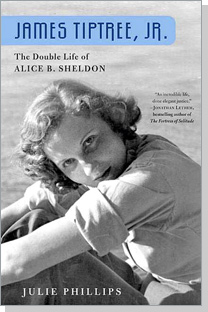

How did you find out about Alice Sheldon? Were you a big science fiction fan?
I wasn’t a fan; I hadn’t read science fiction since high school. And I don’t think you need to know anything about science fiction to read the book; it’s about the dilemmas of a woman writer.
But I had been writing a lot about women’s lives; almost everything I was writing, from sports features to book reviews, was about women or gender in one way or another. So when I read about a new prize called the Tiptree Award, which is given for a work of science fiction that “expands or explores our understanding of gender,” I thought it sounded up my alley. That led me to Tiptree’s stories and then to Alice Sheldon’s life — her writer mother, her childhood trips to Africa, her career in intelligence. Then I read some of the letters she wrote as Tiptree, with their intensity and humor — and I was hooked.
What was your greatest challenge in researching this book?
It was hard for me to explain what women were up against, before feminism, without giving lectures. I had to collect a lot of background on women’s experience; and I had to understand myself what it was like to be a young woman in the 1930s.
What happened was, when I found evidence that was either strikingly unjust or memorably weird, I would try to find a way to work it into the book, like the Women’s Army Corps making its officers wear girdles (so they would look “military”), or NASA not wanting women astronauts because their breasts would bounce in zero-G and distract the men. And in the end I think those strange specifics helped make my case.
Alice Sheldon made an art out of disguising herself. Was it hard to write a biography of this kind of person? Did you wind up feeling you’d gotten to the real her?
Well, I don’t know if you ever get to the “real” anybody; but she had one gate for keeping people out, and once I got past that I did feel I had access to her inner life. Behind the mask, when she was alone, in her diaries, for instance, she was usually fairly honest with herself. A person who appeared more honest, but had many subtle strategies for keeping herself concealed, would I think be much harder to get to know.
No one in her life ever really recognized her, and I felt that to be my responsibility: to show her herself whole. To let her be herself.
If you could discover the truth about one unanswered question or mystery about Sheldon, what would it be?
I still want to know what she was really up to in Mexico in 1941, when she was a bohemian and went to hang around with painters.
It’s a tricky business, writing a biography about a figure who’s important to a subculture, especially a subculture as feisty as science fiction readers. What’s the response been?
Very enthusiastic. I’ve been thrilled by how warmly the book has been received by science fiction readers — who are, as you say, not an easy audience. I can say all I want that it’s not really a science fiction book; as far as the SF world is concerned, it’s theirs. Of course, the other things it’s about — identity, sexuality, feminism — are all very important to that community, partly because science fiction offers an imaginative space for exploring and playing with these ideas.
I feel very lucky they like the book, because it’s also meant getting to talk to some of the people working in that space. The feminist conversation in science fiction is pretty incredible. Ursula Le Guin, Kelly Link, Karen Joy Fowler, and so many other people whose names you don’t know but you should.
A science fiction critic recently told me she saw my book as feminist science fiction’s “mission to the rest of the literary world. ‘See what you’ve been missing?'”
What did writing this book lead you to conclude about the belief that women and men have inherently different writing styles?
Oddly enough, I think they do in fact tend to write differently, if only because of their different cultural experiences. I think you can still generalize, a little, as long as you see those generalizations as taking place within a huge range of possibility — and if you never take your gender assumptions for granted.
Do you have a favorite book from 2006?
Everything good that’s been written about Alison Bechdel’s “Fun Home” is true. It’s playful, sad, sophisticated, brilliant. I probably liked it so much for the ways in which it’s like “Tiptree.” It’s another book all about secret identities, gender dysphoria, creativity, and the importance of what Bechdel calls “erotic truth.”
Excerpt from “James Tiptree, Jr.”:
No one […] has, to my knowledge, ever met Tiptree, ever seen him, ever talked with him on the phone. No one knows where he lives, what he looks like, what he does for a living. […] He volunteers no information about his personal life, and politely refuses to answer questions about it. […] Most SF people […] are wild to know who Tiptree “really” is. —Gardner Dozois, 1976
In 1921 in the Belgian Congo, a six-year-old girl from Chicago with a pith helmet on her blond curls walks at the head of a line of heavily laden native porters. Her mother walks next to her, holding a rifle and her daughter’s hand.
In 1929, the girl huddles under quilts in a cabin in the Great North Woods, reading “Weird Tales.” The candle by her bed flickers as an alien gently removes a young human’s brassiere.
On Christmas Eve 1934, a nineteen-year-old in a white beaded evening gown makes her debut. At the party she meets a handsome, dark-haired boy in a tie and tails. She makes a joke; he laughs, and makes another. Five days later they elope and marry.
In 1942, a divorcie wearing three-inch heels and a fox fur jacket goes down to a Chicago recruiting station and enlists in the army.
Sometime in the near future, a woman and a man meet an extraterrestrial exploring party. The man tries to protect the woman. The woman says she doesn’t believe in women’s chances on Earth, and asks the aliens to take her away.
In 1970, a man who does not exist sits down at a typewriter. He writes, “At last I have what every child wants, a real secret life. Not an official secret, not a Q-clearance polygraph-enforced bite-the-capsule-when-they-get-you secret, nobody else’s damn secret but MINE.”
James Tiptree, Jr., appeared on the science fiction scene in the late 1960s, writing fast-paced, action-filled stories about rocket ships, alien sex, and intergalactic bureaucratic anxiety. He was a brilliant and original talent, with a voice like no one else’s: knowing, intense, utterly convinced of its authority and the urgency of its message. No one had ever seen or spoken to the owner of this voice. He wrote letters, warm, frank, funny letters, to other writers, editors, and science fiction fans. His correspondence was intimate and revealing, yet even his closest friends knew little more about “Tip” than his address: a post office box in McLean, Virginia.
He was rumored to be a government official or secret agent. He did seem to know a lot about spooks around the water cooler: his characters worked in “an unimportant bit of C.I.A.” or remarked, “Paranoia hasn’t been useful in my business for years, but the habit is hard to break.” He had opinions about fishing, duck hunting, and politics. He was courtly and flirtatious with women. When one of his friends, the writer Robert Silverberg, sent him a letter on his wife’s stationary, Tip answered that he had “shaved and applied lotion” before reading on. Silverberg pictured Tip as “a man of 50 or 55, I guess, possibly unmarried, fond of outdoor life, restless in his everyday existence, a man who has seen much of the world and understands it well.” Men looked up to him. His women friends fell in love.
The stories that came out of PO Box 315 became more and more brilliant and disturbing. It wasn’t the sex, and it wasn’t the death, but it was the combination of the two. His stories read like urgent messages from some haunted house on the corner of Eros and Mortality. Humans meet aliens — and abandon their very souls for a chance to sleep with them. A man in love with the Earth kills off the human race, including himself, to save her. A mission to the stars finds an alien egg for which the colonists themselves turn out to be the sperm.
Like Philip K. Dick, Tiptree used science fiction to talk about the importance of empathy and explore what it means to be human — though he was less likely than Dick to question reality. Reality is there; the human project is to learn to see it, or die. Or learn to see ourselves: the reality of human flesh and emotions was what terrified, and fascinated, Tiptree. Can the body be trusted? Will it betray us? What does it want? Can we get rid of it?
This masculine writer, who let his readers in on the technology of space flight and the inner workings of government, also showed a surprising sympathy toward his female characters. He wrote about women’s alienation in a world of men, and was held up as an example of a male feminist, a man who understood. Still, his stories were so full of action, philosophy, and desire for women that everyone knew they were dealing with a man. In 1975, in an introduction to a book of Tiptree’s short stories, Robert Silverberg wrote of his friend, “It has been suggested that Tiptree is female, a theory that I find absurd, for there is to me something ineluctably masculine about Tiptree’s writing.”
He likened Tiptree’s “lean, muscular, supple” stories to Hemingway’s:
Hemingway was a deeper and trickier writer than he pretended to be; so too with Tiptree, who conceals behind an aw-shucks artlessness an astonishing skill for shaping scenes and misdirecting readers into unexpected abysses of experience. And there is, too, that prevailing masculinity about both of them — that preoccupation with questions of courage, with absolute values, with the mysteries and passions of life and death as revealed by extreme physical tests, by pain and suffering and loss.
In the same year, another of Tiptree’s letter-friends, the feminist science fiction writer Joanna Russ, wrote him that a professor at a party had “asked me if you were a woman (!) by which I gather he can’t recognize a female point of view if it bites him.” When Tiptree participated in a written symposium on “Women in Science Fiction” as a token “sensitive man,” Russ told him he had ideas “no woman could even think, or understand, let alone assent to.”
By then Tiptree had introduced a protigie, Raccoona Sheldon, who seemed strongly influenced by Tiptree’s style. No one, not even herself, had opinions about Raccoona’s sex: she was a former schoolteacher who published little and wrote, “As for me, really the less said the better.”
Tiptree did reveal a few facts about himself. He had been born in Chicago. His parents had been African explorers and his mother a writer. He had spent part of his childhood in colonial Africa, and the Second World War “in a Pentagon sub-basement.” He was reluctant to reveal his true identity because he couldn’t have the people around him know he was writing science fiction, and because he liked his secret life.
Then in late 1976, Tiptree told a few friends that his elderly mother had died. More than one of Tip’s correspondents checked the Chicago papers and found an obituary for Mary Hastings Bradley, novelist, travel writer, and African explorer. Under “survivors” was listed her only child: Alice Bradley (Mrs. Huntington) Sheldon.
Ten years later, shortly before her death by suicide, Alli Sheldon wrote, “My secret world had been invaded and the attractive figure of Tiptree — he did strike several people as attractive — was revealed as nothing but an old lady in Virginia.”
Alice Hastings Bradley Davey Sheldon, 1915-1987
As it turned out, the sixty-one-year-old Alice Sheldon, known as Alli, was just as attractive a figure as Tiptree had ever been, opinionated and theatrical, with a past that she revealed, bit by bit, in tantalizing anecdotes. The few friends she allowed into the home in McLean that she shared with her husband, Huntington “Ting” Sheldon, were fascinated by this eloquent storyteller. The writer Gardner Dozois called her “one of the most fascinating conversationalists I’ve ever met, brilliant, theatrical, far-ranging, strikingly perceptive.” David Hartwell, her editor, said “Alli was electrifying, […] enchanting both in person and in her fiction.”
By the time she started writing science fiction she had already been a painter and an airforce intelligence officer. She had eloped with the “beautiful alcoholic poet” who had been seated on her left at her debut. She had worked for the CIA. She had earned a Ph.D. in experimental psychology. She had published a story in “The New Yorker.” She had begun and thrown out essays, scientific works, and novels.
She was born in 1915 as Alice Hastings Bradley, the cute, blue-eyed only child of two extraordinary parents. Her father, Herbert Bradley, was a lawyer who led three expeditions into unmapped Central Africa. Her mother, Mary Hastings Bradley, was a highly successful author of travel books and popular fiction. Both adult Bradleys were charismatic, energetic, public people whose adventures gave the family an exotic air.
Mary Bradley was an enormous presence in Alli’s life: magnetic, generous, theatrical, extremely long-lived. Tiptree described his mother as, “a kind of explorer-heroine, highly literate (Oxford & Heidelberg), yet very feminine whatever that is. You help her through doors — and then find out she can hike 45 miles up a mountain carrying her rifle and yours. And repeat next day. And joke. And dazzling looks […] I am still approached by doddering wrecks, extinguished Scandinavian savants or what have you who want to tell me about Mother as a young woman.”
Alli called her “a dazzling and formidable little person, a “queen bee” with two adoring males in addition to her husband. (In our Victorian culture they were Father’s best friends.) She was gifted, beautiful, emotional, accomplished; a linguist, writer, spell-binding conversationalist — and a superb shot and brave endurer of considerable real hardships. […] She didn’t provide a model for me, she provided an impossibility.”
Mary encouraged her daughter, first as an artist and then as a writer. But what Alli needed to say was not within the scope even of Mary’s wide world, and what she did not learn from Mary’s example was that women could say anything. She learned that women had to be very careful in order to speak at all.
Besides, Mary took up a great deal of emotional and creative space, writing her daughter’s story, literally, in two children’s books about the Bradleys’ African travels. It took a radical subterfuge — taking on a new name, pretending to be a man, turning into a new person — for Alli to get that story back, to become someone else besides her mother’s daughter.
Tiptree wasn’t only a trick for saying things Alli couldn’t. Like all interesting people, Alli had many sides or selves, and Tiptree gave her more room to be those selves: worldly, analytical, independent, bloodthirsty, and funny. He gave her space to play, make jokes, or, on a bad day, annihilate the human race. He gave her space to love women (though not always to like them). Sometimes he said things she didn’t have words for, in the days when no one wrote honestly about women’s experience. Many artists feel they have another persona who does their work for them, a secret self very much unlike the “me” of their daily interactions. Tiptree was that person for Alli: a writer who (he once said) longed to stop sweating over words and drafts and instead “storm naked with hard-on waving thru the world spouting whatever comes.”
Tiptree helped Alli to write partly because he wrote science fiction. “Literature,” with its famous injunction to “write what you know,” cannot always help us discover what we don’t know. Science fiction gave Alli a language for writing around the boundaries, for imagining what cannot yet be said. It has been seen as a masculine genre. And yet, with its metaphors for alienation and otherness, its unruly imagination, and its power to predict change, it is highly suited to talking about women’s experience.
Alli chose her male pseudonym on a whim, in a supermarket, where a jar of Tiptree jam caught Alli’s eye. She was sending out some science fiction stories as a joke, and she wanted a name “editors wouldn’t remember rejecting.” But the male name turned out to have many uses. It made her feel taken seriously when she wrote about what she knew: guns, hunting, politics, war. It let her write the way she wanted to write, with an urgency that was hers. It gave her enough distance and control to speak honestly about herself.
In 1931, when Alice Bradley was fifteen, Virginia Woolf wrote “Professions for Women,” with its famous image of the imagination diving deep into the stream and the woman writer forced to pull it back. In one of Woolf’s drafts, the writer explains to her imagination, “I cannot make use of what you tell me — about women’s bodies for instance — their passions — and so on, because the conventions are still very strong. If I were to overcome the conventions I should need the courage of a hero […] I doubt that a writer can be a hero. I doubt that a hero can be a writer.” Alice longed to be a genius, an artist who spoke the truth about her experience. But she didn’t have the words for that experience, or the rare courage to become a literary heroine. Instead, late in life, she became one of our greatest literary tricksters.
Tiptree never pretended to be a man in person. Yet Tiptree’s appropriation of the male mind is even more exciting. It’s a much deeper challenge to the established narrative order, and promises a greater freedom. It questions all our assumptions about writing and gender. It changes how we look at our male writer heroes. As science historian Donna Haraway has suggested, Tiptree takes the figure of the Great White Hunter and reconfigures it for a postcolonial, postgender world. And it speaks, in a way no other writer’s life has, to the ongoing problem of writing as a woman. Which is not to say that Alice wrote only about or for women. She wanted to lose her gender partly because, like Woolf, she didn’t want to write for half the world.
She couldn’t always imagine her way out of the problems she raised. Tiptree’s stories most often end in death — for the protagonist, the crew, the colony, or the planet. In the same way, Alli put an end to her own story. She and her husband Ting agreed to commit suicide together when they became too old to go on. On May 19, 1987, when she was seventy-one and Ting eighty-four, she shot him and then herself.
Since her death, her work has gone on finding new audiences and influencing new writers, from cyberpunk authors like William Gibson to those who imagine the future of gender and sexuality. Tiptree now stands alongside Philip K. Dick and Ursula K. Le Guin as one of the twentieth century’s most important and exciting writers of fantastic literature in America. While new generations of readers are drawn to her prescient work, her passionate life and tragic death have much to tell us about what it means to write — and to be human. And her performance as Tiptree, with its reversal of everything we expect about men and women writers, may be her greatest achievement, her greatest influence of all.
Excerpted from “James Tiptree, Jr.: The Double Life of Alice B. Sheldon” by Julie Phillips. Copyright ) 2006 by the author and reprinted by permission of St. Martin’s Press, LLC.
