
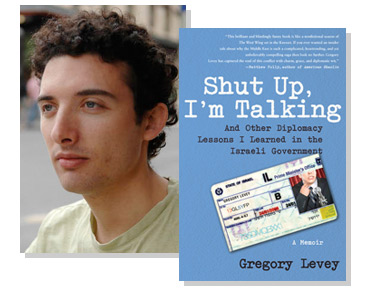

In January 2004, when I was a 25-year-old Canadian law student in New York, I decided to apply for an internship at the Israeli Consulate. Little did I know, the speechwriter for the Israeli delegation to the United Nations was quitting, and I was soon asked to fill the vacancy. It was just the beginning of a bizarre, revealing and often comical two and a half year journey into the nerve center of Israeli and Middle Eastern politics — a journey that grew even stranger with my transfer, the following year, to an even more unlikely job in Jerusalem, at the heart of the Israeli government.
On an excruciatingly slow August day in New York City, a resolution was coming up for consideration, apparently, at the U.N. General Assembly. There was almost nobody at the Israeli Mission, and those there already had their afternoons planned. “You should go,” one of my superiors said to me. “It won’t be a big deal. Just take notes.”
Nobody thought to explain to me what the resolution was about, and I didn’t think to ask, but I was happy to agree, having very little else to do at the time. And although I had not yet done it at a meeting of the General Assembly, I had gone on a few of these little note-taking missions at the U.N.’s other organs. I went to the meeting hall and took my seat at Israel‘s place, the little placard reading “ISRAEL” in front of me. Thankfully, Italy and Ireland were there, so I didn’t have to deal with Iran sitting — or refusing to sit — beside me, as I’d experienced at a previous meeting. There seemed to be more tension in the room than usual, and a few more people than would normally be present at a regular discussion. Something was clearly up.
Although I didn’t recognize him, the Italian representative greeted me and shook my hand. Then he leaned in and said, “So you know, the vote is definitely going to happen today after all.”
I smiled and nodded, as if I knew what he was talking about. But I was suddenly numb, thinking, “The vote? The vote? What vote? Nobody said anything about a vote!”
“So have you decided how you’re voting?” I asked, more than a little awkwardly. I had absolutely no idea how this sort of discussion normally progressed.
Clearly that was not how, because he gave me a strange look and nodded. “Yes, we’ve worked it out.”
I knew at very least that the “we” was not just the Italian delegation but the whole European Union, which always voted together on issues of foreign policy. Still, that cleared up nothing for me.
“Would you excuse me?” I said to the Italian as suavely as possible — which is to say not suavely at all — before darting out of the room to the hallway, clutching my cellphone. There were still lots of people streaming in, and many had not yet taken their seats, so I knew there was still some time and was not yet totally overcome by the situation.
I called the Israeli Mission, trying the extensions of various senior diplomats, but none of them picked up. Finally I reached the deputy ambassador’s secretary, and started to tell her about the situation, but the phone connection dropped. I had previously noticed that cellphone reception at the U.N. was terrible, but it had never really affected me until now. I tried again and was not able to get any signal whatsoever.
I swore quietly to myself, unsure what to do. This bad cellphone reception problem, I thought, probably didn’t affect most diplomats here quite as much because they probably actually knew what they were doing. I was not so lucky.
Racing back into the assembly hall, I scanned the room, noting that most people were now seated, and those in front who ran the meeting were clearly getting ready to proceed. Starting to get a bit desperate — “Should I vote at all? Will there be repercussions if I don’t vote? What are we even voting about?” — I looked around the room again, hoping that some solution to this problem would present itself. Then one did: the United States of America.
I knew that Israel usually voted along with the Americans, its closest ally and supporter. And since there were no Israelis around to tell me what to do, I figured that I might as well just ask the Americans.
I walked up to them, and after quickly confirming that their U.N. tags listed their country as the United States, I greeted the one who appeared to be the senior diplomat. He was in his mid- to late 50s and was quite clearly an important official from the State Department. Just as clearly to him, I was sure, I was a fool.
“Um, yeah,” I said, drawing out my words awkwardly and almost stuttering. “I’m, uh, representing Israel at this meeting.”
His brow furrowed a bit, and while still trying to remain diplomatic, he gave me a look that seemed to say, “What are you, 15?”
“Anyway,” I went on, leaning in so that nobody else would hear me, “I don’t really, exactly, know how I’m supposed to vote, and — ”
“You don’t know?” he asked incredulously.
“Not as such,” I said slowly, and paused for a second on this note. “There has been some miscommunication in the Israeli Mission today.”
He just nodded.
“Anyway,” I continued painfully, “I just wanted to know if you would mind telling me how you guys were going to vote.”
He looked around warily to make sure that nobody was around. Then he leaned in even closer to me. His two assistants did the same, until the four of us were essentially in a huddle on the floor of the assembly hall.
“This is just between you and us,” he warned me, and when I nodded, he whispered, “We’re voting no.”
Our huddle broke then, and I fought the urge to give the American diplomats a high-five.
“Thank you very much,” I told them instead.
“Good luck,” the senior diplomat said, and I walked away, aware that they were probably puzzling over the fact that Israel was now sending very young-looking North Americans to handle its diplomacy.
Heading to my seat, I thought, “No! They’re going to vote no! But what does that mean? No to what?” I was not about to ask the Americans to explain to me exactly what the resolution they were voting against was about, since that would make Israel look even more ridiculous, so I just made my way across the hall, trying to decide whether to vote the same way as they were.
Shortly after I got back to my seat, with the voting about to begin, I quickly tried my cellphone again. This time, miraculously, I managed to get through to someone with authority at the Israeli Mission. He didn’t know there was going to be a vote, or what the vote was about, but he said he’d find out and get back to me. He then hung up.
It was an astonishing moment of disorganization, but as I would see on a pretty regular basis, the maneuvers and accomplishments of the Israeli government could be as much a function of barely controlled chaos as one of shrewd planning and execution of policy.
After a few more seconds the vote was called, and there was no longer any choice but to go for it. I put my earpiece in and looked down at the three buttons — green, red and yellow. “Well,” I thought, “red it is.”
Literally moments after the vote I got a call on my cellphone. Now, of course, the reception was fine. On the other end of the line was one of the senior diplomats from the mission, speaking urgently.
“Greg,” he said, “are you still there?”
“Yes.”
“We found out what the resolution is about. Vote against it, OK?”
“Sure,” I said. “No problem.”
Only later did I find out that the resolution was about weapons of mass destruction.
At one point during my last week at the mission in May 2005, when I had stepped out of the office at lunchtime to run an errand, my cellphone rang with a call from the mission’s spokesperson.
“Greg,” she said, “I got another call from the Prime Minister’s Office.”
“What could it be now?” I wondered.
“Well,” she continued slowly, and I could tell by her voice that she was smiling. “The prime minister liked your speech, and so did his aides, and they want to know if you want to come work for him in Jerusalem.”
I couldn’t believe what I had just heard. I immediately felt exhilarated and confused. I was, of course, immensely flattered, and started wildly picturing where this unexpected turn could lead me — writing speeches and working for one of the most storied figures in international politics. Ariel Sharon was both hated and loved, but nobody denied his importance. The idea that I could work on his staff astounded me. And not just that, I thought, I could be doing this at a uniquely pivotal time in the Middle East‘s history, as he tried to implement the disengagement plan from Gaza and move Israel forward. It was a time when real, positive change could be brought about for both Israel and its neighbors, and my head spun with the possibilities of tangibly helping to make it happen.
I spoke to an aide to the prime minister, with whom I had recently worked on a speech, and he told me that the position they were offering me would soon be open. It included English speechwriting for the prime minister and a lot of work with the foreign media and other foreign organizations. The withdrawal from Gaza was coming, he said, and they needed all the help they could get. I would have to make the decision very soon so that they could begin the procedure of getting me on the prime minister’s staff. He suggested that early the next morning I speak to Ra’anan Gissin, Prime Minister Sharon’s spokesman and media advisor for English media. If I took the job, he’d be one of my supervisors.
I woke up at 6 the next morning, and still lying in bed, I called the Prime Minister’s Office. For several years now, beginning before I had become involved with the government, I had been watching Gissin on television. He was in his late 50s or early 60s, and in fast, clipped and heavily accented but fluent English, he had heatedly given the Israeli position in frequent appearances on all the major cable networks, always seeming hawkish and cantankerous.
“Yes, hello, hello,” he snapped into the phone.
“This is Gregory Levey,” I said, “calling from New York.”
“Yes; hello, Greg,” he barked quickly, and I had to move the phone away from my ear a little. He was yelling, and I didn’t know why. “You’re gonna come work for us? Work with me? We need you. It’s a very busy time here, and it’s going to get busier. Are you coming? When are you coming?”
He was talking nonstop and in rapid fire, and it was very difficult to get a word in.
“I’ve been watching you on television for years,” I said, rather lamely, “and it would definitely be interesting to work with you.”
“Yes, I’m on TV a lot. You know, let me tell you about this position. When I was in the paratroopers, we thought of ourselves as the advance guard, the guys who go in first, who don’t wait, who don’t take orders, who just go on ahead and look for dangers and opportunities. If you get injured, you deal with it, and you just go on. You know what I’m saying?”
I had absolutely no idea what he was saying, but that didn’t matter because he didn’t give me any time to respond anyway.
“That will be like you, Greg, in this position. You’ll just march on ahead as my sort of front line, looking out for me and the prime minister, for information and news we might need. I don’t need people who just want to take orders. I want them to take initiative, like a paratrooper.”
I tried to say something, but there was still no room for me in the conversation.
“Greg,” he continued at lightning speed. “There’s a lot to do. A lot of things to do. News comes in, and we just move. We don’t wait at all. If you wait, you get left behind. This is the Middle East. It’s not New York. In fact, sometimes we don’t even wait for news. We make it ourselves. Greg, I’ve got to go now, but we’re looking forward to seeing you here soon. We need your help. There’s a lot to do. OK? Bye.”
But even then, I had no idea of how much wilder the ride would get once I landed in Jerusalem a few weeks later.
