

The editors at the New Orleans Review have put together a post-Katrina issue that avoids easy responses to the disaster, withholds simple prognoses for the future, and inhabits its moment of most-relevance so surely that its collective voice rises high above the din. And what a disheartening din it’s been. Whether it was Anderson Cooper’s repeated public tears, Celine Dion’s Marie Antoinette-esque sound bite “Let them touch those things!” President Bush’s Potemkin photo ops, or, later, Ray Nagin’s helpless racial buffoonishisms, the culture hasn’t managed to deal with the hurricane in any significant way. Perhaps we’re all still too shocked. And why shouldn’t we be? We lost one of our most beloved and mythical cities, a psychological escape of libertinism and subversion — whether we’ve been there or not — from our prudish, puritanical country.
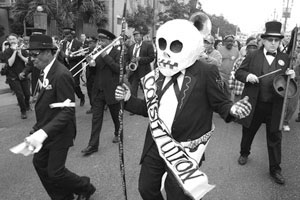
No literary journal has ever been called upon to react specifically to the loss of its place of genesis, and what more could have been expected from this collection than page after page of horror and sorrow? But after the first four poems without a mention of Katrina anywhere, I understood that something very different was being done. Look at these lines from Ralph Adamo’s poem “New Orleans Elegies”: “I wish once we could sleep like two horses/ standing side by side after a twilight feed,/ eyes lashed for the night, forelegs atremble,/ but just barely, with being so strongly still.” And again from Brad Richard’s poem “St. Roch Camp Santo, New Orleans” a few pages later: “I would kiss his dark sore if it would give/ either of us solace, if it would bring back whole/ companions who died from the wrong touch,/ whatever killer stole their love” And from “Memento N.O.” by Srdjan Smaji: “me kneeling & you kneeling/ me pressing into you/ in the alley behind the bar…/ we return repentant/ two prodigals all apologies/ & our friends plug us back/ into the same conversation.” The first 112 pages of the review are full of stories and poems like these, not of Katrina, not disaster, but of people, of their desires, loves, losses, of their small lives frankly lived in a city we all recognize within a few words, the first glimpse of an image: New Orleans, our New Orleans, even if it wasn’t ours. Cajun, jazz, the French Quarter, Canal Street, Bourbon Street, Algiers, Louis Armstrong and, of course, Mardi Gras. David Rae Morris’ photograph on Page 92 of a New Orleans brass band marching beside a death-head wearing a “Constitution” sash is an image understandable only in the context of that one place.
That place is gone. Whether intended or not, the first half of the New Orleans Review has the feeling of walking around in a Holocaust museum: all of those head shots, all of those piles of shoes. This is the lost New Orleans we knew and took for granted. From Aliisa Rosenthal’s story “Mambo”: “I light one feminine cigarette under the languish of saxophones and cellos. There are debutantes in the gutters here. The dirty blonde and rusting beauties decay in hot puddles. But we’re all sipping mint juleps and our feet are leveraged into stilettos and we know how to limbo our words into a drawl with lusty undertones, until the boys lunge at palmettos in the dark lantern light.” And from Tara Jill Ciccarone’s “Wait for Me, Susanna”: “the men drinking their beers in front of the little grocery stores, saying How ya doing with sex in their eyes always, the young women, curvy and without makeup in flowered dresses, blooming themselves, the heat that slowed the body, teaching the body not to fight so much, to give in to the needs of the flesh and take it slow, and the guitar players on the sidewalks outside the coffee shops not wanting to go to work.” And from C.W. Cannon’s “Fools Rush In”: “The kid’s cornet was right on the thermostat, frowning and threatening and ignoring all supplicants, sending the mercury up, up. The band started chanting Talk Dat Shit Now and Say What?! and pointing at the dancers, pushing them to march harder. The boy blowing into his horn through the side of his mouth found some undiscovered and previously unused muscle in his face or his belly and started swinging and leaned into it, bumped the volume up one more decibel, and treated the air in front of his cornet to a righteous, vicious pummeling.”
It’s wonderful stuff, like a vault full of the literary art of Atlantis. Reading it in the context of Katrina is to almost hear these characters and places cry out, “We existed. We existed like this.” But the work is so good that it transports the reader at times away from the fact of pre-Katrina New Orleans’ own existential end, no one piece more so than C. Morgan Babst’s story “Other Real Girls.” With early lines like, “The cheese man liked their school skirts, and they would unbutton their second buttons and pull their Wigwams up to their knees for him … Lille turned up her turned-up nose at him because he was a Yat. He came from the West Bank … Allie had tried to keep from getting a crush on him,” Babst creates a world quick to seduce. Complete in its universe, it leaves no ground to wonder whether Allie or Lille or any of the often nasty teenage girls of a certain New Orleans privileged upper class captured here are anything but real. “Other Real Girls” should win an award, as should the whole issue. Interviewing Christopher Chambers, editor since 1999 of the New Orleans Review, about what happened to him, his staff and his city after Katrina, I received this e-mail: “I am so tired of talking about Katrina, yet living here there is no way not to talk about it. We used to joke that New Orleans was like a third world country … it is no longer a joke. City services are unreliable, leadership and a coherent plan for recovery nonexistent, violent crime back to pre-K[atrina] levels with one third of the population. Looting continues … not sure why this has been swept under the rug … Everyone here has been traumatized, and there is an undercurrent of bad energy. Recklessness, rage, and hard drinking like even this town has never seen.”
Chambers and the NOR’s poetry editor Katie Ford deserve credit for the artistic achievement of their editing. Running only work that’s set in the days before Katrina in the first half of the issue, they ground and contextualize the loss and drama of the post-Katrina second half. And they manage to make the turn from the “pre” to “post” landscape feel as sudden and dramatic as it was in life. Though there are warnings of impending disaster, they are as easy to ignore as were all of those 1950s-era levee warnings. The excerpt of Walker Percy’s 1968 essay “New Orleans Mon Amour,” which opens the issue, reveals that the city has always suffered corruption and a certain sense of doom, and James Nolan’s poem “Acts of God” admits that the city had been flooded by hurricanes past. Of all the lively poems and stories about New Orleans nightlife and Mardi Gras, almost none can be said to end joyfully.
And still, on Page 113, when Katrina appears almost out of nowhere in Anne Gisleson’s essay “The Chain Catches Hold,” we’re not prepared. Gisleson’s essay seems to be a quaint walk through interesting neighborhoods of the city. It’s not. Like the whole of the issue itself, Gisleson’s essay is a bait and switch: Here’s New Orleans, here’s New Orleans taken away. She writes about bars, brawls, a decaying mural, quietly decaying fences. Interesting but innocuous stuff. And then comes this entry: “Fall 2005. The razor wire rolled back, the concrete barricades moved to the side, the Bywater was opened back up to us officially in early October. On one end of Clouet Street at the river, a block from our house, a fire, started by either looters or the police, depending on whom you talked to, had raged for several days during the aftermath and destroyed six blocks of riverfront warehouses and wharves … thousands of propane tanks were being stored inside … during the fire many of them exploded and shot all over the neighborhood into houses, throughout streets. You can still come across their dented blackened carapaces, in gutters, on sidewalks and untended yards, pocked with rust, puckered holes.”
Katrina happened like that. As with everything else in the city, the storm brought to a halt production of the New Orleans Review. Among the better of the literary journals in the country, the NOR regularly had work reprinted in Best American Poetry, the Pushcart Anthology, Poetry Daily and the Utne Reader. Katrina scattered the staff to Baton Rouge, Austin, Texas, Portland, Ore., Washington and Boston. Some have left New Orleans for good.
Chambers says, “In the first few weeks after, I can’t say that I gave the magazine a thought. I spent my days sitting stunned in front of CNN for hours on end, drinking steadily, and searching the Internet for news of friends and colleagues. I remember the dates I returned to the city: September 15, October 2, October 30. Otherwise those months are a blur. At some point, late September I guess, I started to think about how New Orleans Review could respond to this unfolding disaster. Everywhere I turned … people were writing about New Orleans. Much of it was good and accurate, but there was also a lot of bullshit written by people who did not really know or understand the place. It occurred to me that now was the time for the magazine to publish an issue on New Orleans, by New Orleans writers. By this time, my wife and I had moved into a tiny ramshackle garage apartment in Houston. I compiled a list of all the local writers I could find, sent out a call for submissions, asked them to forward it around.
“I began receiving submissions immediately. My vision for this issue was that it would be a celebration of New Orleans, a chance for the writers and poets of the city to respond to the disaster. And I saw it as an elegy, for I knew by this point that the New Orleans I had left no longer existed, and that though the city might survive, it would never be the same. In March, there were already a slew of New Orleans and Katrina books in the stores. There must have been people signing book contracts before the waters receded. I feel we had a little more critical distance, and were able to put together something that was more thoughtful and coherent.” The post-Katrina half of the issue looks at how the storm hurt the city, and how seeing the injured city hurt its people. It’s imagistic and visceral, and of special note are the nine photographs by David Rae Morris that range from an accounting of the graffiti that blossomed in the flooded city, from both an official “Possible Body” sprayed on a home to a less official “9 Ward RIP,” to evocative images of humanity’s remnants underwater. Yes, there are some simple laments here that don’t add much to what’s already been said about New Orleans, though these are few and almost serve as a brief record of that genre of contemporary literature.
The best part about this Katrina writing is how quirky and unexpected it is. Lyrical, often funny, the second half of the issue even includes a science fiction story. From Moira Crone’s “The Great Sunken Quarter”: “September, 2132. The sun started to come up behind the clouds, turning the sky from pink to white, and then the Ponchart Sea was all silver. Port Gramercy shrank into a line on the horizon. The Islands of New Orleans were thirty miles distant, and not yet visible. We were headed for the greatest of the wonders there, the Sunken Quarter.” Wry, witty, often angry edging toward bitterness, this Katrina-inspired art is decidedly postmodern, clearly distrustful of traditional forms, confrontational, impatient, and there is almost enough of a theme here to announce a new school. These lines, for example, from Elizabeth Gross’ “Delta”: “The video store is broken. I mean,/ closed for good, the tapes all sold,/ or else boxed up and taken home/ by those bird-eyed men who/ used to run the place.” And this from Robin Kemp’s “Body” on the facing page: “the Dumaine Street Bridge/ …now it’s snagged itself/ just another face-down man/ right there where I used to walk the dog.” How about this little gem from Abraham Burickson’s “Soft and Splinter”: “She called to say she wasn’t coming back/ …to say that he could keep the fish, keep the television, the house,/ that Texas is a big ol’ pile of rock/ and she’s gonna stay…”
Then there’s Andrei Codrescu. As Jeffrey Chan writes in the issue’s penultimate essay — a who’s who of the recovering N.O. literary scene — Codrescu is “the famous New Orleans author in some people’s opinion … one of New Orleans’ literati and editor of a terminally hip pub called Exquisite Corpse. His distinctive Romanian accent can be heard on NPR … I think he’s in the Ozarks now. He’s written several books … including “Road Scholar,” the mandatory haywire road trip book which takes him across this oh-so-kooky country. [I]t was quite a bore…”
Why is Chan taking shots at Codrescu? Admittedly, Codrescu’s contribution to the issue was the only one of the more than 40 pieces that gave me real pause, because while I clearly am no fan of lament for lament’s sake, flippancy doesn’t seem appropriate at all. What was Codrescu up to in his poem “The Good Shepherdess of Nether,” a Dadaist experiment that he wrote jointly with Dave Brinks? While Brinks’ stanzas come across as searching for meaning in all of this, Codrescu’s are more like the ADHD kid in the back of the class who clearly is in his own world, here again offering little more than confirmation of his well-known morbid fascination with bugs. Brinks begins: “when hurricane names reach/ the greek alphabet/ it takes us a long way away from the theory/ of original sin/ and the common housefly.” Codrescu responds, “all the way to common sin/ of wishing it was not the way it is/ and the original fly/ did you ever see one this blue, Dave?” Chan closes his essay with a parting salvo at the eminent one, “As for you, Codrescu … oh, whatever. You get published, get on the air, get to be the king of the freak parade, and slouch for Ferlinghetti. More power to you.”
One New Orleans has passed, another begun. And if the writers are already sniping at each other, then the writers are returning to normalcy. Whatever dark or bright thing it will eventually be, the new New Orleans will find a normalcy as well. This remarkable issue of the New Orleans Review ends with an outward look, beyond the flooded city and its own black and nighttime cover, to the plight of the greater world in the new era of weather chaos. As Gisleson had written earlier in the collection, “In the hard blue fall sky two jet contrails had crossed each other, and for a moment it wasn’t just our houses, or city but the whole sky, the world itself, marked for search and rescue.”
