
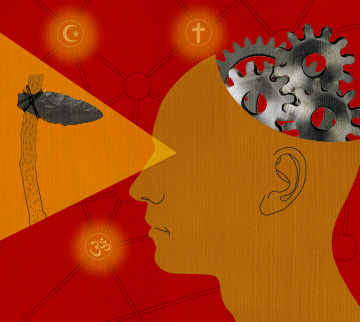

In Lewis Carroll’s “Through the Looking Glass,” Alice tells the White Queen that she cannot believe in impossible things. But the Queen says Alice simply hasn’t had enough practice. “When I was your age, I always did it for half-an-hour a day. Why, sometimes I’ve believed as many as six impossible things before breakfast.” That human penchant for belief — or perhaps gullibility — is what inspired biologist Lewis Wolpert to write a book about the evolutionary origins of belief called “Six Impossible Things Before Breakfast.”
Wolpert is an eminent developmental biologist at University College London. Like fellow British scientist Richard Dawkins, he’s an outspoken atheist with a knack for saying outrageous things. Unlike Dawkins, Wolpert has no desire to abolish religion. In fact, he thinks religious belief can provide great comfort and points to medical studies showing that the faithful tend to suffer less stress and anxiety than nonbelievers. In Wolpert’s view, religion has given believers an evolutionary advantage, even though it’s based on a grand illusion.
He has a theory for why religion first took root. He thinks human brains evolved to become “belief engines.” Once our ancient ancestors understood cause and effect, they figured out how to manipulate the natural world. In essence, toolmaking made us human. Similarly, early hominids felt compelled to find causes for life’s great mysteries, including illness and death. They came to believe in unseen gods and spirits.
Wolpert sees human credulity all around him — not just religious faith but all sorts of modern superstitions. His book targets astrology, psychics, homeopathy and acupuncture. Wolpert has participated in public debates with maverick scientist Rupert Sheldrake about telepathy and other paranormal experiences. He dismisses Sheldrake’s theory — that “morphic fields” can transmit thoughts through space and time — as nonsense.
There’s no doubt that Wolpert is a provocateur, but unlike some other prominent atheists, he doesn’t come across as a bitter enemy of religion. In conversation, his pronouncements are often punctuated by laughter and mock horror. I spoke with Wolpert by phone about the origins of religion, his doubts about telepathy and acupuncture, and why the debate over religion is so personal for him.
Can you explain the “belief engine” in the human brain?
What makes us different from all other animals is that we have causal beliefs about the physical world. I know that if I throw this glass at the window, it’s probably going to break. Children have this understanding at a very early age. Animals, on the other hand, have a very poor understanding of cause and effect in the physical world. My argument is that causal understanding gave rise to toolmaking; that was the evolutionary advantage. It’s toolmaking that’s really driven human evolution. This is not widely accepted, I’m afraid, but there’s no question about it. It’s tools that really made us human. They may even have given rise to language.
But there is evidence that some animals have a very primitive form of toolmaking.
There’s no question that certain apes are at the edge of causal understanding and they do make some very simple tools. Chimpanzees can break a nut with a stone. They can also take a stick and peel it to get ants out of a tree. But it’s still very primitive. Curiously, some crows show remarkable toolmaking, using sticks to get things out of bottles. But on the whole, it’s primitive compared to us.
And I suppose the radically new thing our ancestors did was to put two objects together — for instance, a piece of stone on a wooden handle.
Precisely. You can’t do that without having a concept of cause and effect. And once you had that concept, you wanted to understand the causes of other things that mattered in your life, like illness. That’s the origin of religion. The most obvious causes were those things caused by humans, so people imagined there was some sort of god with human characteristics. There are hundreds, if not thousands, of different gods in different societies.
So once you have an understanding of cause and effect, then ignorance is no longer tolerable? You want to explain everything.
Exactly. You know, we cannot tolerate not knowing the causes of things that affect our lives. If you go to the doctor when you’re ill, the one thing you can’t stand is the doctor saying he or she has no idea what’s wrong with you. And when they do diagnose you, I’m prepared to bet that on your way home, you’ll tell yourself a story as to why you got ill.
But which came first: understanding cause and effect or learning to make tools?
They went together, but you cannot make complex tools without a concept of cause and effect. You must remember that no animal has a basket. If they go away from water, they can’t take any water with them. They can’t carry things. However, we’re driven by interacting with our environment and looking for causes that affect our lives.
Are you saying our brains are hard-wired for belief?
Our brains are absolutely hard-wired for causal belief. And I think they’re a bit soft-wired for religious and mystical belief. Those people who had religious beliefs did better than those who did not, and they were selected for.
Why did they do better?
They were less anxious. They also had someone to pray to. In general, religious people are somewhat healthier than people who don’t have religious beliefs.
Haven’t studies shown that religious believers tend to be more optimistic, and that they’re less prone to strokes and high blood pressure?
Yes, exactly. Therefore, evolution will select them.
So religion gives us a sense of purpose and meaning, even though in your view it’s totally an illusion.
Yes, many people would find it very hard to live without religion. But there is no meaning, I regret to tell you. [Laughs] We don’t understand where the universe came from. But to say God made it, well, you want to say, who made God?
To say there’s no meaning is a pretty depressing assessment, isn’t it?
No, why should there be a meaning? I mean, we want a cause as to why we’re here, but I’m afraid there isn’t one. I don’t find it depressing at all. I think it’s remarkable that evolution has brought us into being. We’re only here for one purpose, from an evolutionary point of view, and that’s to reproduce.
You write that you were once quite a religious child yourself. When did you turn away from religion?
I came from quite a conventional Jewish family — not Orthodox, but conventional — in South Africa. I had to say my prayers every night. And I used to pray to God to help me in various things but found it didn’t help. So I stopped being religious.
Your son became a fundamentalist Christian after a difficult late adolescence. Is he still an evangelical Christian?
No, he’s not. The church he was in broke up. He’s still a believer, but he doesn’t go to church.
Does his faith bother you?
No. I found that religion was helping him a great deal. It gave him someone to pray to. He became a member of a church where they could discuss their problems. And I think the idea that he would eventually go to heaven gave him a great deal of encouragement.
Has your son read the chapter on religion in your book? It’s rather dismissive of religion.
He knows I’m dismissive of it. In fact, I just spoke to him last night on the telephone and asked him, “Did I ever try to dissuade you from being religious?” He said, “No, you never did.” I wouldn’t agree with him, but I never tried to dissuade him not to be.
Do you find yourself wondering about ultimate meaning? Does that matter in your life?
Never. Ultimate meaning has no meaning in my life. I sound a bit shallow, but I think it’s actually quite deep not to be bothered by that sort of thing.
You call David Hume your “hero philosopher.” Why do you like him so much?
First of all, I don’t like any other philosopher. I think philosophers are terribly clever but have absolutely nothing useful to say whatsoever. I avoid philosophy like mad. But David Hume does say such interesting and important things. He’s very good on religion, for example. I like him for that.
Well, he didn’t like religion.
No, it’s not that he didn’t like religion. If you take miracles, for example, there’s a lovely quote from David Hume that you shouldn’t believe in any miracle unless the evidence is so strong that it would be miraculous not to believe in it.
There are various competing theories about the origins of religion. One is the idea that religion evolved because it helped bind people together in social groups. Essentially, it acted like social glue. Why don’t you think that’s right?
I don’t think it’s wrong. There is some evidence that religion does lead to a community with shared views. But you have to ask, Why does religion deal so much with cause and effect? That comes from causal beliefs.
What about Daniel Dennett’s idea that religion is a kind of “meme” — an idea that has infected human cultures and keeps on spreading?
If you could tell me what a meme is, and how useful it is, I’d be very grateful. [Laughs] Please don’t misunderstand, I’m a great admirer of Richard Dawkins [who developed the concept of memes]. But what are memes? How do you decide whether something is a meme or not? And what you really want to understand is, how is it passed on and why does it persist? This is never discussed. So for Daniel Dennett — who’s a philosopher, after all — to get involved with memes, the moment he does that, I just stop reading him.
Virtually all these theories draw on evolutionary psychology. But I wonder if we’re losing the flavor of religious experience, the willingness to live in mystery, embrace imagination and intuition.
Sometimes I’ve thought it must be quite nice to believe in religion. I’m getting quite old. The idea that I might go to heaven — of course, there’s also the possibility, in my case, that I would go to hell — is quite an attractive one. Unfortunately, I don’t believe that for a single second. I mean, the evidence for God is simply nonexistent.
Isn’t there more to religion than belief in supernatural beings?
Certainly not.
But many theologians and scholars, such as historian Karen Armstrong, say religion at its root is not really about a set of beliefs. It’s more about how to live your life and being compassionate in the world.
Well, many people who are atheists can behave quite well. That doesn’t make us religious. No, it doesn’t work like that at all.
I grant that. But do you really think religion comes down to belief in the supernatural?
When I talk about religion, I’m talking about belief in the supernatural. In Western society, we’re talking about God. I don’t believe you can be religious without having some concept of a god.
What about William James? He talked about religion as experience more than belief.
I think “The Varieties of Religious Experience” is one of the best books written about belief. Nothing has really changed since he wrote it a hundred years ago. He did point out that many people become religious because they had a religious experience. And that fits with my idea that we’re partly wired to have religious beliefs. If you take the active component of a magic mushroom and give it to a group of people, quite a few of them will have mystical, almost religious, beliefs. It must mean the circuits are there which are turned on by the drug.
So it all comes down to the chemicals that are firing in the brain?
I’m afraid so. Your neural circuits, yes.
What about paranormal experiences like telepathy or life after death? Are those bogus?
Yes. All bogus. I have a very close friend, an artist, who claims to have seen three ghosts. She knew they were ghosts because they didn’t have legs, and they told her things about the house she was staying in that she didn’t know before. Yes, she had strange experiences. It doesn’t mean they were ghosts. And I don’t believe telepathy. Rupert Sheldrake, who’s an old friend of mine, is a strong promoter of telepathy and things like that. I’m afraid the evidence just isn’t there.
Rupert Sheldrake is a biochemist who used to teach at the University of Cambridge.
Oh, he was a very clever plant cell biologist.
He’s done various controlled experiments trying to figure out whether people know who’s going to phone them, or whether dogs know when their owners are coming home. You’re saying none of that is legitimate science?
It’s legitimate, but I’m unimpressed by all of it.
Let’s talk about one of his experiments. He did a controlled study of what he calls “telephone telepathy.” People were asked to give four phone numbers of friends. The callers were chosen randomly and then asked to guess who was calling. The statistical probability was that 25 percent of the guesses would be right. Sheldrake said the responses were more like 45 percent.
I’d like to see someone else do the experiment and have it confirmed. Remember what David Hume said? In order to believe in miraculous things, the evidence should be so miraculous that you could not but believe it. You can’t just do one experiment like that on such an extraordinary thing like telepathy. Telepathy goes against everything we know about neurophysiology and physics. If telepathy exists, it would be a miracle. That’s why I go back to Hume. The evidence has to be overwhelming.
Listen, almost everybody has a strange, non-normal experience once a year. Many, many people have these. If you take the right drugs, you can have them on order. People taking LSD had the most extraordinary experiences. Those experiences were real, but they had nothing to do with the real world.
Well, telepathy goes against the understanding that the mind is totally the product of the neural processes within the brain, which is certainly the dominant thinking among neuroscientists.
You also have to transmit that message over distances into somebody else’s mind. That’s just nonsense.
What if there are forces out there — perhaps energy fields, as Sheldrake would say — that we just haven’t discovered yet?
[Laughs] OK, when he discovers them, he’ll let us know. I’m saying you really have to have good evidence. And there isn’t any.
When my grandfather was 16 years old, he heard an odd sound, looked up and saw the photograph of his grandfather knocking on the wall in the living room. This was so unusual that he checked the time it happened. Later that day, his family got a telegram saying that his grandfather had died at precisely that time. Is that just coincidence?
Well, that is remarkable and I don’t have an explanation. I’m afraid it probably is coincidence. But it does sound as if it’s some sort of telepathic experience. And we all have that. You’re thinking of someone and suddenly they phone you. You haven’t spoken to them for six months and suddenly the phone rings and there they are. OK, I don’t have a good explanation for that. But to think that there’s some message going across is just most unlikely.
Unlikely yes, but doesn’t this get at the limits of science?
No, it’s not the limits of science. You’ve got to find experiments that will really show it. Science can’t rely on anecdotes, on single, one-off experiences like this. You’ve got to find some way of testing them. Maybe the way Rupert Sheldrake goes about it is the right way to do it. But it has to be done extremely carefully, and single anecdotes tell you nothing.
You have written about alternative medicine and are highly skeptical of various healing practices, including energy healing and even acupuncture, which is now used quite widely in the West.
Yes, I know it’s used. It’s quite tricky because the placebo effect can really confuse these results very significantly. So if you believe the treatment is going to work, you’ve got a much higher chance that it’s going to work. But there’s just no evidence for the idea of energy fields, which acupuncturists use for deciding where to put the needles.
But there are thousands of years of experiential evidence going back to ancient China.
But nothing to do with energy. Energy is a well-defined concept. And I’m terribly sorry, no physiologist has ever detected any of these energy fields.
Maybe the scientific instruments that we have at our disposal just can’t detect anything about qi.
Sorry. When they invented qi, how in the hell did they know what an energy field was? They hardly had a concept of energy. I mean, if you go back and look at their evidence, I’m afraid it was a nice set of ideas, but I’m terribly sorry, evidence matters. And that’s what causal beliefs are really about. If we believe that something has a particular cause, we should be looking for the evidence.
Many people say they’ve been helped by acupuncture. Are you saying the placebo effect is the only explanation?
I have no idea why it works. But it’s extremely unlikely that it’s got anything to do with those energy fields. It could be largely due to the placebo effect. And homeopathy, where there are no molecules in the liquid that you take, is even more bizarre. And many people believe in homeopathic medicine.
Do you have any superstitions yourself?
[Laughs] I touch wood occasionally, I’m ashamed to say. And I don’t ever like to say that I’m really happy because I think the gods may not like it.
Are you joking? Or is there some little part of you that really believes this?
I suppose this is part of the soft-wiring for mysticism. There’s a lovely story — I’ve forgotten the physicist — who had a horseshoe over his door. He said it didn’t do him any harm, but might do him some good.
Pascal’s wager, right? You decide you’re better off believing in God, even though the existence of God seems unlikely.
[Laughs] No, I don’t go as far as that, but I am a little superstitious, yes. A tiny bit.
If you look into your crystal ball, do you think we will always have religion? Or will reason win out at some point?
I believe we will always have religion. Churchgoing has declined in England, but the number of people who believe in God is still quite high. And in America, it’s very high. And you just have to look at the Muslim world. It’s very strong there. I’d be very surprised if it disappeared.
So the project of Richard Dawkins — basically, to try to turn us all into atheists — is just a pipe dream?
I believe it to be a pipe dream. The idea that you could persuade people not to be religious is in my view a hopeless aim. It comes from people’s personal experience, rather than logical arguments.
But isn’t this what you’re doing in your book, arguing for the virtues of reason over religious belief?
Not at all. I’m trying to understand what determines religious belief. I’m not trying to convert people out of religion. Not for a moment. But if they then want to impose some of their religious beliefs onto other people — for example, in relation to abortion or not using contraceptives — then I ask them to look at the evidence. I ask them to be much more careful about their beliefs.
